


COMEDK · Physics · 1. Mathematics in Physics
Vectors \(\mathbf{A}, \mathbf{B}\) and \(\mathbf{C}\) are such that \(\mathbf{A} \cdot \mathbf{B}=0\) and \(\mathbf{A} \cdot \mathbf{C}=0\), then the vector parallel to \(\mathbf{A}\) is
- A \(\mathbf{A} \times \mathbf{B}\)
- B \(\mathbf{B}+\mathbf{C}\)
- C \(\mathbf{B} \times \mathbf{C}\)
- D \(\mathbf{B}\) and \(\mathbf{C}\)
Answer & Solution
Correct Answer
(C) \(\mathbf{B} \times \mathbf{C}\)
Step-by-step Solution
Detailed explanation
As per Boolean expressions, \[ \mathbf{A} \times(\mathbf{B} \times \mathbf{C})=(\mathbf{A} \cdot \mathbf{C}) \mathbf{B}-(\mathbf{A} \cdot \mathbf{B}) \mathbf{C}=0-0=0 \] \(\therefore(\mathbf{B} \times \mathbf{C})\) is parallel to \(\mathbf{A}\).
See the Complete Solution
Get step-by-step explanations for this and 2.5 Lakh+ more JEE, NEET & CET questions.
- Unlock all solutions
- Practice the full chapter
- Track accuracy across PYQs
4.8 rated on Google Play · 14,000+ reviews
More questions from Physics
- A square shaped aluminium coin weighs \(0.75 \mathrm{~g}\) and its diagonal measures \(14 \mathrm{~mm}\). It has equal amounts of positive and negative charges. Suppose those equal charges were concentrated in two charges \((+Q\) and \(-Q)\) that are separated by a distance equal to the side of the coin, the dipole moment of the dipole isCOMEDK 2024 Medium
- A motor bike is moving with a speed of \(36 \mathrm{~km} / \mathrm{h}\) along a straight road. The radius of its wheel and its moment of inertia about the axis of rotation are 40 cm and \(5 \mathrm{~kg} \mathrm{~m}^2\) respectively. What is the magnitude of the torque applied by the brake to the wheel so as to stop the bike in 10 s?COMEDK 2025 Medium
- Select the unit of the coefficient of mutual induction from the following.COMEDK 2024 Easy
- A convex lens of focal length \(F\) is placed in contact with a concave lens of focal length \(F\). The equivalent focal length of the combination isCOMEDK 2012 Easy
- Pick out the weakest force from the four given fundamental forces in nature.COMEDK 2025 Easy
- Carnot cycle of an engine is given below
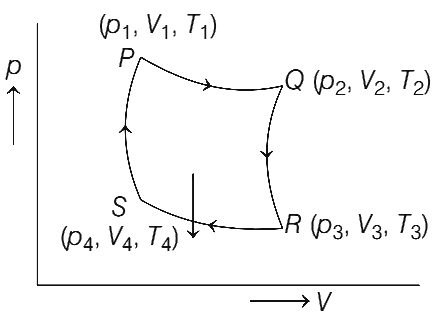
Total work done by the gas in one cycle isCOMEDK 2021 Hard
More PYQs from COMEDK
- The number of neutrons in \({ }_{92} \mathrm{U}^{235}\) nucleus isCOMEDK 2012 Easy
- Three long straight wires \(A, B\) and \(C\) are carrying currents as shown in figure, then the resultant force on \(B\) is directed
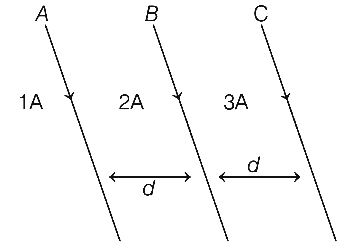 COMEDK 2013 Medium
 - The voltage – current graph for a metal wire of uniform area of cross section at two different temp T and T' is shown. Then choose the correct statement:
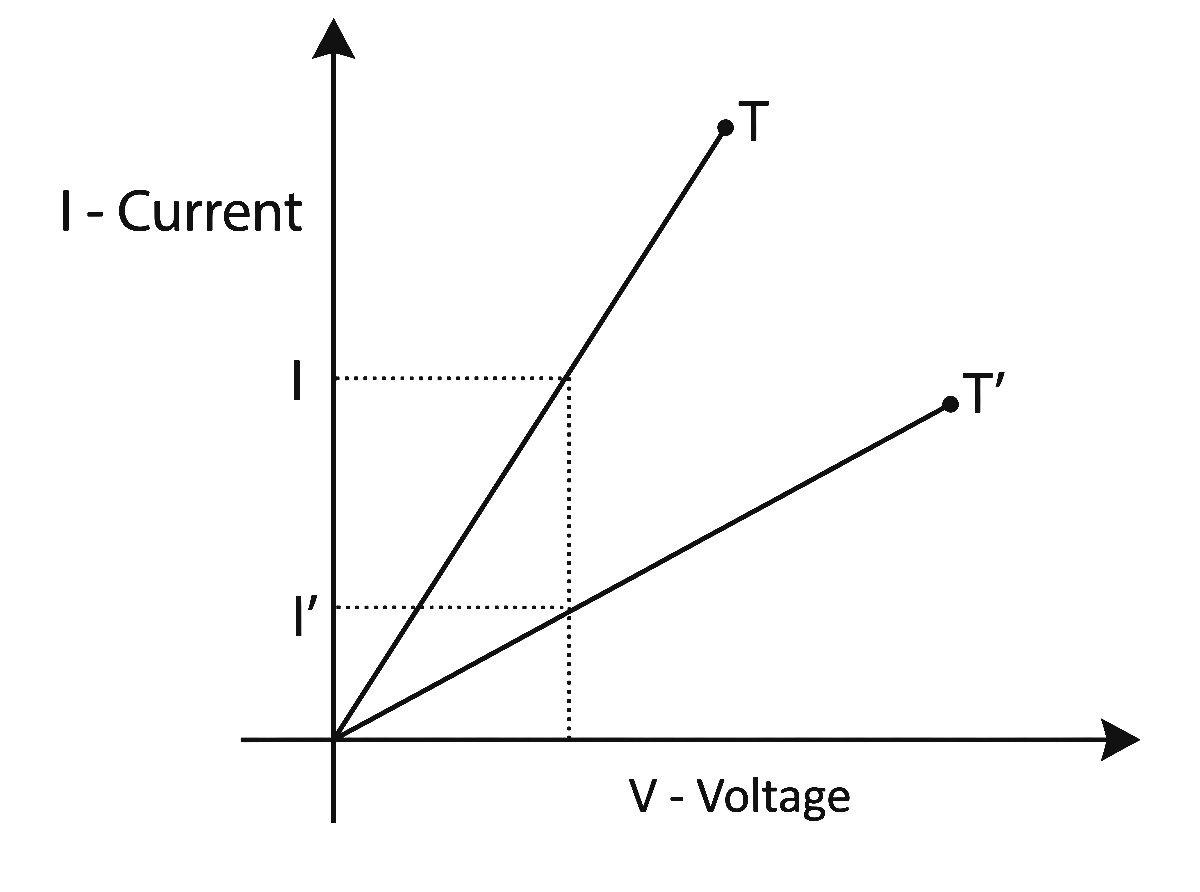 COMEDK 2026 Easy
 - On increasing the temperature of a conductor, its resistance increases becauseCOMEDK 2024 Easy
- \(\int_{0}^{\pi / 8} \cos ^{3} 4 \theta d \theta\) is equal toCOMEDK 2013 Easy
- What volume of \(0.2 \mathrm{~M}\) Acetic acid is to be added to \(100 \mathrm{ml}\) of \(0.4 \mathrm{M}\) Sodium acetate so that a Buffer solution of \(\mathrm{pH}\) equal to 4.94 is obtained? \((\mathrm{pK}_{\mathrm{a}}\) of \(\mathrm{CH}_3 \mathrm{COOH}=4.76)\)COMEDK 2024 Medium