


COMEDK · Physics · 17. Electrostatics
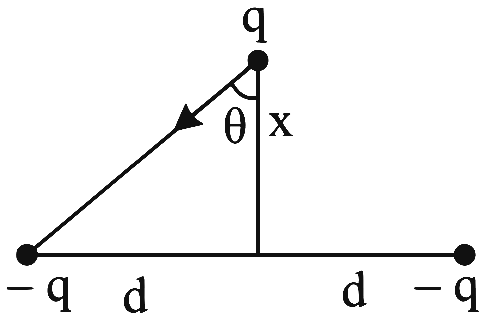
Two charges '\(-q\)' each are fixed, separated by distance '\(2 d\)'. A third charge '\(q\)' of mass '\(m\)' placed at the mid-point is displaced slightly by '\(x\)' \((x< < d)\) perpendicular to the line joining the two fixed charges as shown in Fig. The time period of oscillation of '\(q\)' will be
- A \(\mathrm{T}=\sqrt{\dfrac{4 \varepsilon_0 \mathrm{~m} \pi^3 \mathrm{~d}^3}{\mathrm{q}^2}}\)
- B \(\mathrm{T}=\sqrt{\dfrac{8 \varepsilon_0 \mathrm{~m} \pi^3 \mathrm{~d}^3}{\mathrm{q}^3}}\)
- C \(\mathrm{T}=\sqrt{\dfrac{8 \varepsilon_0 \mathrm{~m} \pi^3 \mathrm{~d}^3}{\mathrm{q}^2}}\)
- D \(\mathrm{T}=\sqrt{\dfrac{8 \varepsilon_0 \mathrm{~m} \pi^2 \mathrm{~d}^3}{\mathrm{q}^2}}\)
Answer & Solution
Correct Answer
(C) \(\mathrm{T}=\sqrt{\dfrac{8 \varepsilon_0 \mathrm{~m} \pi^3 \mathrm{~d}^3}{\mathrm{q}^2}}\)
Step-by-step Solution
Detailed explanation
Let the two fixed charges \(-q\) be located at \((-d, 0)\) and \((d, 0)\). The charge \(q\) is at \((0, x)\). The distance \(r\) between the charge \(q\) and each of the fixed charges is \(r = \sqrt{d^2 + x^2}\). The force exerted by each fixed charge on \(q\) is…
See the Complete Solution
Get step-by-step explanations for this and 2.5 Lakh+ more JEE, NEET & CET questions.
- Unlock all solutions
- Practice the full chapter
- Track accuracy across PYQs
4.8 rated on Google Play · 14,000+ reviews
More questions from Physics
-
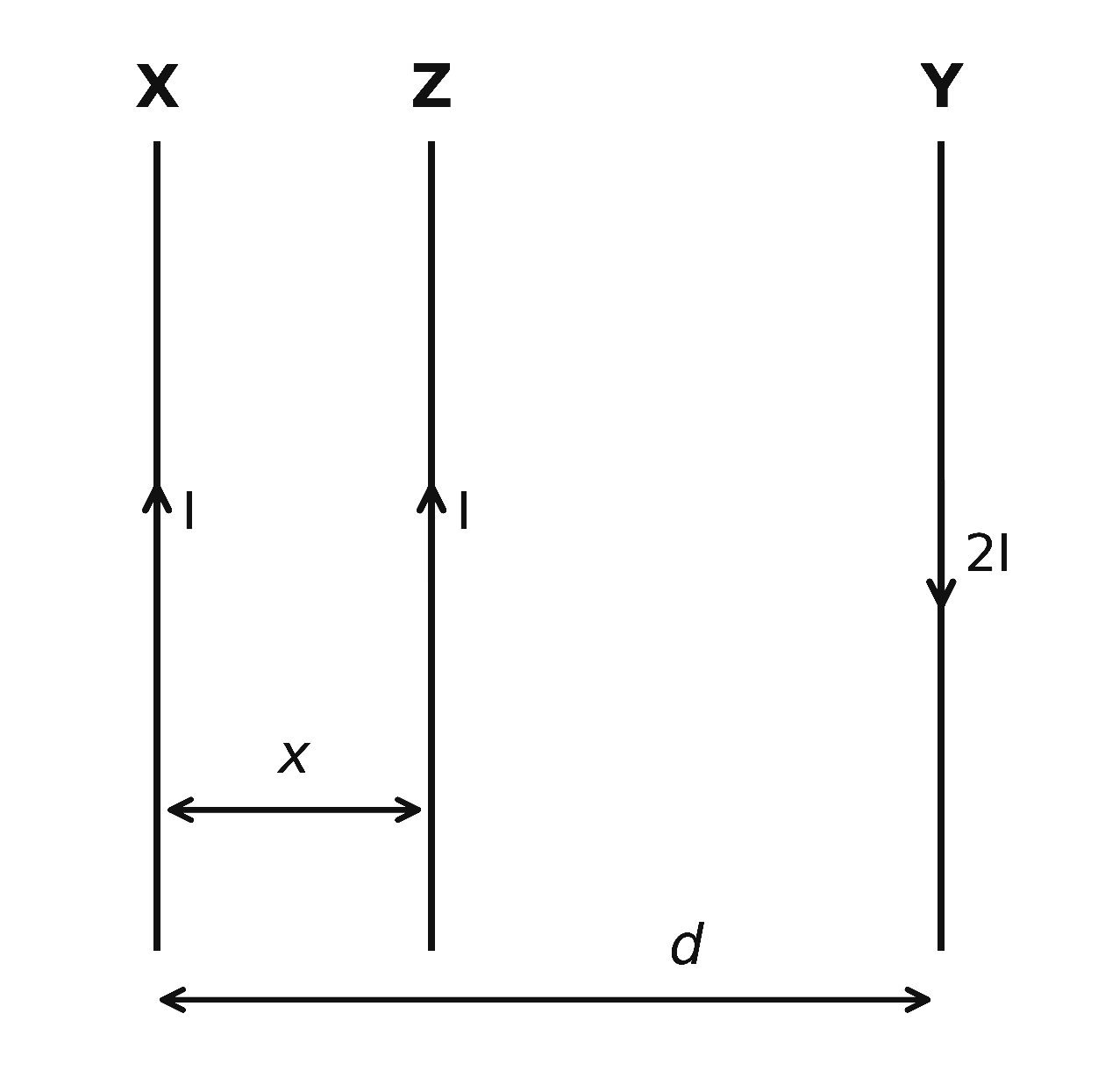
Two long parallel conductors X and Y are placed vertically at a distance d apart. Conductor X carries a current I upwards and conductor Y carries a current 2I downwards. A third long conductor Z is placed parallel to both X and Y and between X and Y. If Z carries a current I upwards and is at a distance \(x\) from conductor X, then:COMEDK 2026 Medium - Light of frequency \(10^{15} \mathrm{~Hz}\) falls on a metal surface of work function \(2.5 \mathrm{eV}\). The stopping potential of photoelectrons (in V) isCOMEDK 2020 Medium
- \(n\)-type and \(p\)-type semiconductors can be obtained by doping pure silicon, respectively withCOMEDK 2016 Easy
- When a \(p\) - \(n\) junction diode is connected in forward bias, its barrier potentialCOMEDK 2020 Easy
- The gases carbon monoxide \((\mathrm{CO})\) and nitrogen at the same temperature have kinetic energies \(E_1\) and \(E_2\), respectively. Then,COMEDK 2023 Easy
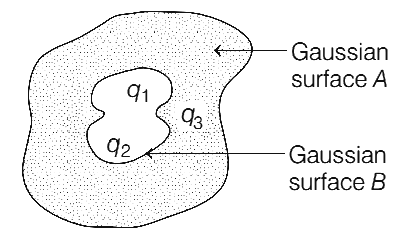
- The electric flux for Gaussian surface \(A\) that enclose the charged particles in free space is (Given, \(q_{1}=-14 \mathrm{nC}, q_{2}=78.85 \mathrm{nC}, q_{3}=-56 \mathrm{nC}\) )
 COMEDK 2017 Medium
More PYQs from COMEDK
- Molar conductance of a complex of cobalt is zero. Then its structure would beCOMEDK 2014 Medium
- An organic compound "A" reacts with \(\mathrm{Zn} / \mathrm{Hg} /\) Conc. HCl to form p-Xylene. It reduces Tollen's reagent and on oxidation with \(\mathrm{KMnO}_4 / \mathrm{H}^{+}\)it yields 1, 4-benzenedicarboxylic acid.
Identify compound A .COMEDK 2025 Medium - A semiconductor \(\mathrm{X}\) is made by doping silicon with phosphorous. A second semiconductor \(\mathrm{Y}\) is made by doping silicon with aluminium. The two are joined by a suitable technique to form a \(\mathrm{p}\)-\(\mathrm{n}\) junction and is connected to a battery such that \(\mathrm{Y}\) is joined to negative of the battery and \(\mathrm{X}\) to the positive of the battery. Which of the following statements is correct?COMEDK 2024 Medium
- Match the metals in Column II with their characteristic properties given in Column I.
\(\begin{array}{|c|l|c|c|} \hline & \text { Properties } & & \text { Metals } \\ \hline \text { A } & \text { Lanthanoid with low value of } 3^{\text {rd }} \text { ionisation enthalpy. } & P & V \\ \hline \text { B } & \text { f-Block element with electronic configuration }[\mathrm{Rn}] 6 \mathrm{~d}^2 7 \mathrm{~s}^2 & Q & G d \\ \hline \text { C } & 3 \mathrm{~d} \text {-series metal whose } \mathrm{M}^{3+}{ }_{(\mathrm{aq})} \text { is colourless. } & R & T h \\ \hline \text { D } & 3 \mathrm{~d} \text {-series metal with highest } \Delta \mathrm{H}_{(\text {atomisation })} & S & S c \\ \hline \end{array}\)COMEDK 2025 Medium - \(\int \dfrac{x}{x^4-16} d x=\)COMEDK 2024 Medium
- An aqueous solution of volume V ml contains a non-volatile solute of unknown mass \(W_B \mathrm{~g}\) and molar mass \(M_B \mathrm{~g} / \mathrm{mol}\). If the Osmotic pressure of the solution is 1.013 bar , which one of the following is the mathematical expression to be used to calculate \(W_B\) ?COMEDK 2025 Medium