


COMEDK · Physics · 17. Electrostatics
Three charges, \(\mathrm{Q},-\mathrm{q}\) and 2 q are placed at the vertices of a right-angled isosceles triangle. What is the value of \(q\) for the net electrostatic energy of the configuration to be zero?
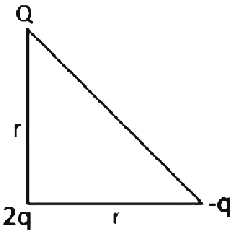
- A \(Q\left[\dfrac{1}{2 \sqrt{2}}-1\right]\)
- B \(Q\left[1+\dfrac{1}{2 \sqrt{2}}\right]\)
- C \(Q\left[1-\dfrac{1}{2 \sqrt{2}}\right]\)
- D \(Q\left[\dfrac{2 \sqrt{2}+1}{2}\right]\)
Answer & Solution
Correct Answer
(C) \(Q\left[1-\dfrac{1}{2 \sqrt{2}}\right]\)
Step-by-step Solution
Detailed explanation
The electrostatic potential energy \(U\) of a system of point charges is given by the sum of the potential energies of all pairs of charges: \(U = \sum \dfrac{k q_i q_j}{r_{ij}}\). The charges are \(Q\), \(2q\), and \(-q\). The distances between the pairs are \(r\), \(r\), and…
See the Complete Solution
Get step-by-step explanations for this and 2.5 Lakh+ more JEE, NEET & CET questions.
- Unlock all solutions
- Practice the full chapter
- Track accuracy across PYQs
4.8 rated on Google Play · 14,000+ reviews
More questions from Physics
-
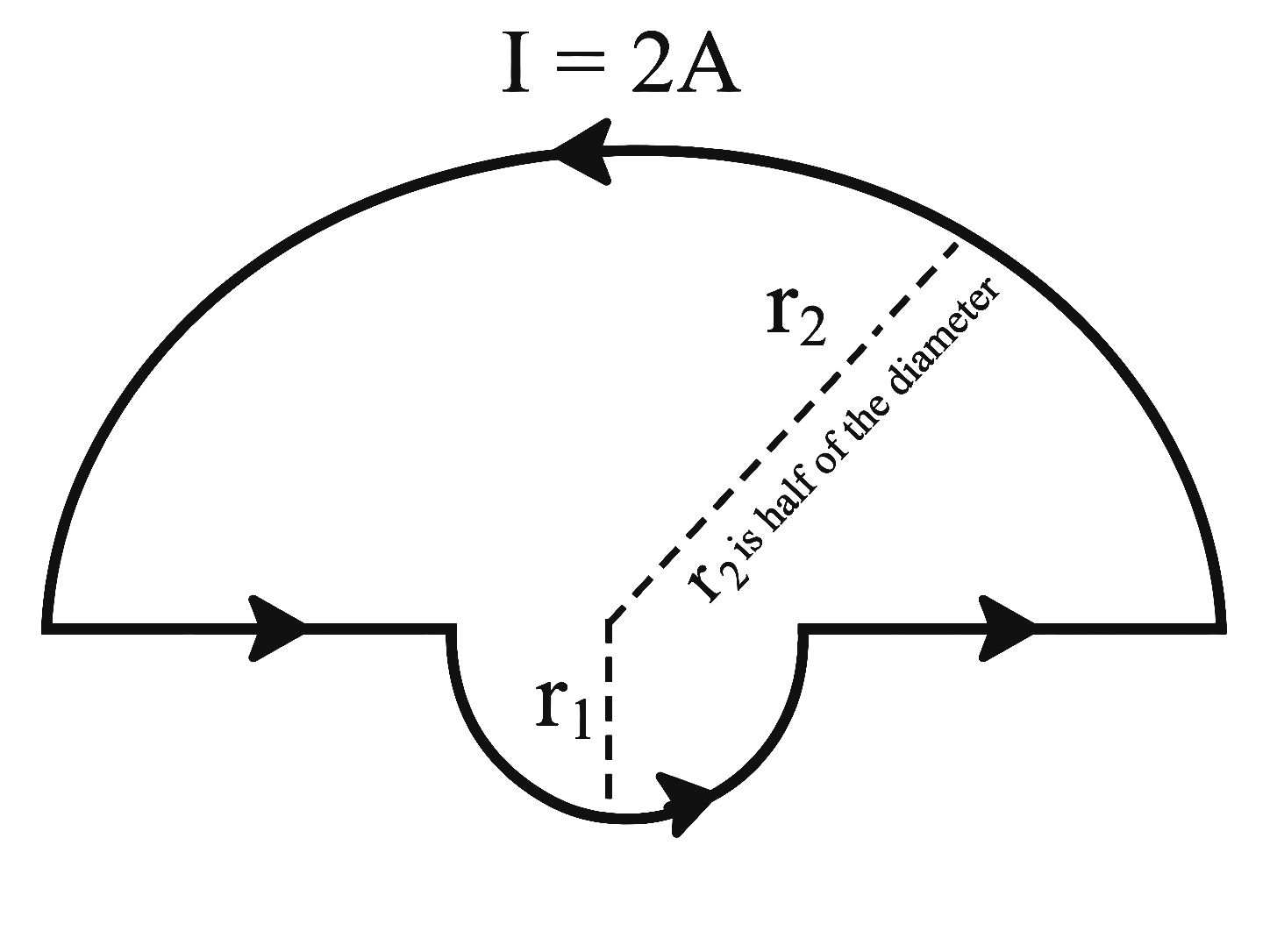
The magnetic field at the centre of a wire loop formed by two semicircular wires of radii \(r_1\) = 3.14m and \(r_2\) = 6.28m and carrying a current of I =2A is:COMEDK 2026 Medium - Assuming, \(R=8.3 \mathrm{~J} \mathrm{~mol}^{-1} \mathrm{~K}^{-1}\) and \(\gamma=1.4\) the values of \(C_{p}\) and \(C_{V}\) of a gas areCOMEDK 2012 Easy
- Two resistances are connected in two gaps of a meterbridge. The balance point is \(20 \mathrm{~cm}\) from the zero en(d) A resistance of \(15 \Omega\) is connected in series with the smaller of the two. The null point shifts to \(40 \mathrm{~cm}\). The value of the smaller resistance \((\) in \(\Omega)\) isCOMEDK 2017 Easy
- Absorption coefficient of an open window isCOMEDK 2013 Easy
- If 216 drops of the same size are charged at \(200 \mathrm{~V}\) each and they combine to form a bigger drop, the potential of the bigger drop will beCOMEDK 2024 Medium
- With what velocity should an observer approach a stationary sound source, so that the apparent frequency of sound should appear double the actual frequency?COMEDK 2023 Easy
More PYQs from COMEDK
- An inorganic salt comprises of atoms of elements \(\mathrm{A}, \mathrm{B}\) and \(\mathrm{C}\). If the oxidation numbers of A, B and \(\mathrm{C}\) are \(+3,+6\) and \(-\)2 respectively, what is the possible formula of the compound?COMEDK 2024 Easy
- In Young's double slit experiment, if monochromatic light used is replaced by white light, thenCOMEDK 2019 Easy
- Which of the following is not true?COMEDK 2023 Medium
- The number of bond pairs and lone pairs of electrons in the molecule \(\text{IF}_5\) is:COMEDK 2026 Medium
- In an \(L-C-R\) circuit, the potential difference between the terminals of the inductance is \(60 \mathrm{~V}\), between the terminals of the capacitor is \(30 \mathrm{~V}\) and that between the terminals of resistance is \(40 \mathrm{~V}\). The supply voltage will be equal toCOMEDK 2013 Medium
- Consider the Born-Haber cycle for the formation of an ionic compound, given below and identify the compound \((Z)\) forme(d)
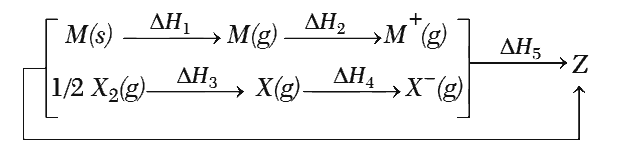 COMEDK 2017 Hard