


COMEDK · Physics · 11. Mechanical Properties of Fluids
The speeds of air-flow on the upper and lower surfaces of a wing of an aeroplane are \(v_1\) and \(v_2\), respectively. If \(A\) is the cross-sectional area of the wing and \(\rho\) is the density of air, then the upward lift is
- A \(\dfrac{1}{2} \rho A\left(v_1+v_2\right)\)
- B \(\dfrac{1}{2} \rho A\left(v_1-v_2\right)\)
- C \(\dfrac{1}{2} \rho A\left(v_1^2-v_2^2\right)\)
- D \(\dfrac{1}{2} \rho A\left(v_1^2+v_2^2\right)\)
Answer & Solution
Correct Answer
(C) \(\dfrac{1}{2} \rho A\left(v_1^2-v_2^2\right)\)
Step-by-step Solution
Detailed explanation
According to Bernoulli's principle for streamline flow, the pressure \(P\) and velocity \(v\) at any two points on a streamline are related by \(P + \dfrac{1}{2} \rho v^2 = \text{constant}\). Let \(P_1\) and \(P_2\) be the pressures on the upper and lower surfaces of the wing…
See the Complete Solution
Get step-by-step explanations for this and 2.5 Lakh+ more JEE, NEET & CET questions.
- Unlock all solutions
- Practice the full chapter
- Track accuracy across PYQs
4.8 rated on Google Play · 14,000+ reviews
More questions from Physics
- A bat emitting an ultrasonic wave of frequency \(4.5 \times 10^4 \mathrm{~Hz}\) at speed of \(6 \mathrm{~m} / \mathrm{s}\) between two parallel walls. The two frequencies heard by the bat will beCOMEDK 2022 Hard
- A voltmeter of resistance \(1000 \Omega .0 .5 \mathrm{~V} /\) div is to be converted into a voltmeter to make it to read \(=1 \mathrm{~V} / \mathrm{div}\). The value of high resistance to be connected in series with it isCOMEDK 2024 Medium
- There are two identical containers \(C_1\) and \(C_2\) containing to identical gases. Gas in \(C_1\) is reduced to half of its original volume adiabatically, while the gas in container \(C_2\) is also reduced to half of its initial volume isothermally. Find the ratio of final pressure in these containers. ( \(\gamma\) be the adiabatic constant).COMEDK 2022 Medium
- A body of mass 10 kg is moving up on an inclined plane of \(30^{\circ}\) with an acceleration \(2 \mathrm{~ms}^{-2}\). Find the force required, if the coefficient of friction between the object and the plane surface is \(\dfrac{\sqrt{3}}{6}\), [given \(g=10 \mathrm{~ms}^{-2}\) ].COMEDK 2025 Medium
- The gravitational field strength at the surface of a certain planet is \(g\). Which of the following is the gravitational field strength at the surface of a planet with twice the radius and twice the mass?COMEDK 2015 Easy
- PQRS is square of side \(1 \mathrm{~m}\). A charge of \(100 \mu \mathrm{C}\) is placed at the centre of the square. Then the work done to take \(3 \mu \mathrm{C}\) charge from the corner \(\mathrm{P}\) to the corner \(\mathrm{R}\).COMEDK 2023 Medium
More PYQs from COMEDK
- The resistance of a heating element is found to be \(120 \Omega\) at room temperature which is \(20^{\circ} \mathrm{C}\). If the temperature coefficient of the material of the resistor is \(1.6 \times 10^{-4} C^{-1}\) and the resistance is found to be \(160 \Omega\), the temperature of the element is:COMEDK 2025 Medium
- Match the structures in Column I with their correct IUPAC names given in Column II.
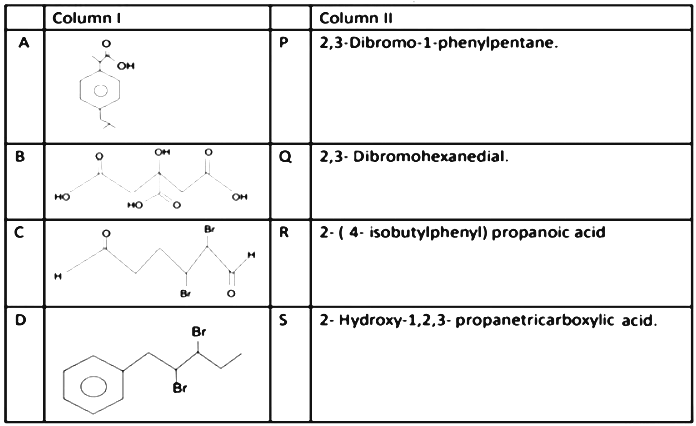 COMEDK 2025 Medium
 - The IUPAC name of tertiary butyl chloride isCOMEDK 2014 Easy
- A circular coil of 20 turns and radius 10 cm is placed in a uniform magnetic field of 0.10 T normal to the plane of the coil. If the current in the coil is 5 A, the cross-sectional area of the wire is \(10^{-5} \text{ m}^2\), and the free electron density is \(10^{29} \text{ m}^{-3}\), then the average force on each electron in the coil due to the magnetic field is:COMEDK 2022 Medium
- Which of the following statements about benzyl chloride is incorrect?COMEDK 2016 Easy
- Two point charges \(Q_{1}=2 \mu \mathrm{C}\) and \(Q_{2}=1 \mu \mathrm{C}\) are placed as shown. The coordinates of the point \(P\) are \((2 \mathrm{~cm}, 1 \mathrm{~cm})\). The electric intensity vector at \(P\) subtends an angle \(\theta\) with the positive \(X\)-axis. The value of \(\theta\) is given by
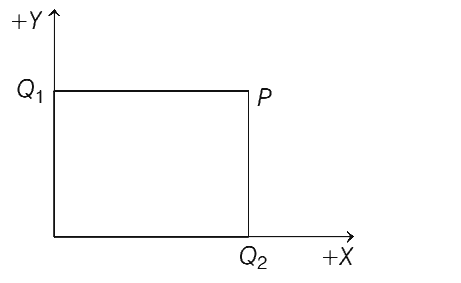 COMEDK 2012 Hard