


COMEDK · Physics · 17. Electrostatics
The magnitude and direction of the electric field in a particular region is \((10 \boldsymbol{i}+4 \boldsymbol{j}+2 \boldsymbol{k}) \times 10^4 \mathrm{NC}^{-1}\). What s the electric flux through an area \((3 \boldsymbol{i}-\boldsymbol{k}) 10^{-2} \mathrm{~m}^2\)
- A \(1.4 \times 10^3 \mathrm{Nm}^2 \mathrm{C}^{-1}\)
- B \(2.8 \times 10^3 \mathrm{Nm}^2 \mathrm{C}^{-1}\)
- C \(2.8 \mathrm{Nm}^2 \mathrm{C}^{-1}\)
- D \(2.8 \times 10^2 \mathrm{Nm}^2 \mathrm{C}^{-1}\)
Answer & Solution
Correct Answer
(B) \(2.8 \times 10^3 \mathrm{Nm}^2 \mathrm{C}^{-1}\)
Step-by-step Solution
Detailed explanation
The electric flux \(\Phi_E\) through a surface is given by the dot product of the electric field vector \(\vec{E}\) and the area vector \(\vec{A}\). Given \(\vec{E} = (10 \hat{i} + 4 \hat{j} + 2 \hat{k}) \times 10^4 \text{ NC}^{-1}\) and…
See the Complete Solution
Get step-by-step explanations for this and 2.5 Lakh+ more JEE, NEET & CET questions.
- Unlock all solutions
- Practice the full chapter
- Track accuracy across PYQs
4.8 rated on Google Play · 14,000+ reviews
More questions from Physics
- The rms velocity of the gas molecule at \(327^{\circ} \mathrm{C}\) is same as the rms velocity of the oxygen molecules at \(27^{\circ} \mathrm{C}\). If the molecular weight of oxygen is 32 then the molecular weight of the given gas molecule is:COMEDK 2025 Medium
- In the equation \(X = G^{-1/2}\,h^{1/2}\,c^{5/2}\), where G- universal gravitation constant, h- Planck's constant and c- velocity of light, the dimensions of X are that ofCOMEDK 2026 Medium
- The nuclear forces
a. are central forces, independent of the spin of the nucleons.
b. have a short-range dominant over a distance of about a few fermi
c. are stronger being hundred times stronger than that of electromagnetic forces.
d. are independent of the nuclear charge.
Which of the above is not true?COMEDK 2025 Easy - An electron is accelerated through a potential difference of \(45.5 \mathrm{~V}\). The velocity acquired by it (in \(\mathrm{ms}^{-1}\) ) isCOMEDK 2019 Easy
- Two spheres of masses \(M_1\) and \(M_2\) are in air separated by a distance of d m. The gravitational force of attraction between them is F. If the space around the masses is filled with a liquid of density \(\rho\), the force between the masses will beCOMEDK 2026 Easy
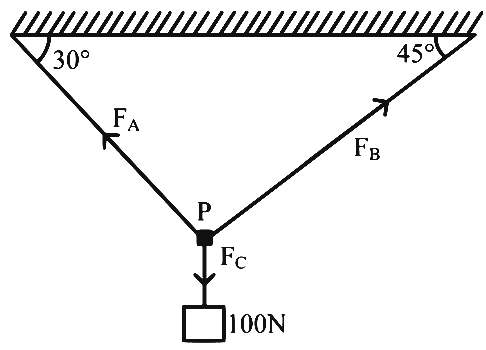
- \(\mathrm{F}_{\mathrm{A}}, \mathrm{F}_{\mathrm{B}}\) and \(\mathrm{F}_{\mathrm{C}}\) are three forces acting at point \(\mathrm{P}\) as shown in figure. The whole system is in equilibrium state. The magnitude of \(\mathrm{F}_{\mathrm{A}}\) is
 COMEDK 2023 Medium
More PYQs from COMEDK
- When \(3.92 \mathrm{~g}\) of Mohr salt is dissolved in \(100 \mathrm{~mL}\) of water, and titrated against \(\mathrm{KMnO}_4\) solution, \(20 \mathrm{~mL}\) of this solution required \(18 \mathrm{~mL}\) of \(\mathrm{KMnO}_4\) for complete oxidation. The strength of \(\mathrm{KMnO}_4\) is:
[Molar mass of Mohr salt is \(392 \mathrm{~g} \mathrm{~mol}^{-1}\) and \(\mathrm{KMnO}_4\) is \(158 \mathrm{~g} \mathrm{~mol}^{-1}\)]COMEDK 2024 Medium - A small conducting sphere of radius \(r\) is lying concentrically inside a bigger hollow conducting sphere of radius \(R\). The bigger and smaller spheres are charged with \(Q\) and \(q(Q>q)\) and are insulated from each other. The potential difference between the spheres will beCOMEDK 2018 Medium
- A bus covers the first half of the total distance 6 km at a speed ' \(u\) ' and the second half at speed of \(30 \mathrm{~km} \mathrm{~h}^{-1}\). If the average speed is \(15 \mathrm{~km} \mathrm{~h}^{-1}\) the value of ' \(u\) ' is:COMEDK 2025 Easy
- Which of the following would undergo Hofmann reaction to give a primary amine?COMEDK 2018 Easy
- If the vectors \(\mathbf{a}=\hat{\mathbf{i}}+2 \hat{\mathbf{j}}-\hat{\mathbf{k}}, \mathbf{b}=\hat{\mathbf{i}}-2 \hat{\mathbf{j}}+\lambda \hat{\mathbf{k}}\) and \(\mathbf{c}=\hat{\mathbf{i}}+\hat{\mathbf{j}}+\hat{\mathbf{k}}\) are coplanar, then the value of \(\lambda\) isCOMEDK 2024 Easy
- The order of the differential equation \(\left[1+\left(\frac{d y}{d x}\right)^{5}\right]^{\frac{2}{3}}=\frac{d^{3} y}{d x^{3}}\)COMEDK 2012 Easy