


COMEDK · Physics · 27. Dual Nature of Matter
The de-Broglie wavelength of a neutron having kinetic energy 0.025 eV is \(\lambda\). If the kinetic energy of the neutron is reduced to \(\dfrac{0.025 \mathrm{eV}}{8}\), its de-Broglie wavelength will be:
- A \(2 \sqrt{2} \lambda\)
- B \(\dfrac{\lambda}{2 \sqrt{2}}\)
- C \(\dfrac{0.025 \lambda}{2 \sqrt{2}}\)
- D \(\dfrac{\lambda}{0.025 \sqrt{2}}\)
Answer & Solution
Correct Answer
(A) \(2 \sqrt{2} \lambda\)
Step-by-step Solution
Detailed explanation
The de-Broglie wavelength \(\lambda\) of a particle with mass \(m\) and kinetic energy \(K\) is given by the relation \(\lambda = \dfrac{h}{\sqrt{2mK}}\). For the initial state, the wavelength is \(\lambda = \dfrac{h}{\sqrt{2m(0.025 \text{ eV})}}\). When the kinetic energy is…
See the Complete Solution
Get step-by-step explanations for this and 2.5 Lakh+ more JEE, NEET & CET questions.
- Unlock all solutions
- Practice the full chapter
- Track accuracy across PYQs
4.8 rated on Google Play · 14,000+ reviews
More questions from Physics
- A mass of \(10 \mathrm{~kg}\) is suspended from a spring balance. It is pulled a side by a horizontal string, so that it makes an angle of \(60^{\circ}\) with the vertical. The new reading of the balance isCOMEDK 2018 Easy
- The sides of a parallelogram are represented by vectors \(\vec{p}=5 \hat{\mathrm{i}}-4 \hat{\mathrm{j}}+3 \hat{\mathrm{k}}\) and \(\vec{q}=3 \hat{\mathrm{i}}+2 \hat{\mathrm{j}}-\hat{\mathrm{k}}\). Then, the area of the parallelogram isCOMEDK 2023 Medium
- In an ammeter \(10 \%\) of main current is passing through the galvanometer. If the resistance of the galvanometer is \(G\), then the shunt resistance (in \(\Omega\) ) isCOMEDK 2017 Easy
- A machine gun fires a bullet of mass m with a velocity of 1000 m/min. The man holding the gun can exert a force of 200 N on the gun. The product of mass of each bullet and the number of bullets fired in one sec isCOMEDK 2026 Medium
- When a dielectric slab of dielectric constant \(\mathrm{k}=2\) is used to fill the space between the plates of a parallel plate capacitor, the capacitance of the capacitor is found to be \(20 \mu \mathrm{F}\). What will be the capacitance when the slab is replaced with air?COMEDK 2025 Easy
- Which of the following cannot be explained on the basis of Bernoulli's principle?COMEDK 2012 Medium
More PYQs from COMEDK
- If \(a, b, c\), and \(d\) are the roots of the equation \(x^{4}+2 x^{3}+3 x^{2}+4 x+5=0\), then \(1+a^{2}+b^{2}+c^{2}+d^{2}\) is equal toCOMEDK 2018 Hard
- Which of the following is highly basic?COMEDK 2022 Medium
- Identify the law which is stated as "For any solutions, the partial vapour pressure of each volatile component in the solution is directly proportional to its mole fraction".COMEDK 2026 Easy
- A gas is taken through the cycle \(A \rightarrow B \rightarrow C \rightarrow A\), as shown in figure. What is the net work done by the gas?
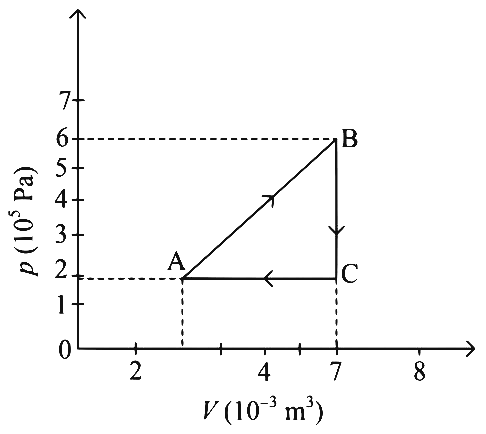 COMEDK 2023 Medium
 - "A storage room must be kept at a temperature (T) such that triple the temperature is at least 15° C, but the temperature plus 8 is not more than 20° C. What is the range of safe temperatures?"COMEDK 2026 Easy
- Find \(\sin \theta\), if \(\theta\) is the angle between the vectors \(3 \hat{\mathbf{i}}+\hat{\mathbf{j}}+2 \hat{\mathbf{k}}\) and \(\hat{\mathbf{i}}+\hat{\hat{\mathbf{j}}}+2 \hat{\mathbf{k}}\).COMEDK 2014 Easy