


COMEDK · Physics · 19. Current Electricity
The current through a conductor is '\(\mathrm{a}\)' when the temperature is \(0^{\circ} \mathrm{C}\). It is '\(\mathrm{b}\)' when the temperature is \(100^{\circ} \mathrm{C}\). The current through the conductor at \(220^{\circ} \mathrm{C}\) is
- A \(\dfrac{11 a b}{5 a-6 b}\)
- B \(\dfrac{5 a b}{6 a-11 b}\)
- C \(\dfrac{5 a b}{11 a-6 b}\)
- D \(\dfrac{5 a b}{11 b-6 a}\)
Answer & Solution
Correct Answer
(C) \(\dfrac{5 a b}{11 a-6 b}\)
Step-by-step Solution
Detailed explanation
The resistance of a conductor at temperature \(T\) is given by \(R_T = R_0(1 + \alpha T)\), where \(R_0\) is the resistance at \(0^{\circ} \text{C}\) and \(\alpha\) is the temperature coefficient of resistance. Given the current \(I = \dfrac{V}{R}\), where \(V\) is the constant…
See the Complete Solution
Get step-by-step explanations for this and 2.5 Lakh+ more JEE, NEET & CET questions.
- Unlock all solutions
- Practice the full chapter
- Track accuracy across PYQs
4.8 rated on Google Play · 14,000+ reviews
More questions from Physics
- An inductor and a resistor are connected to an \(\mathrm{AC}\) supply of \(50 \mathrm{~V}\) and \(50 \mathrm{~Hz}\). If the voltage across the resistor is \(40 \mathrm{~V}\), then the voltage across the inductor will beCOMEDK 2012 Easy
- For a \(30^{\circ}\) prism when a ray of light is incident at an angle \(60^{\circ}\) on one of its faces, the emergent ray passes normal to the other surface. Then the refractive index of the prism is:COMEDK 2024 Medium
- The emitter-base junction of a transistor is ....... biased, while the collector-base junction is ....... biased.COMEDK 2019 Easy
- Force constant of interatomic bond, in a certain element, is \(7.1\ Nm^{-1}\). If the atom oscillates in SHM in a certain direction, what is its frequency?
Given: Mole weight of the given element is 108g and Avagadro's number \(= 6.023 \times 10^{23}\ g\ mol^{-1}\)COMEDK 2026 Medium - The phase difference between displacement and velocity of a particle in simple harmonic motion isCOMEDK 2023 Easy
- The ratio of speed of sound in hydrogen to that in oxygen at the same temperature isCOMEDK 2012 Easy
More PYQs from COMEDK
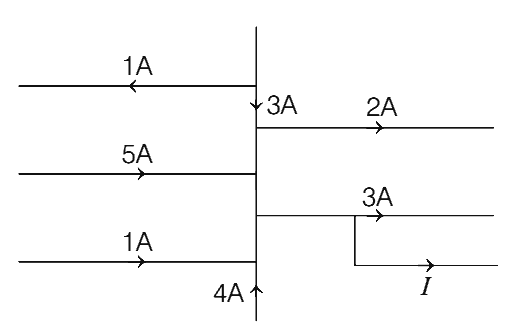
- For the given electrical arrangement, what is the value of current \(I\) ?
 COMEDK 2021 Easy
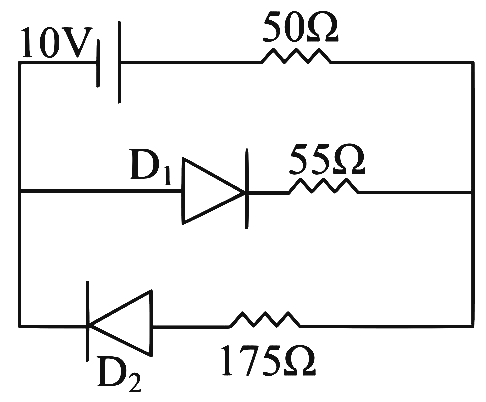
 - In the given circuit, assuming the battery is oriented with its positive terminal on the right, the diode \(D_1\) and \(D_2\) have the forward resistance \(25\,\Omega\) and infinite backward resistance. When they are connected to the source, the current passing through the \(175\,\Omega\) resistor is:
 COMEDK 2023 Medium
 - \(5 \mathrm{~L}\) of \(\mathrm{NaOH}\) solution of \(\mathrm{pH} 12\) containsCOMEDK 2019 Hard
- The magnetic properties of a magnet is lost at itsCOMEDK 2014 Easy
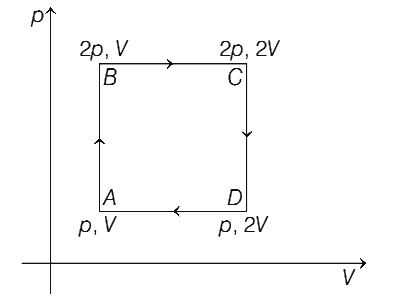
- An ideal monoatomic gas is taken around the cycle \(A B C D A\) as shown in the \(p-V\) diagram. The work done during the cycle is given by
 COMEDK 2017 Easy
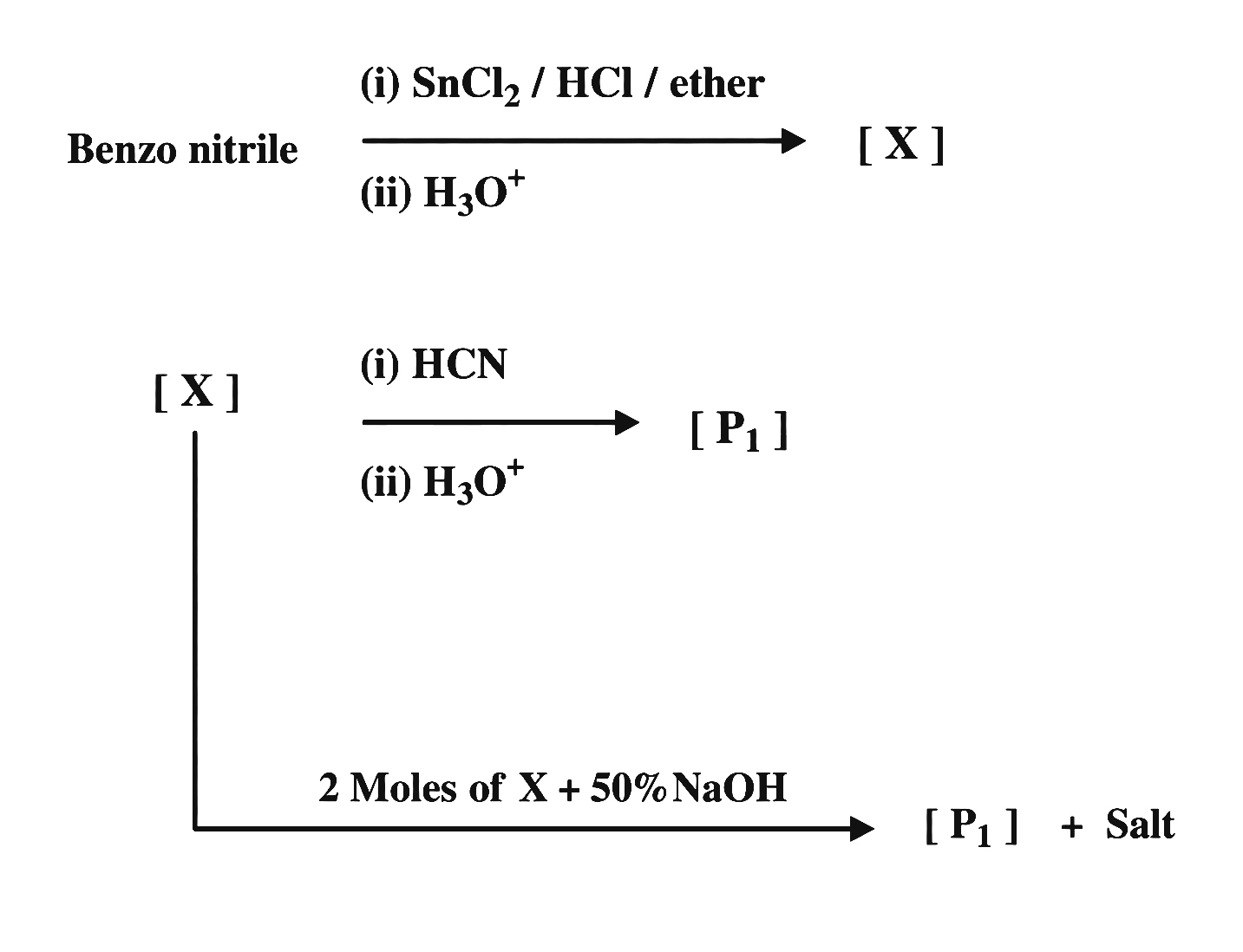
 - Identify products [P\(_1\)] and [P\(_2\)] formed when Benzonitrile undergoes the following reactions.
 COMEDK 2026 Medium