


COMEDK · Physics · 30. Semiconductors
In an unbiased \(p\) - \(n\) junction
- A potential at \(p\) is more than that at \(n\)
- B potential at \(p\) is less than that at \(n\)
- C potential at \(p\) is equal to that at \(n\)
- D potential at \(p\) is + ve and that at \(n\) is - ve
Answer & Solution
Correct Answer
(B) potential at \(p\) is less than that at \(n\)
Step-by-step Solution
Detailed explanation
An unbiased \(p\) - \(n\) junction is shown below. From the diagram, it is clear that in depletion region, \(n\)-side has immobile positive charge, whereas \(p\)-side has immobile negative charge. Therefore, potential at \(n\) is less than that of \(n\).
See the Complete Solution
Get step-by-step explanations for this and 2.5 Lakh+ more JEE, NEET & CET questions.
- Unlock all solutions
- Practice the full chapter
- Track accuracy across PYQs
4.8 rated on Google Play · 14,000+ reviews
More questions from Physics
- A straight wire carrying current of 21 A is bent into an arc of radius 11 cm as shown below. The magnetic field produced by the current at the centre \(O\) of the arc is:
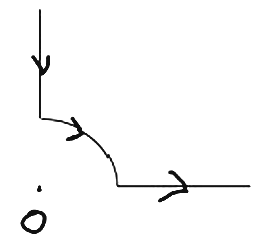 COMEDK 2025 Medium
 - A string vibrates with a frequency of \(200 \mathrm{~Hz}\). When its length is doubled and tension is altered, it begins to vibrate with a frequency of \(300 \mathrm{~Hz}\). The ratio of the new tension to the original tension isCOMEDK 2023 Easy
- The average kinetic energy of a molecule in air at room temperature of \(20^{\circ} \mathrm{C}\)COMEDK 2022 Easy
- Three long straight wires \(A, B\) and \(C\) are carrying currents as shown in figure. Then, the resultant force on \(B\) is directed
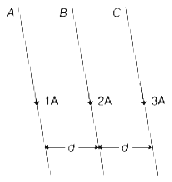 COMEDK 2019 Medium
 - The velocity of a body moving in a viscous medium is given by \(v = \dfrac{A}{B+C}\left[1 - e^{\frac{-t}{B}}\right]\) where t is time; dimensions of A and C areCOMEDK 2026 Easy
- The difference in energy levels of an electron at two excited levels is \(13.75 \mathrm{~eV}\). If it makes a transition from the higher energy level to the lower energy level then what will be the wave length of the emitted radiation?
[given \(h=6.6 \times 10^{-34} \mathrm{~m}^2 \mathrm{~kg} \mathrm{~s}^{-1} ; c=3 \times 10^8 \mathrm{~ms}^{-1} ; 1 \mathrm{~eV}=1.6 \times 10^{-19} \mathrm{~J}\)]COMEDK 2024 Easy
More PYQs from COMEDK
- A spherical metal ball of density '\(\rho\)' and radius '\(r\)' is immersed in a liquid of density '\(\sigma\)'. When an electric field is applied in the upward direction the metal ball remains just suspended in the liquid. Then the expression for the charge on the metal ball is :COMEDK 2023 Medium
- Which of the following statement is incorrect about activation energy?COMEDK 2022 Easy
- When \(0.1 \mathrm{~mol} \mathrm{~L}^{-1}\) of KCl was filled in a Conductivity cell the resistance was 80 ohms at 298 K . (Conductivity of 0.1 M KCl at 298 K is \(1.29 \mathrm{~S} \mathrm{~m}^{-1}\). The same cell when filled with an unknown electrolyte of concentration 0.025 M , had a resistance of 92 ohms. What is the Molar conductivity of the electrolyte at the given concentration?COMEDK 2025 Medium
- The sum of \(n\) terms of the series, \(\frac{4}{3}+\frac{10}{9}+\frac{28}{27}+\ldots\) isCOMEDK 2023 Hard
- In the equation \(X = G^{-1/2}\,h^{1/2}\,c^{5/2}\), where G- universal gravitation constant, h- Planck's constant and c- velocity of light, the dimensions of X are that ofCOMEDK 2026 Easy
- \(\mathrm{K}_1\) and \(\mathrm{K}_2\) are maximum kinetic energies of photoelectrons emitted when lights of wavelength \(\lambda_1\) and \(\lambda_2\) respectively are incident on a metallic surface. If \(\lambda_1=3 \lambda_2\), thenCOMEDK 2024 Medium