


COMEDK · Physics · 23. Alternating Current
In an electrical circuit \(R, L, C\) and \(\mathrm{AC}\) voltage source are all connected in series. When \(L\) is removed from the circuit, the phase difference between the voltage and the current in the circuit is \(\pi / 3\). If instead \(C\) is removed from the circuit, the phase difference is again \(\pi / 3\). The power factor of the circuit is
- A \(\dfrac{\sqrt{3}}{2}\)
- B \(1 / 2\)
- C 1
- D \(1 \sqrt{2}\)
Answer & Solution
Correct Answer
(C) 1
Step-by-step Solution
Detailed explanation
In an \(LCR\) series circuit, the phase difference \(\phi\) is given by \(\tan \phi = \dfrac{X_L - X_C}{R}\). When \(L\) is removed, the circuit contains only \(R\) and \(C\). The phase difference is \(\phi_1 = -\pi / 3\). Thus, \(\tan(-\pi / 3) = \dfrac{-X_C}{R}\), which…
See the Complete Solution
Get step-by-step explanations for this and 2.5 Lakh+ more JEE, NEET & CET questions.
- Unlock all solutions
- Practice the full chapter
- Track accuracy across PYQs
4.8 rated on Google Play · 14,000+ reviews
More questions from Physics
- A square shaped aluminium coin weighs \(0.75 \mathrm{~g}\) and its diagonal measures \(14 \mathrm{~mm}\). It has equal amounts of positive and negative charges. Suppose those equal charges were concentrated in two charges \((+Q\) and \(-Q)\) that are separated by a distance equal to the side of the coin, the dipole moment of the dipole isCOMEDK 2024 Medium
- For the charge configuration shown here, which of the following is not true?
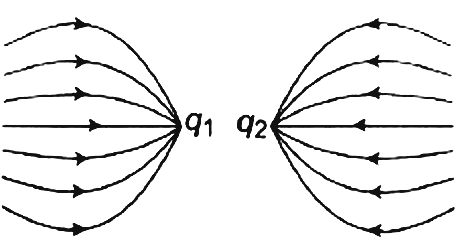 COMEDK 2025 Easy
 - A scooter moves with a speed of \(7 \mathrm{~ms}^{-1}\), on a straight road and is stopped by applying the brakes. Before stopping, the scooter travels \(10 \mathrm{~m}\). If the weight of the scooter is \(\mathrm{W}\), then the total resistance to the motion of the scooter will beCOMEDK 2024 Medium
- The nucleus of a helium atom travels along the inside of a straight hollow tube \(4 \mathrm{~m}\) long which forms part of a particle accelerator. If one assumes uniform acceleration, how long is the particle in the tube if it enters at a speed of \(2000 \mathrm{~m} / \mathrm{s}\) and leaves at \(8000 \mathrm{~m} / \mathrm{s}\)COMEDK 2023 Easy
- The mean energy per molecule for a diatomic gas isCOMEDK 2023 Easy
- A body initially at rest undergoes rectilinear motion. The forcetime (F-t) graph for the motion of the body is given below. Find the linear momentum gained by the body in \(2 \mathrm{~s}\).
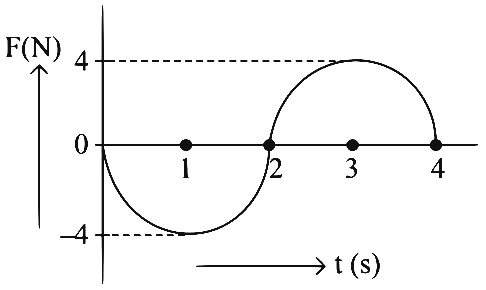 COMEDK 2024 Medium
More PYQs from COMEDK
- Arrange the following compounds in the increasing order towards \(\mathrm{S}_{\mathrm{N}} 1\) reactions.
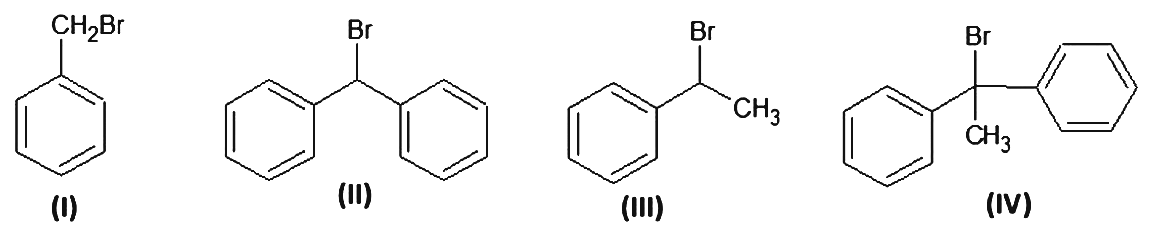 COMEDK 2025 Medium
 - A transition metal M forms 4 homoleptic octahedral coordination compounds, A, B, C and D of the type [MX6] \({ }^{z-}\) with monodentate ligands \(\mathrm{a}, \mathrm{b}, \mathrm{c}\) and d respectively. These compounds absorb red, blue, yellow and blue-green light respectively. Which one of the options shows the correct order of decreasing ligand strength?COMEDK 2025 Medium
- The particular solution of \(e^{\dfrac{d y}{d x}}=2 x+1\) given that \(y=1\) when \(x=0\) isCOMEDK 2023 Medium
- A bulb of resistance 280 Ohm is supplied with a voltage \(\mathrm{V}=400 \sin \pi \mathrm{t}\). The peak current isCOMEDK 2025 Easy
- The dimensions of universal gravitational constant isCOMEDK 2014 Easy
- Which of the following does not correctly represent the order of the property indicated against it?COMEDK 2026 Easy