


COMEDK · Physics · 29. Nuclear Physics
In a nuclear fusion reaction, two nuclei, \(A\) and \(B\) fuse to produce a nucleus \(C\), releasing an amount of energy \(\Delta \mathrm{E}\) in the process. If the mass defects of the three nuclei are \(\Delta M_A, \Delta M_B\) and \(\Delta M_C\) respectively, then which of the following relations is true? ( \(c\) is the speed of light).
- A \(\Delta M_A-\Delta M_B=\Delta M_C+\dfrac{\Delta E}{c^2}\)
- B \(\Delta M_A+\Delta M_B=\Delta M_C-\dfrac{\Delta E}{c^2}\)
- C \(\Delta M_A+\Delta M_B=\Delta M_C+\dfrac{\Delta E}{c^2}\)
- D \(\Delta M_A-\Delta M_B=\Delta M_C-\dfrac{\Delta E}{c^2}\)
Answer & Solution
Correct Answer
(B) \(\Delta M_A+\Delta M_B=\Delta M_C-\dfrac{\Delta E}{c^2}\)
Step-by-step Solution
Detailed explanation
Energy released in fusion: \(\Delta E = BE_C - (BE_A + BE_B)\) Since \(BE = \Delta M \cdot c^2\): \(\Delta E = (\Delta M_C)c^2 - [(\Delta M_A)c^2 + (\Delta M_B)c^2]\) Dividing by \(c^2\): \(\dfrac{\Delta E}{c^2} = \Delta M_C - \Delta M_A - \Delta M_B\)…
See the Complete Solution
Get step-by-step explanations for this and 2.5 Lakh+ more JEE, NEET & CET questions.
- Unlock all solutions
- Practice the full chapter
- Track accuracy across PYQs
4.8 rated on Google Play · 14,000+ reviews
More questions from Physics
- An ideal diode is connected in series with a capacitor. The free ends of the capacitor and the diode are connected across a \(220 \mathrm{~V}\) ac source. Now the potential difference across the capacitor is :COMEDK 2024 Medium
- A solid cylinder of mass \(2 \mathrm{~kg}\) and radius \(0.2 \mathrm{~m}\) is rotating about its own axis without friction with angular velocity \(5 \mathrm{~rad} \mathrm{s}^{-1}\). A particle of mass \(1 \mathrm{~kg}\) moving with a velocity of \(5 \mathrm{~ms}^{-1}\) strikes the cylinder and sticks to it as shown in figure.
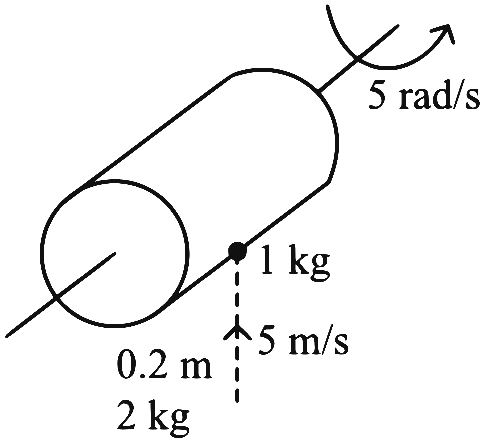
The angular velocity of the system after the particle sticks to it will beCOMEDK 2024 Medium - Two physical quantities having the same dimensional formula \(\left[\mathrm{M}^1 \mathrm{~L}^{-1} \mathrm{~T}^{-2}\right]\) areCOMEDK 2025 Easy
- A rectangular coil of 300 turns has an average area of \(25 \mathrm{~cm} \times 10 \mathrm{~cm}\). The coil rotates with a speed of 50 cps in a uniform magnetic field of strength \(4 \times 10^{-2} \mathrm{~T}\) about an axis perpendicular to the fiel(d)The peak value of the induced emf (in volt) isCOMEDK 2019 Easy
- Two point charges \(20 \mu \mathrm{C}\) and \(-10 \mu \mathrm{C}\) are separated by a distance of \(1 \mathrm{~m}\) in air. At what point on the line joining the two charges, the electric potential is zero.COMEDK 2023 Medium
- If \(M\) is the atomic mass and \(A\) is the mass number, packing fraction is given byCOMEDK 2019 Medium
More PYQs from COMEDK
- How many numbers greater than 1000000 be formed from \(2,3,0,3,4,2,3\) ?COMEDK 2015 Medium
- For the cell reaction \(4 \mathrm{Br}^{-}+\mathrm{O}_2+4 \mathrm{H}^{+} \rightarrow 2 \mathrm{Br}_2+2 \mathrm{H}_2 \mathrm{O}\) at 298 K , the \(\mathrm{E}^0\) cell \(=0.16 \mathrm{~V}\).
What would be the \(\mathrm{K}_{\mathrm{c}}\) (Equilibrium constant) value if the reverse reaction were to take place?COMEDK 2025 Medium - The area of the region bounded by the ellipse \(\dfrac{x^2}{a^2}+\dfrac{y^2}{b^2}=1\) isCOMEDK 2025 Easy
- If \(4^{\log _{9} 3}+9^{\log _{2} 4}=10^{\log _{x} 83}\), then \(x\) is equal toCOMEDK 2012 Easy
- \(\int e^x\left[\dfrac{x^2+1}{(x+1)^2}\right] d x \quad \text { is equal to }\)COMEDK 2024 Medium
- Three vertices are chosen randomly from the nine vertices of a regular 9 -sided polygon. The probability that they form the vertices of an isosceles triangle, isCOMEDK 2023 Easy