


COMEDK · Physics · 26. Wave Optics
If \(E\) is the amplitude of the electric field of the waves starting from the slits in a double slit experiment and \(\theta\) is the phase difference between the waves reaching a point on the screen, the ratio of the amplitude of the resultant electric field at that point on the screen to the amplitude at one of the slits is
- A \(2 \cos \left(\dfrac{\theta}{2}\right)\)
- B \(2 \cos (\theta)\)
- C \(\cos \left(\dfrac{\theta}{2}\right)\)
- D \(\cos (\theta)\)
Answer & Solution
Correct Answer
(A) \(2 \cos \left(\dfrac{\theta}{2}\right)\)
Step-by-step Solution
Detailed explanation
Let the electric field of the waves from the two slits be \(E_1 = E \sin(\omega t)\) and \(E_2 = E \sin(\omega t + \theta)\), where \(E\) is the amplitude of each wave and \(\theta\) is the phase difference. The resultant electric field \(E_R\) is given by the superposition…
See the Complete Solution
Get step-by-step explanations for this and 2.5 Lakh+ more JEE, NEET & CET questions.
- Unlock all solutions
- Practice the full chapter
- Track accuracy across PYQs
4.8 rated on Google Play · 14,000+ reviews
More questions from Physics
- Two slabs are of the thicknesses \(d_1\) and \(d_2\). Their thermal conductivities are \(K_1\) and \(K_2\), respectively. They are in series. The free ends of the combination of these two slabs are kept at temperatures \(\theta_1\) and \(\theta_2\). Assume \(\theta_1>\theta_2\). The temperature \(\theta\) of their common junction isCOMEDK 2023 Easy
- A calcite crystal is placed over a dot on a paper sheet and the crystal is rotate(d) On viewing through the calcite or sees,COMEDK 2016 Medium
- The maximum current that can be measured by a galvanometer of resistance \(40 ~\Omega\), is \(10 \mathrm{~mA}\). It is converted into a voltmeter that can read upto \(50 \mathrm{~V}\). The resistance to be connected in series with the galvanometer (in \(\Omega\) ) isCOMEDK 2013 Easy
- LCD stands forCOMEDK 2012 Easy
- A plot of kinetic energy of emitted photoelectrons from a metal versus the frequency of incident radiation gives a straight line, the intercept of which
A. Depends on the nature of the metal used
B. Depends on the intensity of radiation
C. Depends both on the intensity and the nature of metal used
D. Is a constant and is same for all metals which is independent of the intensity of Incident radiationCOMEDK 2025 Easy - An uniform sphere of mass \(M\) and radius \(R\) exerts a force of \(F\) on a small mass \(m\) placed at a distance of 3R from the centre of the sphere. A spherical portion of diameter \(R\) is cut from the sphere as shown in the fig. The force of attraction between the remaining part of the disc and the mass \(\mathrm{m}\) is
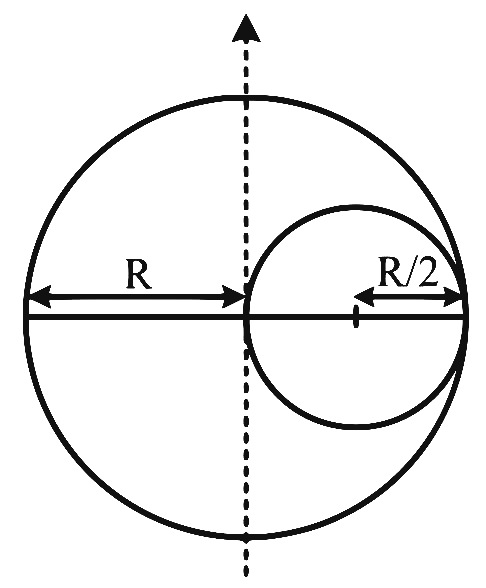 COMEDK 2023 Hard
More PYQs from COMEDK
- A candidate is required to answer 7 questions out of 12 questions which are divided into two groups each containing 6 questions. He is not permitted to attempt more than 5 questions from either group. The number of ways in which he can choose the 7 question isCOMEDK 2023 Medium
- The unit of universal gravitational constant is :COMEDK 2025 Easy
- \(\int \tan ^2\left(5-\dfrac{x}{2}\right) d x=\)COMEDK 2025 Medium
- Match the names of reactions given in Column I with the appropriate reactions given in Column II.
<No. Name of reaction No. Equations representing reactions A Sandmeyer P \(2C_6H_5Cl + Na\) (dry ether) \(\to\) Diphenyl B Fittig Q \(CH_3 - CHBr - CH_3 + AgF \to CH_3 - CHF - CH_3 + AgBr\) C Swarts R \(CH_3 - CH_2 - Br + NaI\) (Acetone) \(\to CH_3 - CH_2 - I + NaBr\) D Finkelstein S \(C_6H_5N_2^+ Cl^- + Cu_2Br_2/HBr \to C_6H_5Br + N_2\) COMEDK 2024 Medium - A transformer which steps down \(330 \mathrm{~V}\) to \(33 \mathrm{~V}\) is to operate a device having impedance \(110 \Omega\). The current drawn by the primary coil of the transformer is :COMEDK 2024 Medium
- Match the reactions in Column I with the correct products given in Column II:
\(\begin{array}{|l|l|l|l|} \hline \text{S.N.} & \text{Column I} & \text{S.No.} & \text{Column II} \\ \hline \text{A} & 1- \text{Chloropropane} + (\mathrm{Zn} / \mathrm{HCl}) \rightarrow & \text{P} & \text{Propanone + Methanal} \\ \hline \text{B} & n- \text{Hexane + (anh.} \left.\mathrm{AlCl}_3 / \mathrm{HCl}_{(\mathrm{g})}\right) \rightarrow & \text{Q} & \text{Propanone} \\ \hline \text{C} & 2- \text{Methylpropene} + ( \left.\mathrm{O}_3 ~\&~ \mathrm{Zn} / \mathrm{H}_2 \mathrm{O}\right) \rightarrow & \text{R} & \text{Propane} \\ \hline \text{D} & \text{Propyne} +\left(\mathrm{HgSO}_4 / \mathrm{H}_2 \mathrm{SO}_4\right. at 333 K) \rightarrow & \text{S} & \text{2-Methylpentane + 3-Methylpentane} \\ \hline \end{array}\)COMEDK 2025 Medium