


COMEDK · Physics · 15. Oscillations
From the equations given below select the correct equation representing the displacement of a particle undergoing a periodic motion. [\(y\) - displacement; a - amplitude \(T\) - Period; \(\omega\) - angular velocity; \(t\)-time]
- A \(y=a \sin \left[\dfrac{\omega \mathrm{t}}{T}\right]\)
- B \(y=a \sin \left[\dfrac{(2 \pi \mathrm{t})}{T}\right]\)
- C \(y=a \sin \left[\dfrac{(2 \pi \omega)}{T}\right]\)
- D \(y=a \omega \sin \left[\dfrac{(2 \pi \mathrm{t})}{T}\right]\)
Answer & Solution
Correct Answer
(B) \(y=a \sin \left[\dfrac{(2 \pi \mathrm{t})}{T}\right]\)
Step-by-step Solution
Detailed explanation
The general equation for the displacement of a particle undergoing simple harmonic motion is given by \(y = a \sin(\omega t + \phi)\), where \(\omega\) is the angular frequency and \(t\) is the time. The relationship between angular frequency \(\omega\) and the time period \(T\)…
See the Complete Solution
Get step-by-step explanations for this and 2.5 Lakh+ more JEE, NEET & CET questions.
- Unlock all solutions
- Practice the full chapter
- Track accuracy across PYQs
4.8 rated on Google Play · 14,000+ reviews
More questions from Physics
- Oxygen is 16 times heavier than hydrogen. Equal volumes of hydrogen and oxygen are mixe(d)The ratio of speed of sound in the mixture to that in hydrogen isCOMEDK 2019 Easy
- The speed of transverse wave in aluminium wire is \(\dfrac{1}{10}\) times the speed of longitudinal wave in the wire. The stress in the wire is (Young's Modulus of \(Al = 10^{10}\) Pa)COMEDK 2026 Medium
- What is the minimum wavelength of radiation required to detect a p-n junction diode made of a semiconductor having band gap 3.3 eV.
[Planck's constant \(h = 6.6 \times 10^{34}\ J.s\)]COMEDK 2026 Medium - A simple pendulum has a period \(T\) inside a lift, when it is stationary. The lift is accelerated upwards with constant acceleration \(a\). The periodCOMEDK 2016 Easy
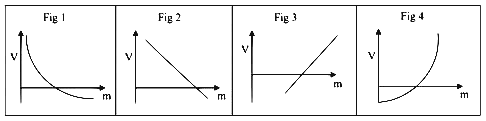
- Which of the following graph shows the variation of velocity with mass for the constant momentum?
 COMEDK 2024 Easy
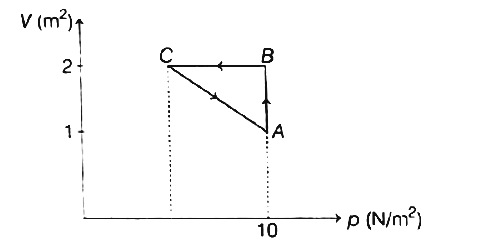
 - An ideal gas is taken through the cycle \(A \to B \to C \to A\), as shown in the figure (assume Volume \(V\) is in \(m^3\)). If the net heat supplied to the gas in the cycle is 5 J, the work done by the gas in the process \(C \to A\) is,
 COMEDK 2022 Medium
More PYQs from COMEDK
- If \(A=\{1,2,3,4\}\), then which one of the following is reflexive?COMEDK 2014 Easy
- A man is moving away from a tower 41.6 m high at a rate of \(2 \mathrm{~m} / \mathrm{s}\). If the eyelevel of the man is 1.6 m above the ground, then the rate at which the angle of elevation of the top of the tower changes, when he is at a distance of 30 m from the foot of the tower isCOMEDK 2025 Medium
- Match the reactions in List I with the final products formed as given in List II.
List I List II W \(\text{C}_6\text{H}_5\text{CH}_3 \xrightarrow{\large{(i)\text{CrO}_3 + (\text{CH}_3\text{CO})_2\text{O};\ (ii)\text{H}_2\text{O} + heat}}\) P \(\text{R}_2\text{CO}\) X \(\text{RCOOC}_2\text{H}_5 \xrightarrow{\large{(i)\text{DIBAL-H};\ (ii)\text{H}_2\text{O}}}\) Q \(\text{C}_6\text{H}_5\text{COCH}_3\) Y \(\text{RCN} \xrightarrow{\large{(i)\text{R-Mg-X /dry ether};\ (ii)\text{H}_3\text{O}^+}}\) R \(\text{C}_6\text{H}_5\text{CHO}\) Z \(\text{C}_6\text{H}_5\text{COCl} + (\text{CH}_3)_2\text{Cd in dry ether} \rightarrow\) S \(\text{RCHO}\) COMEDK 2026 Medium - The ellipse \(\frac{x^{2}}{25}+\frac{y^{2}}{16}=1\) and the hyperbola \(\frac{x^{2}}{25}-\frac{y^{2}}{16}=1\) have in commonCOMEDK 2016 Easy
- \(\text { If }(1-4 i)^3=a+i b \text { then the value of } \mathrm{a} \text { and } \mathrm{b} \text { is }\)COMEDK 2024 Easy
- A cell of emf 5 V and negligible internal resistance is connected across a conducting wire of cross-sectional area \(2 \mathrm{~mm}^2\). If the electron density in the wire is \(5 \times 10^{28}\) and the drift velocity of the electrons is \(0.125 \mathrm{mms}^{-1}\) then the resistance offered by the wire is:COMEDK 2025 Medium