


COMEDK · Physics · 13. Thermodynamics
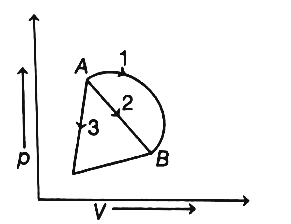
An ideal gas goes from state \(A\) to state \(B\) via three different processes as indicated in the \(p-V\) diagram.
If \(Q_1, Q_2\) and \(Q_3\) indicate the heat absorbed by the three processes and \(\Delta U_1, \Delta U_2\) and \(\Delta U_3\) indicate the change in internal energy along the three processes respectively, then
- A \(Q_1>Q_2>Q_3\) and \(\Delta U_1=\Delta U_2=\Delta U_3\)
- B \(Q_3>Q_2>Q_1\) and \(\Delta U_1=\Delta U_2=\Delta U_3\)
- C \(Q_1=Q_2=Q_3\) and \(\Delta U_1>\Delta U_2>\Delta U_3\)
- D \(Q_3>Q_2>Q_1\) and \(\Delta U_1>\Delta U_2>\Delta U_3\)
Answer & Solution
Correct Answer
(A) \(Q_1>Q_2>Q_3\) and \(\Delta U_1=\Delta U_2=\Delta U_3\)
Step-by-step Solution
Detailed explanation
For all processes 1,2 and 3 Change in internal energy, i.e. \(\begin{gathered} \Delta U=U_B-U_A \\ \therefore \Delta U_1=\Delta U_2=\Delta U_3 \Rightarrow Q=\Delta U+\Delta W \end{gathered}\) Now, \(\Delta W=\) work done by the gas, i.e. area under \(p-V\) curve. As, area…
See the Complete Solution
Get step-by-step explanations for this and 2.5 Lakh+ more JEE, NEET & CET questions.
- Unlock all solutions
- Practice the full chapter
- Track accuracy across PYQs
4.8 rated on Google Play · 14,000+ reviews
More questions from Physics
- Centre of mass of the given system of particles will be at
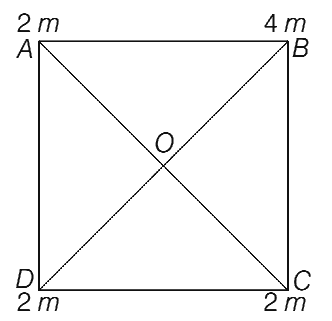 COMEDK 2021 Easy
 - Two vessels A and B contain same mass of Oxygen and Hydrogen respectively at the same temperature. The volume of B is twice that of A. The ratio of gas pressure in A to that in B isCOMEDK 2026 Easy
- If voltage \(V=(200 \pm 8) \mathrm{V}\) and current \(I=(20 \pm 05) \mathrm{A}\), then the percentage error in resistance \(R\) isCOMEDK 2020 Easy
- A light rod of length 1 m is suspended from ceiling horizontally by means of two vertical wires of equal length tied to its ends. One of the wires is made of material X and is of cross-section \(0.1\ \text{cm}^2\) and the other of material Y of cross-section \(0.3\ \text{cm}^2\). A weight is hung from the wire at a point to produce equal strain in the wires. The ratio of Young's moduli of wires A to B is 3:1. The location of the point from one end of the wire isCOMEDK 2026 Medium
- A transformer has 400 turns in its primary winding and 800 turns in its secondary winding. The primary voltage is \(20 \mathrm{~V}\) and the load in the secondary is 4 ohm. The current in the primary, assuming it to be an ideal transformer, isCOMEDK 2024 Medium
- A ray of light incident on one face of an equilateral prism at \(60^{\circ}\) enters and leaves the prism symmetrically. Refractive index of the prism material isCOMEDK 2016 Medium
More PYQs from COMEDK
- The coefficient of \(x^{24}\) in the expansion of \(\left(1-x^5\right)^{10}\) isCOMEDK 2024 Easy
- If \(2\sin\theta = \left(x + \dfrac{1}{x}\right)\), then \(\sin 3\theta + \dfrac{1}{2}\left(x^3 + \dfrac{1}{x^3}\right) =\)COMEDK 2026 Medium
- Solubility product of the sparingly soluble salt \(\mathrm{AgBrO}_3\) in aqueous medium is \(9.3 \times 10^{-10}\) Calculate the mass in gram of \(\mathrm{AgBrO}_3\) present in 100 ml of its saturated solution.
(Molar mass of \(\mathrm{AgBrO}_3\) is \(236 \mathrm{~g} / \mathrm{mol}\) )COMEDK 2025 Medium - A particle on the trough of a wave at any instant will come to the mean position after a time \((T=\) time period \()\)COMEDK 2017 Easy
- An element belonging to chalcogen group isCOMEDK 2015 Easy
- A unit vector perpendicular to both the vectors \(\hat{\mathbf{i}}+\hat{\mathbf{j}}\) and \(\hat{\mathbf{j}}+\hat{\mathbf{k}}\) isCOMEDK 2019 Medium