


COMEDK · Physics · 13. Thermodynamics
An ideal gas goes from state \(A\) to state \(B\) via three different processes as indicated in the \(p\)-\(V\) diagram. If \(Q_1, Q_2\) and \(Q_3\) indicate the heat absorbed by the three processes and \(\Delta U_1, \Delta U_2\) and \(\Delta U_3\) indicate the change in internal energy along the three processes respectively, then
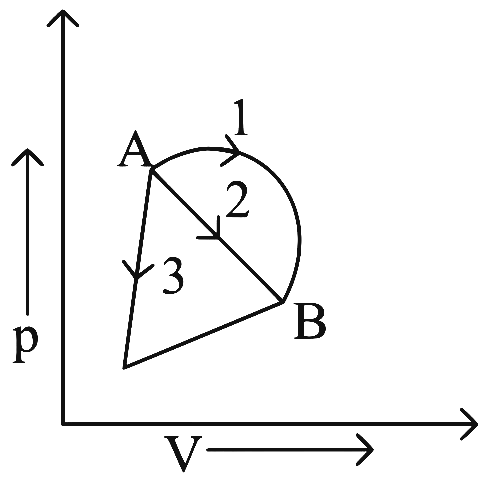
- A \(Q_1 > Q_2 > Q_3\) and \(\Delta U_1=\Delta U_2=\Delta U_3\)
- B \(Q_1=Q_2=Q_3\) and \(\Delta U_1 > \Delta U_2 > \Delta U_3\)
- C \(Q_3 > Q_2 > Q_1\) and \(\Delta U_1=\Delta U_2=\Delta U_3\)
- D \(Q_3 > Q_2 > Q_1\) and \(\Delta U_1 > \Delta U_2 > \Delta U_3\)
Answer & Solution
Correct Answer
(A) \(Q_1 > Q_2 > Q_3\) and \(\Delta U_1=\Delta U_2=\Delta U_3\)
Step-by-step Solution
Detailed explanation
The internal energy of an ideal gas depends only on its temperature, which is a state function. Since all three processes start at state A and end at state B, the change in internal energy \(\Delta U\) is the same for all three paths. Therefore,…
See the Complete Solution
Get step-by-step explanations for this and 2.5 Lakh+ more JEE, NEET & CET questions.
- Unlock all solutions
- Practice the full chapter
- Track accuracy across PYQs
4.8 rated on Google Play · 14,000+ reviews
More questions from Physics
- A wire has a resistance of \(6 \Omega\). It is cut into two parts and both half values are connected in parallel. The new resistance isCOMEDK 2019 Easy
- A galvanometer having a resistance of \(4 \Omega\) is shunted by a wire of resistance \(2 \Omega\). If the total current is \(1.5 \mathrm{~A}\), the current passing through shunt isCOMEDK 2022 Medium
- Two open organ pipes A and B of length \(22 \mathrm{~cm}\) and \(22.5 \mathrm{~cm}\) respectively produce 2 beats per sec when sounded together. The frequency of the shorter pipe isCOMEDK 2023 Medium
- The maximum current that can be measured by a galvanometer of resistance \(40 ~\Omega\), is \(10 \mathrm{~mA}\). It is converted into a voltmeter that can read upto \(50 \mathrm{~V}\). The resistance to be connected in series with the galvanometer (in \(\Omega\) ) isCOMEDK 2013 Easy
- In the head-on collision of two alpha particles \(\alpha_1\) and \(\alpha_2\) with the gold nucleus, the closest approaches are 31.4 fermi and 94.2 fermi respectively. Then the ratio of the energy possessed by the alpha particles \(\alpha_2 / \alpha_1\) is:COMEDK 2023 Medium
- A photon emitted during the de-excitation of electron from a state \(\mathrm{n}\) to the second excited state in a hydrogen atom, irradiates a metallic electrode of work function \(0.5 \mathrm{~eV}\), in a photocell, with a stopping voltage of \(0.47 \mathrm{~V}\). Obtain the value of quantum number of the state '\(n\)'.COMEDK 2024 Medium
More PYQs from COMEDK
- A cell of emf E and internal resistance r is connected to two external resistances \(\mathrm{R_1}\) and \(\mathrm{R_2}\) and a perfect ammeter. The current in the circuit is measured in four different situations:
(a) without any external resistance in the circuit.
(b) with resistance \(\mathrm{R_1}\) only
(c) with \(\mathrm{R_1}\) and \(\mathrm{R_2}\) in series combination.
(d) with \(\mathrm{R_1}\) and \(\mathrm{R_2}\) in parallel combination.
The currents measured in the four cases in ascending order areCOMEDK 2024 Medium - The slope of lines which makes an angle \(60^{\circ}\) with the line \(y-3 x+18=0\)COMEDK 2023 Easy
- The blue colouration obtained from the Lassaigne's test of nitrogen is due to the formation ofCOMEDK 2023 Easy
- The least area of a circle circumscribing any right-angle triangle of area \(\dfrac{9}{\pi}\) sq units isCOMEDK 2025 Medium
- \(\int \dfrac{dx}{x\sqrt{x^2 + 4}} =\)COMEDK 2026 Medium
- A motor bike is moving with a speed of \(36 \mathrm{~km} / \mathrm{h}\) along a straight road. The radius of its wheel and its moment of inertia about the axis of rotation are 40 cm and \(5 \mathrm{~kg} \mathrm{~m}^2\) respectively. What is the magnitude of the torque applied by the brake to the wheel so as to stop the bike in 10 s?COMEDK 2025 Medium