


COMEDK · Physics · 19. Current Electricity
A wire of uniform cross section and resistance 4 ohms is bent in the shape of square ABCD. Point A is connected to a point \(\mathrm{P}\) on DC by a wire AP of resistance \(1 \mathrm{ohm}\). When a potential difference is applied between \(\mathrm{A}\) and \(\mathrm{C}\), the points \(\mathrm{B}\) and \(\mathrm{P}\) are seen to be in same potential. What is the resistance of part \(\mathrm{DP}\) ?
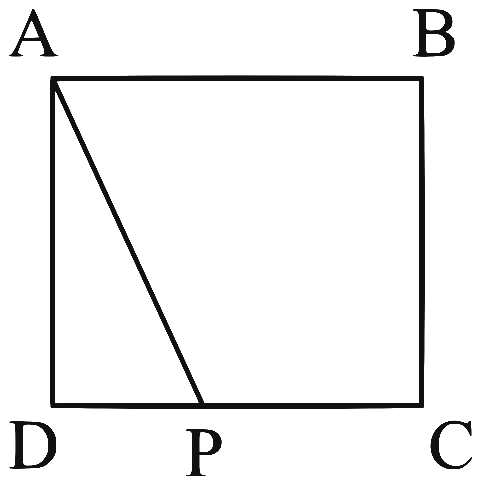
- A 2 Ohm
- B \(\sqrt{2}-1
\) Ohm - C 1 Ohm
- D Zero Ohm
Answer & Solution
Correct Answer
(B) \(\sqrt{2}-1
\) Ohm
Step-by-step Solution
Detailed explanation
Each side of the square has resistance \(\dfrac{4}{4} = 1\ \Omega\). Let \(R_{DP} = x\), so \(R_{PC} = 1-x\). Since B and P are at the same potential, the A-P section resistance equals the P-C section resistance (by symmetry of the voltage divider). From A to P: direct wire AP…
See the Complete Solution
Get step-by-step explanations for this and 2.5 Lakh+ more JEE, NEET & CET questions.
- Unlock all solutions
- Practice the full chapter
- Track accuracy across PYQs
4.8 rated on Google Play · 14,000+ reviews
More questions from Physics
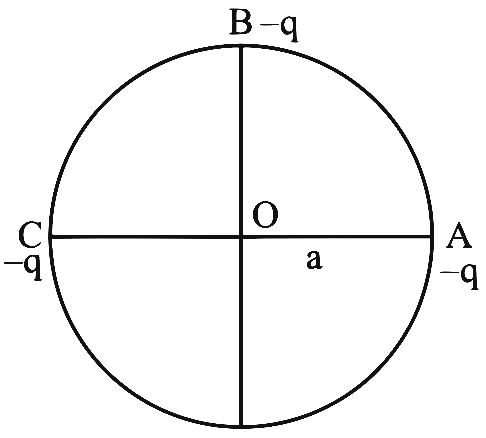
- 3 point charges each of \(-\mathrm{q}\) are placed on the circumference of a circle of diameter \(2 \mathrm{a}\) at \(\mathrm{A}, \mathrm{B}\) and \(\mathrm{C}\) respectively as shown in figure. The electric field at \(\mathrm{O}\) is
 COMEDK 2024 Medium
 - Two very long, straight, parallel wires carry steady currents I and 2I respectively. The distance between the wires is d. At a certain instant of time, a point charge q is at a point equidistant from the two wires, in the plane of the wires. Its instantaneous velocity is v perpendicular to this plane. The magnitude of the force due to the magnetic field acting on the charge at this instant isCOMEDK 2025 Medium
- With what minimum acceleration can a fireman slide down a rope while breaking strength of the rope is \(\dfrac{2}{3}\) of the weight?COMEDK 2022 Easy
- A parallel plated capacitor has area \(2 \mathrm{~m}^{2}\) separated by 3 dielectric slabs. Their relative permittivity is \(2,3,6\) and thickness is \(0.4 \mathrm{~mm}\), \(0.6 \mathrm{~mm}, 1.2 \mathrm{~mm}\), respectively. The capacitance isCOMEDK 2015 Medium
- A uniformly charged conducting sphere of 0.2 m diameter has a surface charge density of \(70 \mu \mathrm{Cm}^{-2}\). The electric flux leaving the surface of the sphere is:COMEDK 2025 Medium
- A coin is placed on a disc rotating with an angular velocity \(\omega\). The co-efficient of friction between the disc and the coin is \(\mu\). The maximum distance of the coin from the centre of the disc up to which it will rotate with the disc isCOMEDK 2025 Medium
More PYQs from COMEDK
- \(5.8 \mathrm{~g}\) of a gas maintained at \(95^{\circ} \mathrm{C}\) occupies the same volume as \(0.368 \mathrm{~g}\) of hydrogen gas maintained at a temperature of \(17^{\circ} \mathrm{C}\) and pressure being the same atmospheric pressure for both the gases. What is the molecular mass of the unknown gas?COMEDK 2023 Medium
- If \(p=3^{\frac{1}{3}} \cdot 3^{\frac{2}{9}} \cdot 3^{\frac{3}{27}} \ldots \infty\), then \(p^{\frac{4}{3}}=\)COMEDK 2012 Medium
- \(\text { The rate of change of the volume of a sphere with respect to its surface area } \mathrm{S} \text { is }\)COMEDK 2024 Medium
- Molarity of a given orthophosphoric acid solution is \(3 \mathrm{M}\). It's normality isCOMEDK 2020 Easy
- A fish in water (refractive index \(n\) ) looks at a bird vertically above in the air. If \(y\) is the height of the bird and \(x\) is the depth of the fish from the surface, then the distance of the bird as estimated by the fish isCOMEDK 2023 Medium
- Choose the correct statement applicable for the reaction: \(2 \mathrm{H}_{2} \mathrm{O}+2 \mathrm{~F}_{2} \rightarrow 4 \mathrm{HF}+\mathrm{O}_{2}\)COMEDK 2015 Medium