


COMEDK · Physics · 17. Electrostatics
A uniformly charged solid sphere of radius \(\mathrm{R}\) has potential \(\mathrm{V}_0\) (measured with respect to infinity) on its surface. For this sphere the equipotential surfaces with potentials \(\dfrac{3 \mathrm{~V}_0}{2}, \dfrac{\mathrm{V}_0}{1}, \dfrac{3 \mathrm{~V}_0}{4}\) and \(\dfrac{\mathrm{V}_0}{4}\) have radius \(\mathrm{R}_1, \mathrm{R}_2, \mathrm{R}_3\) and \(\mathrm{R}_4\) and respectively, then
- A \(R _2< R_4\)
- B \(R_1 \neq 0 \text { and }\left(R_2-R_1\right)>\left(R_4-R_3\right)\)
- C \(R_1=0 \text { and } R_2>\left(R_4-R_3\right)\)
- D \(R_1=0 \text { and } R_2<\left(R_4-R_3\right)\)
Answer & Solution
Correct Answer
(D) \(R_1=0 \text { and } R_2<\left(R_4-R_3\right)\)
Step-by-step Solution
Detailed explanation
The potential \(V(r)\) of a uniformly charged solid sphere of radius \(R\) and total charge \(Q\) is given by: \(V(r) = \dfrac{kQ}{R} = V_0\) for \(r \le R\) \(V(r) = \dfrac{kQ}{r}\) for \(r > R\) Given \(V(R) = V_0\), we have \(V_0 = \dfrac{kQ}{R}\). For \(r \le R\), the…
See the Complete Solution
Get step-by-step explanations for this and 2.5 Lakh+ more JEE, NEET & CET questions.
- Unlock all solutions
- Practice the full chapter
- Track accuracy across PYQs
4.8 rated on Google Play · 14,000+ reviews
More questions from Physics
- Which of the following technique is not used for measuring small time intervals?COMEDK 2021 Easy
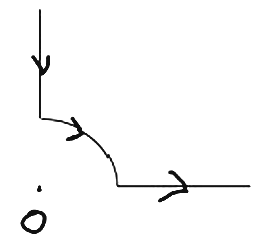
- A straight wire carrying current of 21 A is bent into an arc of radius 11 cm as shown below. The magnetic field produced by the current at the centre \(O\) of the arc is:
 COMEDK 2025 Medium
 - A stone dropped from the top of the tower reaches ground in \(4 \mathrm{~s}\). Height of the tower is \(\left(g=10 \mathrm{~m} / \mathrm{s}^{2}\right)\)COMEDK 2016 Easy
- In a Young's double slit experiment, the slits are separated by 0.5 mm. Fringes are obtained on a screen which is placed at distance 1 m away from the slits. When the screen is moved 7 cm farther away, the fringe width changes by 63 \(\mu\)m. The wavelength of light used in the experiment will be:COMEDK 2026 Medium
- The refractive index of a particular material is \(1.67\) for blue light, \(1.65\) for yellow light and 1.63 for red light. The dispersive power of the material isCOMEDK 2019 Medium
- A force \(F\) applied on the wire of radius \(r\) and length \(L\) and change in the length of the wire is l. If the same force \(F\) is applied on the wire of the same material and radius \(4 r\) and length \(4 l\), then change in length of the other wire is,COMEDK 2022 Medium
More PYQs from COMEDK
- \(S \equiv x^2+y^2+2 x+3 y+1=0\) and
\(S^{\prime} \equiv x^2+y^2+4 x+3 y+2=0\) are two circles.
The point \((-3,-2)\) liesCOMEDK 2022 Easy - Ozone in stratosphere is depleted byCOMEDK 2023 Easy
- While falling through the air, twenty seven droplets having the same radius 1 mm and terminal velocity \(10 \mathrm{cms}^{-1}\) combine to form a single drop. What is the terminal velocity of the single bigger drop?COMEDK 2025 Medium
- The \(\mathrm{pH}\) of boiling water is \(6.4\). This implies that boiling water isCOMEDK 2012 Easy
- The nucleus of oxygen atom contains 8 protons and 8 neutrons. What is the mass defect in amu?
[Given Mass of proton \(=1.00727\) amu Mass of neutron \(=1.00866 \mathrm{amu}\) and the mass of oxygen nucleus \(=15.99053 \mathrm{amu}\).]COMEDK 2025 Medium - Mohr's salt has the formulaCOMEDK 2023 Easy