


COMEDK · Physics · 27. Dual Nature of Matter
A particle of mass \(2 \mathrm{mg}\) has the same wavelength as a neutron moving with a velocity of \(3 \times 10^5 \mathrm{~ms}^{-1}\). The velocity of the particle is (mass of neutron is \(1.67 \times 10^{-27} \mathrm{Kg}\))
- A \(1.5 \times 10^{-13} \mathrm{~ms}^{-1}\)
- B \(2.5 \times 10^{-16} \mathrm{~ms}^{-1}\)
- C \(1.5 \times 10^{-16} \mathrm{~ms}^{-1}\)
- D \(2.5 \times 10^{-13} \mathrm{~ms}^{-1}\)
Answer & Solution
Correct Answer
(B) \(2.5 \times 10^{-16} \mathrm{~ms}^{-1}\)
Step-by-step Solution
Detailed explanation
The de Broglie wavelength \(\lambda\) is given by the relation \(\lambda = \dfrac{h}{mv}\). Since the particle and the neutron have the same wavelength, we have \(\lambda_{p} = \lambda_{n}\), which implies \(m_{p} v_{p} = m_{n} v_{n}\). Given values are: Mass of particle…
See the Complete Solution
Get step-by-step explanations for this and 2.5 Lakh+ more JEE, NEET & CET questions.
- Unlock all solutions
- Practice the full chapter
- Track accuracy across PYQs
4.8 rated on Google Play · 14,000+ reviews
More questions from Physics
- Heavy water isCOMEDK 2019 Easy
- In Young's double slit experiment, the ratio of maximum and minimum intensities in the fringe system is \(9: 1\). The ratio of amplitudes of coherent sources isCOMEDK 2023 Easy
- \(220 \mathrm{~V}\) ac is more dangerous than \(220 \mathrm{~V}\) dc Why?COMEDK 2023 Easy
- Two vessels A and B contain same mass of Oxygen and Hydrogen respectively at the same temperature. The volume of B is twice that of A. The ratio of gas pressure in A to that in B isCOMEDK 2026 Easy
- A rectangular coil of \(300\) turns has an average area of \(25 \mathrm{~cm} \times 10 \mathrm{~cm}\). The coil rotates with a speed of \(50 \mathrm{~cps}\) in uniform magnetic field of strength \(4 \times 10^{-2} \mathrm{~T}\) about an axis perpendicular to the field. The peak value of the induced emf \((\) in \(\mathrm{V})\) isCOMEDK 2013 Hard
- Potential energy of 2 charge \(10 \mathrm{nC}\) each separated by a distance of \(0.09 \mathrm{~m}\) in air isCOMEDK 2016 Easy
More PYQs from COMEDK
- Which of the following is incorrect?COMEDK 2023 Medium
- A magnet \(N-S\) is suspended from a spring and when it oscillates, the magnet moves in and out of the coil \(C\). The coil is connected to a galvanometer \(G\), then as the magnet oscillates
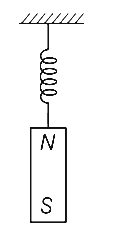
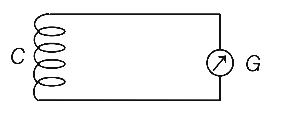 COMEDK 2013 Easy
 - When a certain metal surface is illuminated with light of frequency \(\nu\), the stopping potential for photoelectric current is \(V_0\). When the same surface is illuminated by light of frequency \(\dfrac{\nu}{2}\), the stopping potential is \(\dfrac{V_0}{4}\). The threshold frequency for photoelectric emission isCOMEDK 2023 Medium
- The non-existence of \(\mathrm{PbI}_{4}\) and \(\mathrm{PbBr}_{4}\) is due toCOMEDK 2014 Medium
- The probability that a randomly chosen number from one to twelve is a divisor of twelve isCOMEDK 2024 Easy
- Let \(K_1\) be the maximum kinetic energy of photoelectrons emitted by light of wavelength \(\lambda_1\) and \(K_2\) corresponding to wavelength \(\lambda_2\). If \(\lambda_1=2 \lambda_2\), thenCOMEDK 2023 Easy