


COMEDK · Physics · 8. Rotational Motion
A motor bike is moving with a speed of \(36 \mathrm{~km} / \mathrm{h}\) along a straight road. The radius of its wheel and its moment of inertia about the axis of rotation are 40 cm and \(5 \mathrm{~kg} \mathrm{~m}^2\) respectively. What is the magnitude of the torque applied by the brake to the wheel so as to stop the bike in 10 s?
- A \(12.5 \mathrm{~kg} \mathrm{~m}^2 \mathrm{~s}^{-2}\)
- B \(0.125 \mathrm{~kg} \mathrm{~m}^2 \mathrm{~s}^{-2}\)
- C \(125 \mathrm{~kg} \mathrm{~m}^2 \mathrm{~s}^{-2}\)
- D \(1.25 \mathrm{~kg} \mathrm{~m}^2 \mathrm{~s}^{-2}\)
Answer & Solution
Correct Answer
(A) \(12.5 \mathrm{~kg} \mathrm{~m}^2 \mathrm{~s}^{-2}\)
Step-by-step Solution
Detailed explanation
The speed of the motorbike is \(v = 36 \text{ km/h} = 36 \times \dfrac{5}{18} \text{ m/s} = 10 \text{ m/s}\). The radius of the wheel is \(r = 40 \text{ cm} = 0.4 \text{ m}\). The angular velocity of the wheel is \(\omega = \dfrac{v}{r} = \dfrac{10}{0.4} = 25 \text{ rad/s}\).…
See the Complete Solution
Get step-by-step explanations for this and 2.5 Lakh+ more JEE, NEET & CET questions.
- Unlock all solutions
- Practice the full chapter
- Track accuracy across PYQs
4.8 rated on Google Play · 14,000+ reviews
More questions from Physics
- The dimensional formula for inductance isCOMEDK 2013 Easy
- A proton accelerated through a potential \(V\) has de-Broglie wavelength \(\lambda\). Then, the de-Broglie wavelength of an \(\alpha\)-particle, when accelerated through the same potential \(V\) isCOMEDK 2020 Easy
- The electric flux from cube of side \(1 \mathrm{~m}\) is '\(\Phi\)' When the side of the cube is made \(3 \mathrm{~m}\) and the charge enclosed by the cube is made one third of the original value, then the flux from the bigger cube will be :COMEDK 2023 Easy
- A thin circular ring of mass \(M\) and radius \(R\) rotates about an axis through its centre and perpendicular to its plane, with a constant angular velocity \(\omega\). Four small spheres each of mass \(m\) (negligible radius) are kept gently to the opposite ends of two mutually perpendicular diameters of the ring. The new angular velocity of the ring will beCOMEDK 2023 Easy
- A ray of light passing from glass to water is incident on the glass-water interface at \(65^{\circ}\). If the critical angle for the pair of media is \(63^{\circ}\).COMEDK 2012 Hard
- \(220 \mathrm{~V}\) ac is more dangerous than \(220 \mathrm{~V}\) dc Why?COMEDK 2023 Easy
More PYQs from COMEDK
- If \(A=\{1,2,3,4\}\), then which one of the following is reflexive?COMEDK 2014 Easy
- If \(x=a t+b t^{2}\), where \(x\) is measured in metre and \(t\) in second, then the dimension of \((b / a)\) isCOMEDK 2012 Easy
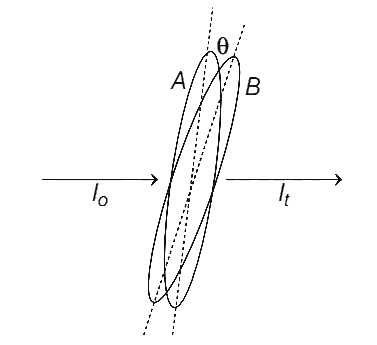
- Two polaroid \(A\) and \(B\) are kept with their transmission axes at an angle \(\theta\) with respect to one another. If the transmitted intensity of light \(I_{t}=0.75 I_{0}\), where \(I_{0}\) is the intensity of light incident on the system, then \(\theta\) is
 COMEDK 2012 Medium
 - Given are 4 statements related to the chemical properties of Glucose.
Identify the two incorrect statements from the following.
A. It reacts with \(\mathrm{Br}_2\) (aq) to form Saccharic acid.
B. Reacts with Acetic anhydride to form Glucose tetraacetate.
C. Reacts with Hydroxylamine to give Glucose oxime.
D. It reacts with ammoniacal \(\mathrm{AgNO}_3\) to form ammonium salt of Gluconic acid with deposition of silver.COMEDK 2024 Medium - Area of the ellipse \(\frac{x^{2}}{25}+\frac{y^{2}}{16}=1\) is given byCOMEDK 2012 Easy
- If \((x - a)^2 + (y - b)^2 = c^2\), where a, b, c are some constants, \(c > 0\) then \(\dfrac{\left[1 + \left(\dfrac{dy}{dx}\right)^2\right]^{\dfrac{3}{2}}}{\dfrac{d^2y}{dx^2}}\) is dependent on:COMEDK 2024 Medium