


COMEDK · Physics · 3. Motion In One Dimension
A body is projected vertically upwards. The times corresponding to height \(h\) while ascending and while descending are \(t_1\) and \(t_2\), respectively. Then, the velocity of projection will be (take, \(g\) as acceleration due to gravity)
- A \(g \dfrac{t_1 t_2}{\left(t_1+t_2\right)}\)
- B \(\dfrac{g \sqrt{t_1 t_2}}{2}\)
- C \(g \sqrt{t_1 t_2}\)
- D \(\dfrac{g\left(t_1+t_2\right)}{2}\)
Answer & Solution
Correct Answer
(D) \(\dfrac{g\left(t_1+t_2\right)}{2}\)
Step-by-step Solution
Detailed explanation
Let \(u\) be the velocity of projection. The equation of motion for a body at height \(h\) is given by \(h = ut - \dfrac{1}{2}gt^2\). Rearranging the terms, we get a quadratic equation in \(t\): \(\dfrac{1}{2}gt^2 - ut + h = 0\). The roots of this equation are \(t_1\) and…
See the Complete Solution
Get step-by-step explanations for this and 2.5 Lakh+ more JEE, NEET & CET questions.
- Unlock all solutions
- Practice the full chapter
- Track accuracy across PYQs
4.8 rated on Google Play · 14,000+ reviews
More questions from Physics
- A cell of emf E and internal resistance r is connected to two external resistances \(\mathrm{R_1}\) and \(\mathrm{R_2}\) and a perfect ammeter. The current in the circuit is measured in four different situations:
(a) without any external resistance in the circuit.
(b) with resistance \(\mathrm{R_1}\) only
(c) with \(\mathrm{R_1}\) and \(\mathrm{R_2}\) in series combination.
(d) with \(\mathrm{R_1}\) and \(\mathrm{R_2}\) in parallel combination.
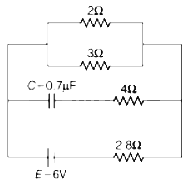
The currents measured in the four cases in ascending order areCOMEDK 2024 Medium - In the circuit shown, the internal resistance of the cell is negligible. The steady state current in the \(2 \Omega 2\) resistor is
 COMEDK 2019 Easy
 - The speeds of air-flow on the upper and lower surfaces of a wing of an aeroplane \(arefv_1\) and \(v_2\), respectively. If \(A\) is the cross-sectional area of the wing and \(\rho\) is the density of air, then the upward lift isCOMEDK 2023 Easy
- A string vibrates with a frequency of \(200 \mathrm{~Hz}\). When its length is doubled and tension is altered, it begins to vibrate with a frequency of \(300 \mathrm{~Hz}\). The ratio of the new tension to the original tension isCOMEDK 2018 Easy
- A rectangular coil of 250 turns has an average area of \(20 \mathrm{~cm} \times 15 \mathrm{~cm}\). The coil rotates with a speed of 60 cycles per second in a uniform magnetic field of \(2 \times 10^{-2} \mathrm{~T}\) about an axis perpendicular to the field. The peak value of the induced emf is:COMEDK 2025 Medium
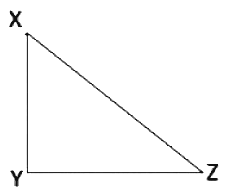
- A current carrying closed loop in the form of a right isosceles triangle XYZ is placed in a uniform magnetic field \(B\) acting along \(X Y\) of the loop. If the magnetic force on the \(\operatorname{arm} Y Z\) is \(\sqrt{2} F\), then the force on the arm \(X Z\) is:
 COMEDK 2025 Medium
More PYQs from COMEDK
- A particle starts from rest and moves along the x -axis with a velocity that varies as \(\mathrm{v}=\sqrt{100+4 x} \mathrm{~ms}^{-1}\). The acceleration of the particle is:COMEDK 2025 Medium
- What is the frequency ' \(v\) ' of the electron in Bohr's first orbit of radius ' \(r\) ' of the hydrogen atom?COMEDK 2025 Medium
- A photodiode fabricated from lead Selenide \([\mathrm{PbSe}]\) has a band gap energy of 0.27 eV . What is the wavelength of the signal the photodiode can detect?COMEDK 2025 Medium
- If \(A=\left[\begin{array}{lll}1 & 1 & 1 \\ 1 & 2 & 3 \\ 1 & 3 & 4\end{array}\right], B=\left[\begin{array}{c}7 \\ 16 \\ 22\end{array}\right], X=\left[\begin{array}{c}x \\ y \\ z\end{array}\right]\) and \(A X=B\), then \(z\) is equal toCOMEDK 2012 Easy
- The second derivative of \(\sin 3x \cos 5x\) is:COMEDK 2026 Medium
- An electric field and magnetic field \(1.8 \times 10^4\ Vm^{-1}\) and \(6 \times 10^{-3}\ T\) respectively are applied simultaneously on an electron beam such that path of the beam remains undeviated, then the speed of the electron will be:COMEDK 2026 Easy