


COMEDK · Maths · 16. Limits
\(\lim _{x \rightarrow 0}\left(\frac{1+5 x^{2}}{1+3 x^{2}}\right)^{\frac{1}{x^{2}}}=\)
- A \(e^{2}\)
- B \(e\)
- C \(\frac{1}{e}\)
- D \(\frac{5}{3}\)
Answer & Solution
Correct Answer
(A) \(e^{2}\)
Step-by-step Solution
Detailed explanation
\(\lim _{x \rightarrow 0}\left(\frac{1+5 x^{2}}{1+3 x^{2}}\right)^{\frac{1}{x^{2}}}\) \(=\lim _{x \rightarrow 0} \frac{\left(1+5 x^{2}\right)^{\frac{1}{5 x^{2}} \cdot 5}}{\left(1+3 x^{2}\right)^{\frac{1}{3 x^{2}}} \cdot 3}=\frac{e^{5}}{e^{3}}=e^{5-3}=e^{2}\)
See the Complete Solution
Get step-by-step explanations for this and 2.5 Lakh+ more JEE, NEET & CET questions.
- Unlock all solutions
- Practice the full chapter
- Track accuracy across PYQs
4.8 rated on Google Play · 14,000+ reviews
More questions from Maths
- The circles \(a x^{2}+a y^{2}+2 g_{1} x+2 f_{1} y+c_{1}=0\) and \(b x^{2}+b y^{2}+2 g_{2} x+2 f_{2} y+c_{2}=0\) \((a \neq 0\) and \(b \neq 0)\) cut orthogonally ifCOMEDK 2016 Medium
- The co-axial system of circles given by \(x^{2}+y^{2}+2 g x+c=0\) for \(c < 0\) representsCOMEDK 2013 Hard
- If \(a, b, c\) are real numbers and \(\omega\) is a complex cube root of unity such that \(a+b \omega+c \omega^{2}=0\), thenCOMEDK 2017 Medium
- The solution of the differential equation \(\dfrac{d y}{d x}+y \log y \cot x=0\) isCOMEDK 2025 Medium
- The value of \(\dfrac{\sin ^2 20^{\circ}+\cos ^4 20^{\circ}}{\sin ^4 20^{\circ}+\cos ^2 20^{\circ}}\) isCOMEDK 2025 Easy
- The solution of the differential equation \(\dfrac{d y}{d x}+y \cos x=\dfrac{1}{2} \sin 2 x\)COMEDK 2023 Medium
More PYQs from COMEDK
- On treatment of glucose with bromine water the product formed isCOMEDK 2022 Medium
- Waxes are esters ofCOMEDK 2017 Medium
- \(\int \tan ^2\left(5-\dfrac{x}{2}\right) d x=\)COMEDK 2025 Medium
-
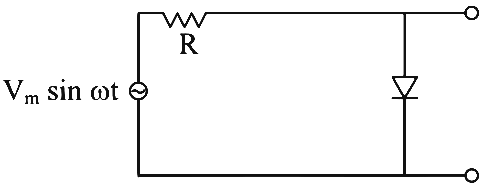
The output of the given circuit is
A. Negatively rectified half wave
B. Positively rectified half wave
C. Negatively rectified full wave
D. Zero all timesCOMEDK 2024 Medium - The value of \(\int_{-2}^{2}\left(a x^{3}+b x+c\right) d x\) depends on theCOMEDK 2018 Easy
- A compound is formed by elements \(A\) and \(B\). This crystallises in the cubic structure, where the \(A\) atoms are at the corners of the cube and \(B\) atoms are at the body centres.COMEDK 2017 Easy