


COMEDK · Maths · 28. Indefinite Integration
\(\text { The value of } \int \dfrac{1}{x+\sqrt{x-1}} d x \text { is }\)
- A \(\log (x+\sqrt{x-1})+C\)
- B \(\log (x+\sqrt{x-1})+\sin ^{-1}\left(\sqrt{\dfrac{x-1}{x}}\right)+C\)
- C \(\log (x-1+\sqrt{x-1})+\dfrac{1}{\sqrt{3}} \log \left|\dfrac{x-2-\sqrt{3}}{x-2+\sqrt{3}}\right|+C\)
- D \(\log (x+\sqrt{x-1})-\dfrac{2}{\sqrt{3}} \tan ^{-1}\left(\dfrac{2 \sqrt{x-1}+1}{\sqrt{3}}\right)+C\)
Answer & Solution
Correct Answer
(D) \(\log (x+\sqrt{x-1})-\dfrac{2}{\sqrt{3}} \tan ^{-1}\left(\dfrac{2 \sqrt{x-1}+1}{\sqrt{3}}\right)+C\)
Step-by-step Solution
Detailed explanation
Let \(I = \int \dfrac{1}{x + \sqrt{x-1}} dx\). Substitute \(t^2 = x - 1\), so \(x = t^2 + 1\) and \(dx = 2t dt\). The integral becomes \(I = \int \dfrac{2t}{t^2 + 1 + t} dt = \int \dfrac{2t}{t^2 + t + 1} dt\). Rewrite the numerator as \(2t + 1 - 1\):…
See the Complete Solution
Get step-by-step explanations for this and 2.5 Lakh+ more JEE, NEET & CET questions.
- Unlock all solutions
- Practice the full chapter
- Track accuracy across PYQs
4.8 rated on Google Play · 14,000+ reviews
More questions from Maths
- A card is picked at random from a pack of cards. Given that the picked card is a queen, what is the probability that it is a spade?COMEDK 2014 Easy
- For real numbers \(x\) and \(y, x R y \Leftrightarrow x-y+\sqrt{2}\) is an irrational number. Then the relation R is:COMEDK 2025 Medium
- If the sum of \(4^{\text {th }}\) and \(7^{\text {th }}\) term of an AP is 31 and sum of first two term is 7 then find the \(10^{\text {th }}\) term of \(A P\) isCOMEDK 2024 Easy
- Evaluate : \(\cos ^{-1}\left[\cos \left(-680^{\circ}\right)\right]+\sin ^{-1}\left[\sin \left(-600^{\circ}\right)\right]-\cos ^{-1}\left(\sin 270^{\circ}\right)\)COMEDK 2024 Medium
- Let the line \(L_1\) be a line passing through the point \((0, -6)\) and making an angle of \(150^\circ\) with the positive \(x\)–axis. Then the equation of a line \(L_2\) parallel to \(L_1\) and crossing the \(y\)–axis 2 units below the origin is:COMEDK 2026 Easy
- Which of the following transformations reduce the differential equation \(\dfrac{d z}{d x}+\dfrac{z}{x} \log z=\dfrac{z}{x^2}(\log z)^2\) into the form \(\dfrac{d u}{d x}+P(x) u=Q(x)\)COMEDK 2025 Medium
More PYQs from COMEDK
- Across the 220 V source of internal resistance \(20 \Omega\), how many lamps of \(40 \mathrm{~W}, 100 \mathrm{~V}\) can be connected in parallel so that all the lamps may glow with full brightness.COMEDK 2025 Medium
- If \(A=\left[\begin{array}{ll}1 & 2 \\ 0 & 1\end{array}\right]\), then \(A^{n}\) isCOMEDK 2018 Easy
- What should be the inductance of an inductor connected to \(200 \mathrm{~V}, 50 \mathrm{~Hz}\) source so that the maximum current of \(\sqrt{2}\) A flows through it?COMEDK 2023 Easy
- Identify the product formed when the following reaction occurs.
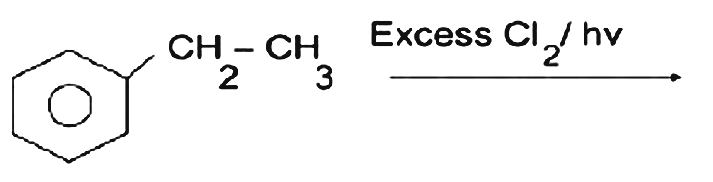
?COMEDK 2025 Medium - A cell of emf \(2 \mathrm{~V}\) is connected with a load of resistance \(1.5 \Omega\). The power delivered by the cell to the load is maximum, then power transferred to the load isCOMEDK 2022 Easy
- A small current carrying loop of area \(A\) behaves like a tiny magnet of magnetic moment \(M\). Current in the loop isCOMEDK 2016 Easy