


COMEDK · Maths · 32. Differential Equations
The solution of the differential equation \(\left(1+y^{2}\right)+\left(x-e^{\tan ^{-1} y}\right) \dfrac{d y}{d x}=0\) is
- A \(2 x e^{\tan ^{-1} y}=e^{2 \tan ^{-1} y}+C\)
- B \(x e^{\tan ^{-1} y}=\tan ^{-1} y+C\)
- C \(x e^{2 \tan ^{-1} y}=e^{\tan ^{-1} y}+C\)
- D \((x-2)=C e^{-\tan ^{-1} y}\)
Answer & Solution
Correct Answer
(A) \(2 x e^{\tan ^{-1} y}=e^{2 \tan ^{-1} y}+C\)
Step-by-step Solution
Detailed explanation
The given differential equation is \((1+y^{2}) + (x - e^{\tan^{-1} y}) \dfrac{dy}{dx} = 0\). Rearranging the terms, we get \((x - e^{\tan^{-1} y}) \dfrac{dy}{dx} = -(1+y^{2})\). Taking the reciprocal,…
See the Complete Solution
Get step-by-step explanations for this and 2.5 Lakh+ more JEE, NEET & CET questions.
- Unlock all solutions
- Practice the full chapter
- Track accuracy across PYQs
4.8 rated on Google Play · 14,000+ reviews
More questions from Maths
- In the group \(G=\{1,5,7,11\}\) under multiplication modulo 12, the solution of \(7^{-1} \underset{12}{\times}(x \underset{12}{12} 11)=5\) is \(x=\)COMEDK 2016 Hard
- The angle between the vectors \(a=2 \hat{\mathbf{i}}+\hat{\mathbf{j}}+\hat{\mathbf{k}}\) and \(b=\hat{\mathbf{i}}-2 \hat{\mathbf{j}}+\hat{\mathbf{k}}\) isCOMEDK 2024 Easy
- Consider an infinite geometric series with first term '\(a\)' and common ratio '\(r\)'.
If the sum of infinite geometric series is 4 and the second term is \(\dfrac{3}{4}\) thenCOMEDK 2024 Medium - Let \(f(x)=5+(2 x-3)^{\frac{4}{3}}\), then the minimum value of \(f(x)\) isCOMEDK 2024 Easy
- Equation of a circle whose area is 154 sq units and having \(2 x-3 y+12=0\) and \(x+4 y-5=0\) as diameters isCOMEDK 2025 Medium
- The domain of the function
\(f(x)=\log (1-x)+\sqrt{x^{2}-1}\)COMEDK 2012 Easy
More PYQs from COMEDK
- Coefficient of variation of two distributions are 60 and 70 , and their standard deviation are 21 and 16 respectively. What are their arithmetic means?COMEDK 2014 Medium
- While shuffling a pack of cards, 3 cards were accidently dropped, then find the probability that the missing cards belong to different suits?COMEDK 2024 Medium
- The value of \(\alpha(\neq 0)\) for which the function \(f(x)=1+\alpha x\) is the inverse of itself isCOMEDK 2018 Easy
- A thin plano-convex lens acts like a concave mirror of focal length \(0.2 \mathrm{~m}\) when silvered from its plane surface. The refractive index of the material of the lens is \(1.5\). The radius of curvature of the convex surface of the lens will beCOMEDK 2019 Hard
- Which of the following is a singleton set?COMEDK 2023 Easy
- Two statements, One Assertion [A ] and the other Reason [ R ] are given. Identify the correct option Assertion [A]: The decreasing order of the acidic character of the following is \(\mathrm{B}>\mathrm{D}>\mathrm{A}>\mathrm{C}\)
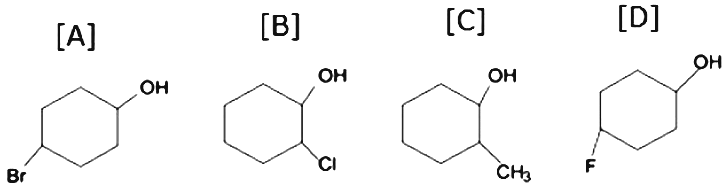
Reason \([\mathrm{R}]\) : Fluorine has larger -I effect than Cl and Br .COMEDK 2025 Medium