


COMEDK · Maths · 32. Differential Equations
The general solution of the differential equation \(\left(\frac{d y}{d x}\right)+y \cdot g^{\prime}(x)=g(x) \cdot g^{i}(x)\), where \(g(x)\) is a given function of \(x\) is
- A \(g(x)+\log (1+y+g(x))=c\)
- B \(g(x)+\log (1+y-g(x))=c\)
- C \(g(x)-\log (1+y-g(x))=c\)
- D \(g(x)-\log (1-y+g(x))=c\)
Answer & Solution
Correct Answer
(B) \(g(x)+\log (1+y-g(x))=c\)
Step-by-step Solution
Detailed explanation
Given, differential equation is \[ \frac{d y}{d x}+y \cdot g^{\prime}(x)=g(x) \cdot g^{\prime}(x) \] This is in the form of linear differential equation. So, \(\quad \mathrm{IF}=e^{\int g^{\prime}(x) d x}=e^{g(x)}\) Required solution is…
See the Complete Solution
Get step-by-step explanations for this and 2.5 Lakh+ more JEE, NEET & CET questions.
- Unlock all solutions
- Practice the full chapter
- Track accuracy across PYQs
4.8 rated on Google Play · 14,000+ reviews
More questions from Maths
- \(\int_{-\dfrac{\pi}{2}}^{\dfrac{\pi}{2}} \cos x d x\)COMEDK 2022 Easy
- Consider the lines \(L_1\) and \(L_2\) given by the following vector equations:
\(L_1: \vec{r} = (\hat{i} + \hat{j} - \hat{k}) + \lambda(3\hat{i} + t\hat{j})\) \(L_2: \vec{r} = (4\hat{i} + a\hat{j} - \hat{k}) + \mu(2\hat{i} + 3\hat{k})\)
If \(a = -2\) and the lines intersect, then the value of 't' is:COMEDK 2026 Medium - The ellipse \(\frac{x^{2}}{25}+\frac{y^{2}}{16}=1\) and the hyperbola \(\frac{x^{2}}{25}-\frac{y^{2}}{16}=1\) have in commonCOMEDK 2016 Easy
- Area of the ellipse \(\frac{x^{2}}{25}+\frac{y^{2}}{16}=1\) is given byCOMEDK 2012 Easy
- The equation of a plane passing through the line of intersection of the planes \(x+2 y+3 z=2\), \(x-y+z=3\) and at a distance \(\dfrac{2}{\sqrt{3}}\) from the point \((3,1,-1)\) isCOMEDK 2021 Medium
- If the direction ratios of two lines are given by \(3 l m-4 l n+m n=0\) and \(l+2 m+3 n=0\), then the angle between the lines isCOMEDK 2023 Hard
More PYQs from COMEDK
- Which of the following is the simplest form of the expression \(\tan^{-1}\left(\dfrac{\sqrt{1+x^2} - 1}{x}\right)\) where \(x \neq 0\)COMEDK 2026 Medium
- The total number of numbers greater than 1000 but less than 4000 that can be formed using 0,2,3,4 (using repetition allowed) areCOMEDK 2023 Easy
- A current of 1.5 A is passed for 2 hours through an aqueous solution of \(\mathrm{Pd} \mathrm{X}_{\mathrm{n}}\) where X is a monovalent anion. During the electrolysis process 2.977 g of Palladium metal gets deposited at the cathode. Calculate the charge on Pd ions. (Atomic mass of Pd \(=106.4 \mathrm{~g} / \mathrm{mol}\) ).COMEDK 2025 Medium
- Two radioactive materials \(X_{1}\) and \(X_{2}\) have decay constant \(5 \lambda\) and \(\lambda\), respectively. If initially they have the same number of nuclei, then the ratio of the number of nuclei of \(X_{1}\) to that \(X_{2}\) will be \(1 / e\) after a timeCOMEDK 2020 Medium
- The electric flux for Gaussian surface \(A\) that enclose the charged particles in free space is (Given, \(q_{1}=-14 \mathrm{nC}, q_{2}=78.85 \mathrm{nC}, q_{3}=-56 \mathrm{nC}\) )
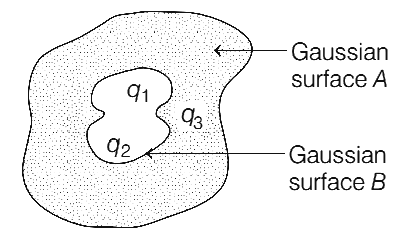 COMEDK 2017 Medium
 - Select the unit of the coefficient of mutual induction from the following.COMEDK 2024 Easy