


COMEDK · Maths · 24. Functions
The function \(f: X \rightarrow Y\) defined by \(f(x)=\sin x\) is one-one but not onto if \(X\) and \(Y\) are respectively, is equal to
- A \(\left[\frac{-\pi}{2}, \frac{\pi}{2}\right]\) and \([-1,1]\)
- B \(\left[0, \frac{\pi}{2}\right]\) and \([-, 1,1]\)
- C \([0, \pi]\) and \([0,1]\)
- D \(R\) and \(R\)
Answer & Solution
Correct Answer
(B) \(\left[0, \frac{\pi}{2}\right]\) and \([-, 1,1]\)
Step-by-step Solution
Detailed explanation
We have, \(f: X \rightarrow Y\) \(X:\) domain and \(Y\) : codomain In one-one function, \(x_{1} \neq x_{2}\) \(f\left(x_{1}\right) \neq f\left(x_{2}\right)\) In onto function, Range \(=\) domain . \(f(x)=\sin x\) So, if \(X=\left[0, \frac{\pi}{2}\right]\) and \(Y=[-1,1]\) For…
See the Complete Solution
Get step-by-step explanations for this and 2.5 Lakh+ more JEE, NEET & CET questions.
- Unlock all solutions
- Practice the full chapter
- Track accuracy across PYQs
4.8 rated on Google Play · 14,000+ reviews
More questions from Maths
- The direction ratios of the vector \((\hat{i} + \hat{j}) \times (\hat{j} + \hat{k})\) areCOMEDK 2026 Easy
- Middle term of the expansion \(\left(x^2+\frac{1}{x^2}+2\right)^n\) isCOMEDK 2024 Easy
- \(11^{3}+12^{3}+13^{3}+\ldots . .+20^{3}\) isCOMEDK 2015 Medium
- The angle between the lines \(2 x=3 y=-z\) and \(6 x=-y=-4 z\) isCOMEDK 2021 Easy
- What is \(\dfrac{\cos \theta}{1-\tan \theta}+\dfrac{\sin \theta}{1-\cot \theta}\) equal to?COMEDK 2022 Easy
- If a number \(n\) is chosen at random from the set \(\{11,12,13, \ldots \ldots, 30\}\). Then, the probability that \(n\) is neither divisible by 3 nor divisible by 5 , isCOMEDK 2023 Medium
More PYQs from COMEDK
- During a chemical reaction \(\mathrm{X} \rightarrow \mathrm{Y}\), the rates of reaction starting with initial concentrations of X as \(4.0 \times 10^{-3} \mathrm{M}\) and \(2.0 \times 10^{-3} \mathrm{M}\) are \(4.8 \times 10^{-4} \mathrm{~mol} \mathrm{~L}^{-1} / \mathrm{s}\) and \(1.2 \times 10^{-4} \mathrm{~mol} \mathrm{~L}^{-1} / \mathrm{s}\) respectively. What is the order of reaction with respect to X ?COMEDK 2025 Medium
- \(A B C\) is a triangle with \(\angle A=30^{\circ}\) and \(B C=10 \mathrm{~cm}\). The area of the circum circle of the triangle is
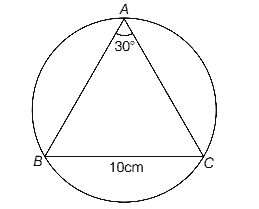 COMEDK 2020 Hard
 - The length of the tangent drawn from any point on the circle \(x^{2}+y^{2}-4 x+6 y-4=0\) to the circle \(x^{2}+y^{2}-4 x+6 y=0\) isCOMEDK 2018 Easy
- The acceleration due to gravity at pole and equator can be related asCOMEDK 2024 Easy
- The area enclosed by the curve \(y = -x^2\) and the line \(x + y + 2 = 0\) isCOMEDK 2026 Medium
- The sum of all 4-digit numbers that can be formed by using the digits \(2,4,6,8\) (repetition of digits is not allowed) isCOMEDK 2017 Hard