


COMEDK · Maths · 36. Probability
Suppose we have three cards identical in form except that both sides of the first card are coloured red, both sides of the second are coloured black, and one side of the third card is coloured red and the other side is coloured black.
The three cards are mixed and a card is picked randomly. If the upper side of the chosen card is coloured red, what is the probability that the other side is coloured black.
- A \(\dfrac{1}{2}\)
- B \(\dfrac{1}{6}\)
- C \(\dfrac{1}{3}\)
- D 0
Answer & Solution
Correct Answer
(C) \(\dfrac{1}{3}\)
Step-by-step Solution
Detailed explanation
Let \(C_1\) be the card with both sides red, \(C_2\) be the card with both sides black, and \(C_3\) be the card with one side red and one side black. There are a total of 6 sides: \(R_1, R_2\) (from \(C_1\)), \(B_1, B_2\) (from \(C_2\)), and \(R_3, B_3\) (from \(C_3\)). The…
See the Complete Solution
Get step-by-step explanations for this and 2.5 Lakh+ more JEE, NEET & CET questions.
- Unlock all solutions
- Practice the full chapter
- Track accuracy across PYQs
4.8 rated on Google Play · 14,000+ reviews
More questions from Maths
- If \(y=\tan ^{-1}(\sec x-\tan x)\), then \(\frac{d y}{d x}\) is equal toCOMEDK 2013 Medium
- The general solution of \(\left(\frac{d y}{d x}\right)^2=1-x^2-y^2+x^2 y^2\) isCOMEDK 2023 Medium
- The feasible region corresponding to the linear constraints of a Linear Programming problem is given below.
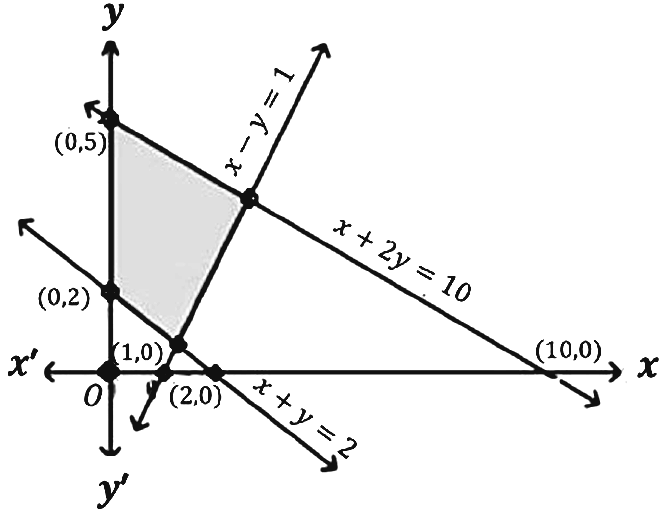
Which of the following is NOT a constraint to the given LPPCOMEDK 2025 Medium - Which of the following functions is differentiable at \(x=0\) ?COMEDK 2018 Medium
- The solution of
\((x+y)^{2}\left(x \frac{d y}{d x}+y\right)=x y\left(1+\frac{d y}{d x}\right)\) isCOMEDK 2014 Hard - The tangent and the normal drawn to the curve \(y=x^{2}-x+4\) at \(P(1,4)\) cut the \(X\)-axis at \(A\) and \(B\) respectively. If the length of the subtangent drawn to the curve at \(P\) is equal to the length of the subnormal, then the area of the \(\triangle P A B\) in square units is,COMEDK 2016 Medium
More PYQs from COMEDK
- Let \(K_1\) be the maximum kinetic energy of photoelectrons emitted by light of wavelength \(\lambda_1\) and \(K_2\) corresponding to wavelength \(\lambda_2\). If \(\lambda_1=2 \lambda_2\), thenCOMEDK 2023 Medium
- The potential energies associated with four orientations of an electric dipole in an electric field are
(i) \(-5 U_{0}\)
(ii) \(-7 U_{0}\)
(iii) \(3 U_{0}\)
(iv) \(5 U_{0}\)
where \(U_{0}\) is positive. Rank the orientations according to the angle between the electric dipole moment \(\mathbf{p}\) and electric field \(\mathbf{E}\), greatest firstCOMEDK 2020 Hard - Curie-Weiss law is obeyed by ironCOMEDK 2013 Easy
- If an electron in hydrogen atom jumps from an orbit of level \(n=3\) to an orbit at level \(n=2\), emitted radiation has a frequency of ( \(R=\) Rydberg's constant and \(c=\) velocity of light)COMEDK 2021 Hard
- A parallel plate capacitor has a capacity \(C\). The separation between the plates is doubled and a dielectric medium is inserted between the plates. If the capacity is \(3 C\), then the dielectric constant of the medium will beCOMEDK 2015 Medium
- The non-existence of \(\mathrm{PbI}_{4}\) and \(\mathrm{PbBr}_{4}\) is due toCOMEDK 2014 Medium