


COMEDK · Maths · 5. Sequences and Series
\(\sum_{n=1}^m n \cdot n\) ! is equal to
- A \(m !-1\)
- B \((m-1) !-1\)
- C \((m+1) !-1\)
- D \(m !(m-1) !\)
Answer & Solution
Correct Answer
(C) \((m+1) !-1\)
Step-by-step Solution
Detailed explanation
The given sum is \(S = \sum_{n=1}^{m} n \cdot n!\). Observe that the general term can be written as \(n \cdot n! = (n+1-1) \cdot n! = (n+1) \cdot n! - n!\). Since \((n+1) \cdot n! = (n+1)!\), the term becomes \((n+1)! - n!\). The summation is a telescoping series:…
See the Complete Solution
Get step-by-step explanations for this and 2.5 Lakh+ more JEE, NEET & CET questions.
- Unlock all solutions
- Practice the full chapter
- Track accuracy across PYQs
4.8 rated on Google Play · 14,000+ reviews
More questions from Maths
- Middle term in the expansion of \(\left(x^{2}+\dfrac{1}{x^{2}}+2\right)^{n}\) isCOMEDK 2021 Hard
- If \(f(x)=\left\{\begin{array}{lc}x^2+1 & x \lt 0 \\ x^3-a & 0 \leq x \lt 1 \text { and it is continuous } \\ 2 b-x & x \geq 1\end{array}\right.\) \(\forall x \in R\), thenCOMEDK 2024 Easy
- The derivative of \(\sin \left(x^{3}\right)\) w.r.t. \(\cos \left(x^{3}\right)\) isCOMEDK 2019 Medium
- If \(z=\sqrt{3}+i\), then the argument of \(z^2 e^{z-i}\) is equal toCOMEDK 2023 Medium
- A bag contans white balls and red balls. balls are drawn one by one randomly from the bag with replacement. If X be the number of white balls drawn, then is equal toCOMEDK 2022 Medium
- The area enclosed by the curve \(y = -x^2\) and the line \(x + y + 2 = 0\) isCOMEDK 2026 Medium
More PYQs from COMEDK
- Diamond is considered as an insulator becauseCOMEDK 2025 Easy
- The non-adjacent vertex in the graph is
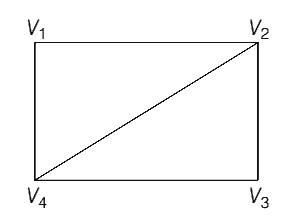 COMEDK 2012 Easy
 - Which of the following is a subgroup of the group \(G=\{1,2,3,4,5,6\}\) under \(\otimes 7 ?\)COMEDK 2012 Easy
- \(100 \mathrm{~mL}\) of \(\frac{N}{5} \mathrm{HCl}\) was added to \(1 \mathrm{~g}\) of pure \(\mathrm{CaCO}_{3}\). What would remain after the reaction?COMEDK 2012 Hard
- One mole of which of the following has the highest entropy?COMEDK 2017 Medium
- Let the population of a species of birds surviving at a time '\(t\)' be governed by the differential equation \(\dfrac{dp}{dt} - p = -100\). If \(p(0) = 50\), then \(p(-\log_e 2)\) is equal toCOMEDK 2026 Medium