


COMEDK · Maths · 7. Binomial Theorem
In the expansion of \(\left(1+3 x+3 x^2+x^3\right)^{2 n}\), the term which has greatest binomial coefficient, is
- A \((3 n-1)\) th term
- B \((3 n+1)\) th term
- C \((3 n+2)\) th term
- D \((3 n)\) th term
Answer & Solution
Correct Answer
(B) \((3 n+1)\) th term
Step-by-step Solution
Detailed explanation
The given expression is \(\left(1+3x+3x^2+x^3\right)^{2n}\). Recognizing the binomial expansion, \(1+3x+3x^2+x^3 = (1+x)^3\). Substituting this into the expression, we get \(((1+x)^3)^{2n} = (1+x)^{6n}\). The expansion of \((1+x)^{6n}\) is given by…
See the Complete Solution
Get step-by-step explanations for this and 2.5 Lakh+ more JEE, NEET & CET questions.
- Unlock all solutions
- Practice the full chapter
- Track accuracy across PYQs
4.8 rated on Google Play · 14,000+ reviews
More questions from Maths
- Let the population of a species of birds surviving at a time '\(t\)' be governed by the differential equation \(\dfrac{dp}{dt} - p = -100\). If \(p(0) = 50\), then \(p(-\log_e 2)\) is equal toCOMEDK 2026 Medium
- If \(c_{0}, c_{1}, c_{2}, \ldots, c_{n}\) are binomial coefficients of order \(n\), then the value of \(\frac{c_{1}}{2}+\frac{c_{2}}{4}+\frac{c_{3}}{6}+\ldots\)COMEDK 2018 Easy
- The expression \(\frac{1}{\sqrt{(3 x+1)}}\left[\left(\frac{1+\sqrt{3 x+1}}{2}\right)^{7}-\left(\frac{1-\sqrt{3 x+1}}{2}\right)^{7}\right]\) is a polynomial in \(x\) of degreeCOMEDK 2015 Hard
- The number of real roots of the equation
\(x^{4}+\sqrt{x^{4}+20}=22\) isCOMEDK 2014 Easy - The domain of the function \(y=\dfrac{1}{\log _{10}(3-x)}+\sqrt{x+7}\) isCOMEDK 2024 Medium
- A graph \(G\) has \(m\) vertices of odd degree and ' \(n\) ' vertices of even degree. Then which of the following statements is necessarily true?COMEDK 2020 Easy
More PYQs from COMEDK
- A cell of emf \(2 \mathrm{~V}\) is connected with a load of resistance \(1.5 \Omega\). The power delivered by the cell to the load is maximum, then power transferred to the load isCOMEDK 2022 Easy
- The main product obtained when a solution of sodium carbonate reacts with mercuric chloride isCOMEDK 2016 Medium
- A plano-convex lens made of refractive index 1.5 and having radius of curvature \(\mathrm{R}=4 \mathrm{~cm}\) fits exactly into a plano-concave lens made of refractive index 1.3 and having the same radius of curvature \(\mathrm{R}=4 \mathrm{~cm}\) such that their plane surfaces are parallel to each other. The focal length of the combination is:COMEDK 2025 Medium
- Which of the following is correct in the case of the Bohr model of atoms?
A. Predicts continuous emission spectra for all atoms
B. Assumes that the angular momentum of electrons is quantised
C. Predicts same emission spectrum for singly ionised neon atom and hydrogen atom
D. Predicts same emission spectrum for singly ionised neon atom and singly ionised helium atomCOMEDK 2025 Easy - When a body falls in air, the resistance of air depends to a great extent on the shape of the body. Three different shapes are given
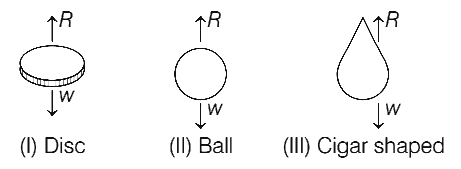
Identify the combination of air resistances which truly represents the physical situation. (The cross-sectional areas are the same.)COMEDK 2017 Medium - Identify the correct coefficients (a), (b), (c) and (d) in the following equations
i) \(\quad \mathrm{x} \mathrm{MnO}_4^{-}+\)(a) \(\mathrm{SO}_3{ }^{2-}+\) (b) \(\mathrm{H}^{+} \longrightarrow \mathrm{x} \mathrm{Mn}^{2+}+\) (a) \(\mathrm{SO}_4{ }^{2-}+\) (c) \(\mathrm{H}_2 \mathrm{O}\)
ii) (c) \(\mathrm{S}_2 \mathrm{O}_3{ }^{2-}+\) (d) \(\mathrm{MnO}_4{ }^{-}+\mathrm{H}_2 \mathrm{O} \rightarrow\) (d) \(\mathrm{MnO}_2+\) (b) \(\mathrm{SO}_4{ }^{2-}+\mathrm{x} \mathrm{OH}^{-}\)COMEDK 2025 Hard