


COMEDK · Maths · 26. Differentiation
If \(y=\sin ^{2}\left(\tan ^{-1} \sqrt{\frac{1-x^{2}}{1+x^{2}}}\right)\), then \(\frac{d y}{d x}=\)
- A \(x\)
- B \(-x\)
- C 1
- D \(-1\)
Answer & Solution
Correct Answer
(B) \(-x\)
Step-by-step Solution
Detailed explanation
We have, \(y=\sin ^{2}\left[\tan ^{-1} \sqrt{\frac{1-x^{2}}{1+x^{2}}}\right]\)…
See the Complete Solution
Get step-by-step explanations for this and 2.5 Lakh+ more JEE, NEET & CET questions.
- Unlock all solutions
- Practice the full chapter
- Track accuracy across PYQs
4.8 rated on Google Play · 14,000+ reviews
More questions from Maths
- The ten's digit in
\(1 !+4 !+7 !+10 !+12 !+13 !+15 !+16 !+17 !\) is divisible byCOMEDK 2019 Hard - If \(f(x)=\left\{\begin{array}{cl}\frac{1-\cos x}{x} & x \neq 0 \\ k & x=0\end{array}\right.\) is continuous at \(x=0,\), then the value of \(k\) isCOMEDK 2013 Easy
- If \({ }^{\mathrm{n}+2} \mathrm{C}_8:{ }^{\mathrm{n}-2} \mathrm{P}_4=57: 16\), then ' n ' isCOMEDK 2025 Medium
- If a tangent to the curve \(y=6 x-x^{2}\) is parallel to the line \(4 x-2 y-1=0\), then the point of tangency on the curve isCOMEDK 2013 Easy
- Evaluate the value of \((1.02)^8\) using binomial theorem up to two decimal places.COMEDK 2025 Medium
- The value of \(\dfrac{1}{2 \sin 10^{\circ}}-2 \sin 70^{\circ}\) isCOMEDK 2025 Medium
More PYQs from COMEDK
- Which of the following is not a characteristic of chemisorption?COMEDK 2013 Easy
- The maximum value of \(P=500 x+400 y\) for the given constraints \(x+y \leq 200, \quad x \geq 20, \quad y \geq 4 x, \quad y \geq 0\) isCOMEDK 2024 Medium
- If \(\left(\frac{3}{2}+i \frac{\sqrt{3}}{2}\right)^{50}=3^{25}(x+i y)\), where \(x\) and \(y\) are real, then the ordered pair \((2 x, 2 y)\) isCOMEDK 2023 Medium
- In how many ways can the squares of a \(4 \times 2\) grid (4 rows and 2 columns) be filled with the letters of the word 'SPHERE' such that each row contains at least one letter?COMEDK 2026 Medium
- A wire of uniform cross section and resistance 4 ohms is bent in the shape of square ABCD. Point A is connected to a point \(\mathrm{P}\) on DC by a wire AP of resistance \(1 \mathrm{ohm}\). When a potential difference is applied between \(\mathrm{A}\) and \(\mathrm{C}\), the points \(\mathrm{B}\) and \(\mathrm{P}\) are seen to be in same potential. What is the resistance of part \(\mathrm{DP}\) ?
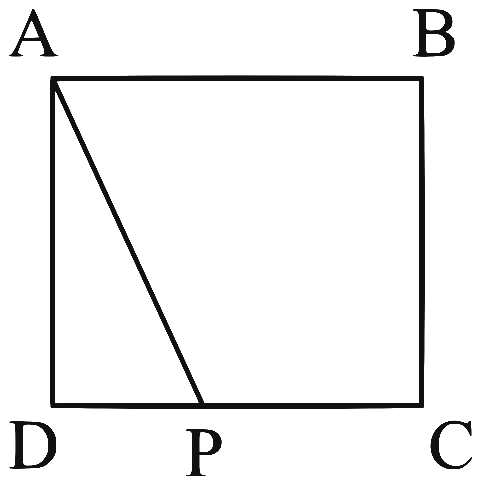 COMEDK 2024 Medium
 - If \(A=\left[\begin{array}{ccc}1 & -1 & 1 \\ 2 & 1 & -3 \\ 1 & 1 & 1\end{array}\right], 10 B=\left[\begin{array}{ccc}4 & 2 & 2 \\ -5 & 0 & \alpha \\ 1 & -2 & 3\end{array}\right]\) a is the inverse of \(A\), then the value of \(\alpha\) isCOMEDK 2020 Medium