


COMEDK · Maths · 5. Sequences and Series
If \(y=\tan ^{-1}\left(\frac{1}{1+x+x^{2}}\right)+\tan ^{-1}\left(\frac{1}{x^{2}+3 x+3}\right)\) \(+\tan ^{-1}\left(\frac{1}{x^{2}+5 x+7}\right)+\ldots+\) upto \(n\) terms then \(\frac{d y}{d x}\) at \(x=0\) and \(n=1\) is equal to
- A \(\frac{1}{2}\)
- B \(-\frac{1}{2}\)
- C 0
- D \(\frac{1}{3}\)
Answer & Solution
Correct Answer
(B) \(-\frac{1}{2}\)
Step-by-step Solution
Detailed explanation
We have, \[ \begin{aligned} &y=\tan ^{-1}\left(\frac{1}{1+x(x+1)}\right)+ \\ &\tan ^{-1}\left(\frac{1}{1+(x+2)(x+3)}\right)+\ldots \\ &\tan ^{-1}\left(\frac{1}{1+(x+1)(x+2)}\right)+ \\ &+\tan ^{-1}\left(\frac{1}{1+(x+n-1)(x+n)}\right) \end{aligned} \] When \(n=1\), then…
See the Complete Solution
Get step-by-step explanations for this and 2.5 Lakh+ more JEE, NEET & CET questions.
- Unlock all solutions
- Practice the full chapter
- Track accuracy across PYQs
4.8 rated on Google Play · 14,000+ reviews
More questions from Maths
- Maximum value of \(z=12 x+3 y\), subject to constraints \(x \geq 0, y \geq 0, x+y \leq 5\) and \(3 x+y \leq 9\) isCOMEDK 2022 Medium
- Which of the following transformations reduce the differential equation \(\dfrac{d z}{d x}+\dfrac{z}{x} \log z=\dfrac{z}{x^2}(\log z)^2\) into the form \(\dfrac{d u}{d x}+P(x) u=Q(x)\)COMEDK 2025 Medium
- If \(|\mathrm{a}|=8,|\mathrm{b}|=3\) and \(|\mathrm{a} \times \mathrm{b}|=12\), then find the angle between \(\mathrm{a}\) and \(\mathrm{b}\).COMEDK 2021 Easy
- The shaded region in the Venn diagram represents
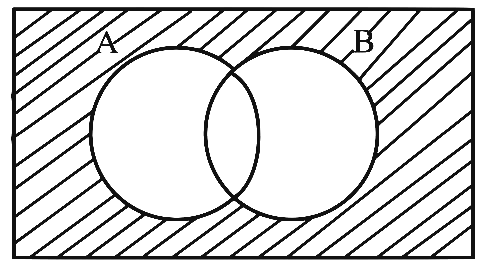 COMEDK 2024 Easy
 - If \(A=\{1,2,5,6\}\) and \(B=\{1,2,3\}\), then \((A \times B) \cap(B \times A)\) is equal toCOMEDK 2021 Easy
- If \(f(x)=\log _{x^{2}}(\log x)\), then \(f^{\prime}(x)\) at \(x=e\) isCOMEDK 2015 Easy
More PYQs from COMEDK
- The place \(x-2 y+z=0\) is parallel to the lineCOMEDK 2023 Medium
- A sonometer wire of length 80 cm and a tuning fork sounded together produces 5 beats per second. The same number of beats per second is produced when the length of the wire is increased to 85 cm . What is the frequency of the tuning fork?COMEDK 2025 Medium
- The mass of oxygen gas which occupies \(5.6 \mathrm{~L}\) at STP would beCOMEDK 2015 Easy
- \(\text { If } x, y, z \text { are non zero real numbers, then inverse of matrix } A=\left[\begin{array}{lll}
x & 0 & 0 \\
0 & y & 0 \\
0 & 0 & z
\end{array}\right] \text { is }\)COMEDK 2024 Easy - The ratio of the coefficient of \(x^3\) to the term independent of \(x\) in the expansion of \(\left(2 x+\dfrac{1}{x^2}\right)^{12}\) isCOMEDK 2025 Medium
- \(\mathrm{CH}_{3}-\mathrm{CN} \stackrel{\mathrm{Na}_{2} \mathrm{C}_{5} \mathrm{OH}}{\longrightarrow} A \stackrel{\mathrm{HNO}_{2}}{\longrightarrow} B \underset{573 \mathrm{~K}}{\stackrel{\mathrm{Cu}}{\longrightarrow}} C\) here \(C\) isCOMEDK 2014 Hard