


COMEDK · Maths · 21. Matrices
\(\text { If } x, y, z \text { are non zero real numbers, then inverse of matrix } A=\left[\begin{array}{lll}
x & 0 & 0 \\
0 & y & 0 \\
0 & 0 & z
\end{array}\right] \text { is }\)
- A \(x y z\left[\begin{array}{ccc}
1 / x & 0 & 0 \\
0 & 1 / y & 0 \\
0 & 0 & 1 / z
\end{array}\right]\) - B \(\dfrac{1}{x y z}\left[\begin{array}{lll}
1 & 0 & 0 \\
0 & 1 & 0 \\
0 & 0 & 1
\end{array}\right]\) - C \(\dfrac{1}{x y z}\left[\begin{array}{lll}
x & 0 & 0 \\
0 & y & 0 \\
0 & 0 & z
\end{array}\right]\) - D \(\left[\begin{array}{ccc}
1 / x & 0 & 0 \\
0 & 1 / y & 0 \\
0 & 0 & 1 / z
\end{array}\right]\)
Answer & Solution
Correct Answer
(D) \(\left[\begin{array}{ccc}
1 / x & 0 & 0 \\
0 & 1 / y & 0 \\
0 & 0 & 1 / z
\end{array}\right]\)
Step-by-step Solution
Detailed explanation
The given matrix is a diagonal matrix \(A = \text{diag}(x, y, z) = \begin{bmatrix} x & 0 & 0 \\ 0 & y & 0 \\ 0 & 0 & z \end{bmatrix}\). For a diagonal matrix \(A = \text{diag}(a_1, a_2, a_3)\), the inverse \(A^{-1}\) is given by \(\text{diag}(1/a_1, 1/a_2, 1/a_3)\), provided all…
See the Complete Solution
Get step-by-step explanations for this and 2.5 Lakh+ more JEE, NEET & CET questions.
- Unlock all solutions
- Practice the full chapter
- Track accuracy across PYQs
4.8 rated on Google Play · 14,000+ reviews
More questions from Maths
- For all \(n \in N, 2 \cdot 4^{2 n+1}+3^{3 n+1}\) is divisible byCOMEDK 2017 Medium
- If \(
\left[\begin{array}{lll}
1 & x & 1
\end{array}\right]\left[\begin{array}{ccc}
1 & 3 & 2 \\
2 & 5 & 1 \\
15 & 3 & 2
\end{array}\right]\left[\begin{array}{l}
1 \\
2 \\
x
\end{array}\right]=[0]
\) then x is equal toCOMEDK 2024 Medium - The differential equation of \(y=a e^{b x+c}\) isCOMEDK 2017 Easy
- The solution of the differential equation
\(y \dfrac{d y}{d x}=x\left[\dfrac{y^{2}}{x^{2}}+\dfrac{\phi\left(\dfrac{y^{2}}{x^{2}}\right)}{\phi^{\prime}\left(\dfrac{y^{2}}{x^{2}}\right)}\right]\) is
(where, \(C\) is a constant)COMEDK 2021 Hard - \(\int \frac{\left(x^{3}+3 x^{2}+3 x+1\right)}{(x+1)^{5}} d x=\)COMEDK 2016 Medium
- Evaluate \(i^{2024}+i^{2025}+i^{2026}+i^{2027}\) (where \(i=\sqrt{-1})\)COMEDK 2024 Easy
More PYQs from COMEDK
- In an entrance test, there are multiple choice questions. There are four possible answers to each question of which only one is correct. The probability that a student knows the answer to a question is \(90 \%\). If he gets the correct answer to a question, then the probability that he was guessing isCOMEDK 2025 Medium
- An organic compound is boiled with alcoholic potash. The product is cooled and acidified with HCl. A white solid separates out. The starting compound may beCOMEDK 2016 Medium
- A simple pendulum has a period \(T\) inside a lift, when it is stationary. The lift is accelerated upwards with constant acceleration \(a\). The periodCOMEDK 2016 Easy
- If \(y=\cos ^{2} \frac{3 x}{2}-\sin ^{2} \frac{3 x}{2}\), then \(\frac{d^{2} y}{d x^{2}}\) isCOMEDK 2020 Medium
- When current in an inductance is changed at a uniform rate from 15 A to 30 A in 3 s, the self-induced emf in the coil is 25 V. The change in energy of the coil during this process is:COMEDK 2025 Easy
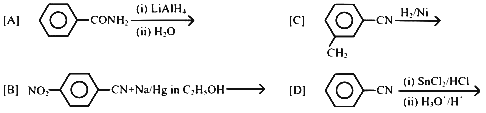
- One of the reactions A, B, C, D given below yields a product which will not answer Hinsberg's test when reacted with Benzene sulphonyl chloride. Identify the reaction.
 COMEDK 2024 Medium