


COMEDK · Maths · 27. Application of Derivatives
If the length of the diagonal of a square is increasing at the rate of \(0.1 \mathrm{~cm} / \mathrm{sec}\).
What is the rate of increase of its area when the side is \(\dfrac{15}{\sqrt{2}} \mathrm{~cm}\) ?
- A \(3 \mathrm{~cm}^2 / \mathrm{sec}\)
- B \(1.5 \mathrm{~cm}^2 / \mathrm{sec}\)
- C \(3 \sqrt{2} \mathrm{~cm}^2 / \mathrm{sec}\)
- D \(0.15 \mathrm{~cm}^2 / \mathrm{sec}\)
Answer & Solution
Correct Answer
(B) \(1.5 \mathrm{~cm}^2 / \mathrm{sec}\)
Step-by-step Solution
Detailed explanation
Let \(a\) be the side length and \(d\) be the diagonal of the square. The relationship between the diagonal and the side is \(d = a\sqrt{2}\), which implies \(a = \dfrac{d}{\sqrt{2}}\). The area \(A\) of the square is given by \(A = a^2\). Substituting…
See the Complete Solution
Get step-by-step explanations for this and 2.5 Lakh+ more JEE, NEET & CET questions.
- Unlock all solutions
- Practice the full chapter
- Track accuracy across PYQs
4.8 rated on Google Play · 14,000+ reviews
More questions from Maths
- If \(\sin \theta, \cos \theta\) and \(\tan \theta\) are in \(\mathrm{GP}\), then \(\cot ^{6} \theta-\cot ^{2} \theta\) isCOMEDK 2018 Easy
- \(\text { If }(1-4 i)^3=a+i b \text { then the value of } \mathrm{a} \text { and } \mathrm{b} \text { is }\)COMEDK 2024 Easy
- What must be the matrix \(X\) if \(2 X+\left[\begin{array}{ll}1 & 2 \\ 3 & 4\end{array}\right]=\left[\begin{array}{ll}3 & 8 \\ 7 & 2\end{array}\right] ?\)COMEDK 2013 Easy
- The radius of the circle passing through the point \((6,2)\) and two of whose diameters are \(x+y=6\) and \(x+2 y=4\) isCOMEDK 2013 Easy
- In the group \(G=\{1,5,7,11\}\) under multiplication modulo 12, the solution of \(7^{-1} \underset{12}{\times}(x \underset{12}{12} 11)=5\) is \(x=\)COMEDK 2016 Hard
- In the group \(Q-\{1\}\) under the binary operation * defined by \(a * b=a+b+a b\) the inverse of 10 isCOMEDK 2018 Easy
More PYQs from COMEDK
- Which of the following represents the Lewis structure of \(\mathrm{N}_{2}\) molecule?COMEDK 2018 Medium
- Speed of electromagnetic wave in a medium having relative permittivity \(\varepsilon_r\) and relative permeability \(\mu_r\) is (speed of light in air, \(\left.c=3 \times 10^8 \mathrm{~m} / \mathrm{s}\right)\)COMEDK 2022 Easy
- What is the minimum wavelength of radiation required to detect a p-n junction diode made of a semiconductor having band gap 3.3 eV.
[Planck's constant \(h = 6.6 \times 10^{34}\ J.s\)]COMEDK 2026 Medium - The electric flux from cube of side \(1 \mathrm{~m}\) is '\(\Phi\)' When the side of the cube is made \(3 \mathrm{~m}\) and the charge enclosed by the cube is made one third of the original value, then the flux from the bigger cube will be :COMEDK 2023 Easy
- Match the structures in Column I with their correct IUPAC names in Column II.
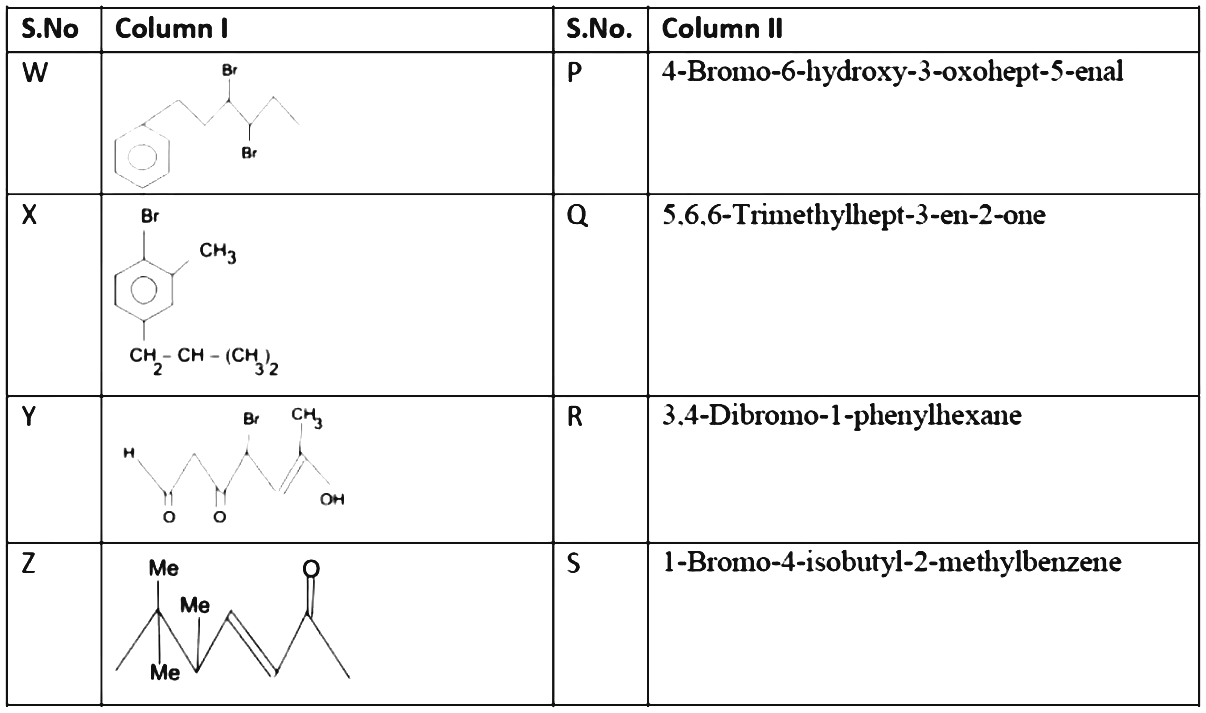 COMEDK 2025 Medium
 - In a set of reactions, bromoethane yielded a final product 'S'.

The compound 'S' should beCOMEDK 2024 Medium