


COMEDK · Maths · 21. Matrices
If \(A=\dfrac{1}{\pi}\left[\begin{array}{cc}\sin ^{-1} \dfrac{1}{2} & \tan ^{-1} \dfrac{x}{\pi} \\ \sin ^{-1} \dfrac{x}{\pi} & \cot ^{-1} \sqrt{3}\end{array}\right] \quad B=\dfrac{1}{\pi}\left[\begin{array}{cc}-\cos ^{-1} \dfrac{1}{2} & \tan ^{-1} \dfrac{x}{\pi} \\ \sin ^{-1} \dfrac{x}{\pi} & -\tan ^{-1} \sqrt{3}\end{array}\right]\) and I is an identity matrix of order \(2 \times 2\), then \(A-B=\)
- A 0
- B \(\dfrac{1}{2} \mathrm{I}\)
- C \(2 I\)
- D \(I\)
Answer & Solution
Correct Answer
(B) \(\dfrac{1}{2} \mathrm{I}\)
Step-by-step Solution
Detailed explanation
\(A - B = \dfrac{1}{\pi}\begin{bmatrix} \sin^{-1}\dfrac{1}{2} + \cos^{-1}\dfrac{1}{2} & 0 \\ 0 & \cot^{-1}\sqrt{3} + \tan^{-1}\sqrt{3} \end{bmatrix}\) Using identities: \(\sin^{-1}(y) + \cos^{-1}(y) = \dfrac{\pi}{2}\) and \(\tan^{-1}(y) + \cot^{-1}(y) = \dfrac{\pi}{2}\)…
See the Complete Solution
Get step-by-step explanations for this and 2.5 Lakh+ more JEE, NEET & CET questions.
- Unlock all solutions
- Practice the full chapter
- Track accuracy across PYQs
4.8 rated on Google Play · 14,000+ reviews
More questions from Maths
- In a 12 storey house, 10 people enter a lift cabin. It is known that they will leave the lift in pre-decided groups of 2, 3 & 5 people at different storeys. The number of ways they can do so if the lift does not stop up to the second storey isCOMEDK 2023 Medium
- \(\text { A square matrix } P \text { satisfies } P^2=I-P \text { where } I \text { is identity matrix. If } P^n=5 I-8 P \text {, then } n \text { is equal to }\)COMEDK 2024 Medium
- If \(f:[0, \infty) \rightarrow[2, \infty)\) is given by \(f(x)=x+\frac{1}{x}\), then \(f^{-1}(x)\) equalsCOMEDK 2014 Easy
- The area of the triangle whose vertices are \((-2, a)(2,-6)\) and \((5,4)\) is 35 sq units then the value of '\(\mathrm{a}\)' isCOMEDK 2024 Medium
- The general solution of the differential equation \(x \dfrac{d y}{d x}=y+x \tan \left(\dfrac{y}{x}\right)\) isCOMEDK 2024 Medium
- The set of all integral multiples of \(5\) is a subgroup ofCOMEDK 2013 Easy
More PYQs from COMEDK
- An organic compound is boiled with alcoholic potash. The product is cooled and acidified with HCl. A white solid separates out. The starting compound may beCOMEDK 2016 Medium
- Two statements, one Assertion (A) and the other Reason (R) are given. Choose the correct option.
Assertion: Compound \([\mathrm{X}]\) reacts with Hydrazine in presence of \(\mathrm{KOH} /\) Glycol to form the product \([\mathrm{Y}]\).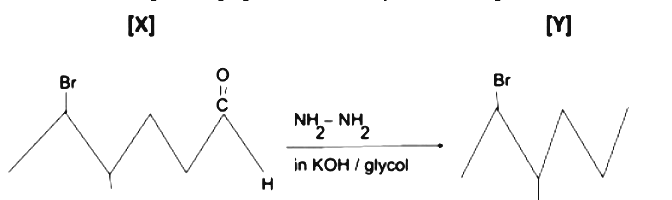 COMEDK 2025 Medium
 - During the fusion of an organic compound with sodium metal, nitrogen of the compound is converted intoCOMEDK 2018 Medium
- Column - I lists the waves of the electromagnetic spectrum. Column - II gives approximate frequency range of these waves. Match Column - I and Column - II and choose the correct match from the given choices.
No. Column I No. Column II A Radiowaves P \(10^{18}\) to \(10^{20}\) Hz B Microwaves Q \(10^{11}\) to \(5 \times 10^{14}\) Hz C Infrared R \(10^{4}\) to \(10^{8}\) Hz D X-rays S \(10^{9}\) to \(10^{12}\) Hz COMEDK 2024 Easy - A cubical box of side \(2 \mathrm{~m}\) contains helium gas. It was observed that in a time of 1 second, an atom travelling with the root-mean-square speed parallel to one of the edges of the cube, made 250 hits with one of the walls, without any collision with other atoms. The average kinetic energy of the helium gas is Take \(R=\dfrac{25}{3} \mathrm{~J} / \mathrm{mol}-\mathrm{K}\) and \(\mathrm{kB}=1.38 \times 10^{-23} \mathrm{JK}{ }^{-1}\)COMEDK 2024 Medium
- When a car of mass \(m\) is moving with speed \(v\) along a circle of radius \(r\) on a level road, the centripetal force is provided by \(f\), where \(f\) denotes
\(\left(\mu_{s} \rightarrow\right.\) coefficient of friction, \(N \rightarrow\) normal reaction)COMEDK 2021 Hard