


COMEDK · Maths · 28. Indefinite Integration
Given that \(f(x)=k x^3-9 k x^2+9 x+3\) is an increasing function on R set of real numbers, then \(k\) belongs to
- A \(\left(0, \dfrac{1}{3}\right]\)
- B \(\left(-\dfrac{1}{3}, 0\right)\)
- C \(\left[\dfrac{1}{3}, \infty\right)\)
- D \((-\infty, 0)\)
Answer & Solution
Correct Answer
(A) \(\left(0, \dfrac{1}{3}\right]\)
Step-by-step Solution
Detailed explanation
The function \(f(x) = kx^3 - 9kx^2 + 9x + 3\) is increasing on \(\mathbb{R}\) if and only if its derivative \(f'(x) \ge 0\) for all \(x \in \mathbb{R}\). Calculating the derivative: \(f'(x) = 3kx^2 - 18kx + 9\). For \(f'(x) \ge 0\) for all \(x\), the quadratic expression…
See the Complete Solution
Get step-by-step explanations for this and 2.5 Lakh+ more JEE, NEET & CET questions.
- Unlock all solutions
- Practice the full chapter
- Track accuracy across PYQs
4.8 rated on Google Play · 14,000+ reviews
More questions from Maths
- The equation of the ellipse whose centre is at the origin and the \(X\)-axis is major axis, which passes through the points \((-3,1)\) and \((2,-2)\) isCOMEDK 2014 Medium
- A group \((G *)\) has 10 elements. The minimum number of elements of \(G\), which are their own inverses isCOMEDK 2020 Easy
- Five persons \(A, B, C, D\) and \(E\) are in queue of a shop. The Probability that \(A\) and \(B\) are always together isCOMEDK 2022 Easy
- If \(f(x)\) satisfies the relation \(2 f(x)+f(1-x)=x^{2}\) for all real \(x\), then \(f(x)\) isCOMEDK 2021 Medium
- \(\text { The value of } \sin ^{-1}\left[\cot \left(\dfrac{1}{2} \tan ^{-1} \dfrac{1}{\sqrt{3}}+\cos ^{-1} \dfrac{\sqrt{12}}{4}+\sin ^{-1} \dfrac{1}{\sqrt{2}}\right)\right]
\) isCOMEDK 2024 Medium - 6 boys and 6 girls in a row at random. The probability that all the girls sit together isCOMEDK 2015 Easy
More PYQs from COMEDK
- Which one of the following is the correct IUPAC name of the given compound?
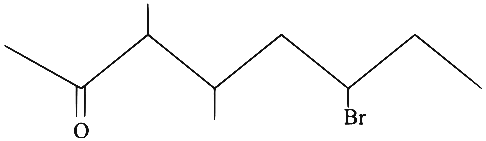 COMEDK 2024 Medium
 - If \(\frac{3 x^{2}-2 x+4}{(x-1)^{6}}=\frac{A_{1}}{x+1}+\frac{A_{2}}{(x+1)^{2}}+\frac{A_{3}}{(x+1)^{3}}\) \(+\frac{A_{4}}{(x+1)^{4}}+\frac{A_{5}}{(x+1)^{5}}+\frac{A_{6}}{(x+1)^{6}}\), then \(\left(A_{1}+A_{2}+A_{2}-A_{4}-A_{6}\right)=\)COMEDK 2018 Hard
- The direction ratios of the line which is perpendicular to the lines \(\frac{x-7}{2}=\frac{y+17}{-3}=\frac{z-6}{1}\) and \(\frac{x+5}{1}=\frac{y+3}{2}=\frac{z-4}{-2}\) areCOMEDK 2015 Medium
- If \(A, B\) and \(C\) are mutually exclusive and exhaustive events of a random experiment such that \(P(B)=\frac{3}{2} P(A)\) and \(P(C)=\frac{1}{2} P(B)\), then \(P(A \cup C)\) equals toCOMEDK 2023 Medium
- What is the minimum wavelength of radiation required to detect a p-n junction diode made of a semiconductor having band gap 3.3 eV.
[Planck's constant \(h = 6.6 \times 10^{34}\ J.s\)]COMEDK 2026 Medium - A cube bar slides thrice the time with friction than that without friction when it slides on an inclined plane of inclination \(45^{\circ}\). The coefficient of friction between the block and the surface isCOMEDK 2024 Medium