


COMEDK · Maths · 28. Indefinite Integration
\(\int \dfrac{e^{\log\left(1+\frac{1}{x^2}\right)}}{x^2 + \dfrac{1}{x^2}}\ dx =\)
- A \(\dfrac{1}{\sqrt{2}}\tan^{-1}\left(\dfrac{x^2-1}{\sqrt{2}\,x}\right) + C\)
- B \(\dfrac{1}{\sqrt{2}}\tan^{-1}\left(x - \dfrac{1}{x}\right) + C\)
- C \(\dfrac{1}{\sqrt{2}}\tan^{-1}\left(\dfrac{x^2+1}{x\sqrt{2}}\right) + C\)
- D \(-\dfrac{1}{\sqrt{2}}\tan^{-1}\left(x - \dfrac{1}{x}\right) + C\)
Answer & Solution
Correct Answer
(A) \(\dfrac{1}{\sqrt{2}}\tan^{-1}\left(\dfrac{x^2-1}{\sqrt{2}\,x}\right) + C\)
Step-by-step Solution
Detailed explanation
Given integral is \(I = \int \dfrac{e^{\log\left(1+\dfrac{1}{x^2}\right)}}{x^2 + \dfrac{1}{x^2}}\ dx\) Using the property \(e^{\log f(x)} = f(x)\), the integral simplifies to: \(I = \int \dfrac{1+\dfrac{1}{x^2}}{x^2 + \dfrac{1}{x^2}}\ dx\) The denominator can be rewritten by…
See the Complete Solution
Get step-by-step explanations for this and 2.5 Lakh+ more JEE, NEET & CET questions.
- Unlock all solutions
- Practice the full chapter
- Track accuracy across PYQs
4.8 rated on Google Play · 14,000+ reviews
More questions from Maths
- If the line \(p x+q y=0\) coincides with one of the lines given by \(a x^{2}+2 h x y+b y^{2}=0\), thenCOMEDK 2018 Easy
- If two lines \(L_1: \dfrac{x-1}{2}=\dfrac{y+1}{3}=\dfrac{z-1}{4}\) and \(L_2: \dfrac{x-3}{1}=\dfrac{y-k}{2}=z\) intersect at a point, then \(2 k\) is equal toCOMEDK 2023 Medium
- The place \(x-2 y+z=0\) is parallel to the lineCOMEDK 2023 Medium
- What is the argument of the complex number \(\dfrac{(1+i)(2+i)}{3-i}\), where \(i=\sqrt{-1}\) ?COMEDK 2021 Medium
- If \(2 x=-1+\sqrt{3} i\), then the value of \(\left(1-x^{2}+x\right)^{6}-\left(1-x+x^{2}\right)^{6}=\)COMEDK 2016 Medium
- In the group \(G=\{1,5,7,11\}\) under \(\otimes_{12}\) the value of \(7 \otimes_{12} 1 \hat{l}^{-1}\) is equal toCOMEDK 2012 Medium
More PYQs from COMEDK
- H-polaroid is prepared byCOMEDK 2019 Medium
- A metallic circular loop is placed with its plane perpendicular to a uniform magnetic field of 0.3 T. If the radius of the loop decreases at a constant rate of \(2\ mm\ s^{-1}\), what will be the induced emf in the loop, when the radius of the loop becomes 5 cm.COMEDK 2026 Medium
- Identify the correct mathematical expression which represents the variation in molar conductivity of a weak acid having concentration C and ionisation constant \(K_a\)
(\(\lambda_m^\infty\) = molar conductivity at infinite dilution, \(\lambda_m\) = molar conductivity at concentration C)COMEDK 2026 Medium - Rank the following compounds in order of increasing basicity.
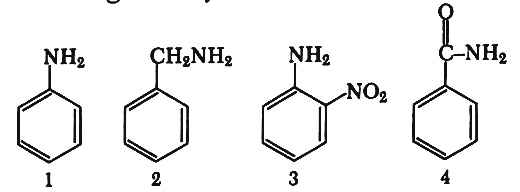 COMEDK 2023 Medium
 - The function \(f(x)=5+36 x+3 x^{2}-2 x^{3}\) is increasing in the intervalCOMEDK 2012 Easy
- For a reaction of the type, \(2 \mathrm{X}+\mathrm{Y} \rightarrow \mathrm{A}+\mathrm{B}\), the following is the data collected:
Experiment [X] [Y] Initial rate of formation of A 1 0.2 0.2 \(12.0 \times 10^{-3}\) 2 0.6 0.4 \(14.4 \times 10^{-2}\) 3 0.6 0.8 \(5.76 \times 10^{-1}\) 4 0.8 0.2 \(4.8 \times 10^{-2}\)
What is the overall order of the reaction?COMEDK 2023 Medium