


COMEDK · Maths · 5. Sequences and Series
Consider an infinite geometric series with first term '\(a\)' and common ratio '\(r\)'.
If the sum of infinite geometric series is 4 and the second term is \(\dfrac{3}{4}\) then
- A \(a=1 \quad r=-\dfrac{3}{4}\)
- B \(a=-1 \quad r=\dfrac{3}{4}\)
- C \(a=3 \quad r=\dfrac{1}{4}\)
- D \(a=-3 \quad r=-\dfrac{1}{4}\)
Answer & Solution
Correct Answer
(C) \(a=3 \quad r=\dfrac{1}{4}\)
Step-by-step Solution
Detailed explanation
The sum of an infinite geometric series is given by \(S = \dfrac{a}{1-r} = 4\), where \(|r| < 1\). The second term of the series is \(ar = \dfrac{3}{4}\). From the first equation, \(a = 4(1-r)\). Substituting this into the second equation: \(4(1-r)r = \dfrac{3}{4}\)…
See the Complete Solution
Get step-by-step explanations for this and 2.5 Lakh+ more JEE, NEET & CET questions.
- Unlock all solutions
- Practice the full chapter
- Track accuracy across PYQs
4.8 rated on Google Play · 14,000+ reviews
More questions from Maths
- \(S \equiv x^2+y^2-2 x-4 y-4=0\) and \(S^{\prime} \equiv x^2+y^2-4 x-2 y-16=0\) are two circles the point \((-2,-1)\) liesCOMEDK 2023 Easy
- \(x=a(\theta+\sin \theta)\) and \(y=a(1-\cos \theta)\) represents the equation of a curve. If \(\theta\) changes at a constant rate \(k\) then the rate of change of the slope of the tangent to the curve at \(\theta=\dfrac{\pi}{3}\) isCOMEDK 2025 Medium
- If the conjugate of \((x+i y)(1-2 i)\) is \(1+i\), thenCOMEDK 2015 Easy
- The solution of the differential equation \(\left(\frac{d y}{d x}\right) \tan y=\sin (x+y)+\sin (x-y)\) isCOMEDK 2023 Hard
- \(\text { If }(1-4 i)^3=a+i b \text { then the value of } \mathrm{a} \text { and } \mathrm{b} \text { is }\)COMEDK 2024 Easy
- The number of triangles in a complete graph with 10 non-collinear vertices isCOMEDK 2018 Easy
More PYQs from COMEDK
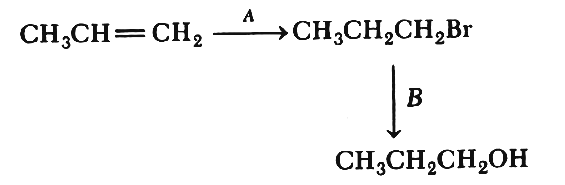
- What can be \(A\) and \(B\) in the following reaction?
 COMEDK 2022 Medium
 - The circle \(x^2+y^2+4 x-7 y+12=0\) cuts an intercept on \(Y\)-axis of lengthCOMEDK 2022 Easy
- Schiffs reagent containsCOMEDK 2019 Medium
- The value of \(\lim _{x \rightarrow 0} \frac{5^{x}-5^{-x}}{2 x}=\)COMEDK 2016 Easy
- Which of the following cannot be explained on the basis of Bernoulli's principle?COMEDK 2012 Medium
- A plano-convex lens made of refractive index 1.5 and having radius of curvature \(\mathrm{R}=4 \mathrm{~cm}\) fits exactly into a planoconcave lens made of refractive index 1.3 and having the same radius of curvature \(R=4 \mathrm{~cm}\) such that their plane surfaces are parallel to each other. The focal length of the combination is:COMEDK 2025 Medium