


COMEDK · Maths · 34. Three Dimensional Geometry
A vector perpendicular to the plane containing the points \(A(1,-1,2), B(2,0,-1), C(0,2,1)\) is
- A \(8 \hat{\mathbf{i}}+4 \hat{\mathbf{j}}+4 \hat{\mathbf{k}}\)
- B \(4 \hat{\mathbf{i}}+8 \hat{\mathbf{j}}-4 \hat{\mathbf{k}}\)
- C \(\hat{\mathbf{i}}+\hat{\mathbf{j}}-\hat{\mathbf{k}}\)
- D \(3 \hat{\mathbf{i}}+\hat{\mathbf{j}}+2 \hat{\mathbf{k}}\)
Answer & Solution
Correct Answer
(A) \(8 \hat{\mathbf{i}}+4 \hat{\mathbf{j}}+4 \hat{\mathbf{k}}\)
Step-by-step Solution
Detailed explanation
We have, \(A(1,-1,2), B(2,0,-1)\) and \(C(0,2,1)\) \(\therefore \quad \mathbf{A B}=\{2-1) \mathbf{i}+(0-(-1)) \mathbf{j}+(-1-2) k\) \(=\mathbf{i}+\mathbf{j}-3 \mathbf{k}\) and \(A C=(0-1) \mathbf{i}+(2-(-1)) \mathbf{j}+(1-2) k\) \(=-\mathbf{i}+3 \mathbf{j}-\mathrm{k}\) Now,…
See the Complete Solution
Get step-by-step explanations for this and 2.5 Lakh+ more JEE, NEET & CET questions.
- Unlock all solutions
- Practice the full chapter
- Track accuracy across PYQs
4.8 rated on Google Play · 14,000+ reviews
More questions from Maths
- What is the argument of the complex number \(\dfrac{(1+i)(2+i)}{3-i}\), where \(i=\sqrt{-1}\) ?COMEDK 2021 Medium
- If the area of the parallelogram with \(\mathbf{a}\) and \(\mathbf{b}\) as two adjacent sides is 15 sq units, then the area of the parallelogram having \(3 \mathbf{a}+2 \mathbf{b}\) and \(\mathbf{a}+3 \mathbf{b}\) as two adjacent sides in sq units isCOMEDK 2016 Easy
- The points of intersection of circles \((x+1)^2+y^2=4\) and \((x-1)^2+y^2=9\) are \((a, \pm b)\), then \((a, b)\) equals toCOMEDK 2023 Medium
- The feasible region represented by the constraints:
\(x + 2y \leq 120\);
\(x + y \geq 60\);
\(x - 2y \geq 0\);
\(x \geq 0\) and \(y \geq 0\)COMEDK 2026 Easy - If the function \(f(x)=\left\{\begin{array}{cl}\frac{1-\cos x}{x^{2}}, & \text { for } x \neq 0 \\ k, & \text { for } x=0\end{array}\right.\) is continuous at \(x=0\), then the value of \(k\) isCOMEDK 2020 Easy
- The angle between the vectors \(\mathrm{a}=\hat{\mathrm{i}}+2 \hat{\mathrm{j}}+2 \hat{\mathrm{k}}\) and \(\mathrm{b}=\hat{\mathrm{i}}+2 \hat{\mathrm{j}}-2 \hat{\mathrm{k}}\) isCOMEDK 2023 Easy
More PYQs from COMEDK
- The area of the region in the first quadrant enclosed by the \(x\)-axis, the line \(x = \sqrt{3}\,y\) and the circle \(x^2 + y^2 = 4\) isCOMEDK 2026 Medium
- Radium having mass number 200 and binding energy per nucleon 5.6 MeV , splits into two fragments Cadmium of mass number 112 and Hassium of mass number 108. If the binding energy per nucleon for Cadmium and Hassium is approximately 8.0 MeV , then the energy Q released per fission will be:COMEDK 2025 Medium
- A thermodynamic system changes its state from A to C in two different paths ABC and AC. The internal energy of the system at state C is \(20\text{ J}\) and at state A is \(10\text{ J}\). Heat supplied to the system to go from A to C along path AC is
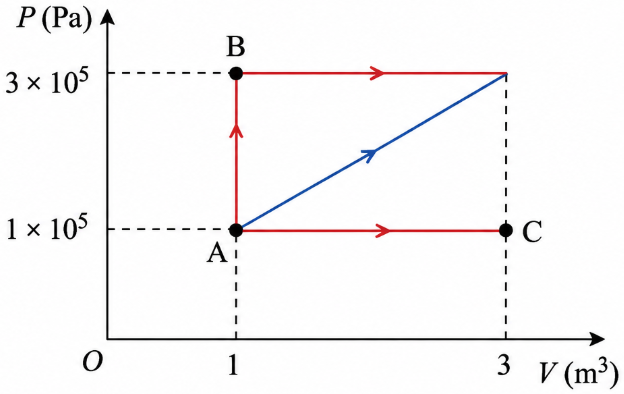 COMEDK 2024 Medium
 - If the length of the major axis of an ellipse is 3 times the length of the minor axis, then its eccentricity isCOMEDK 2023 Easy
- If \(\sin A+\sin B=-\dfrac{21}{65}, \cos A+\cos B=-\dfrac{27}{65}\) and \(\pi < A-B < 3 \pi\), then the value of \(\cos \left(\dfrac{A-B}{2}\right)\) isCOMEDK 2025 Medium
- The general solution of the differential equation \(\left(1+y^2\right) d x=\left(\tan ^{-1} y-x\right) d y\)COMEDK 2023 Medium