


COMEDK · Maths · 5. Sequences and Series
A geometric progression consists of an even number of terms. If the sum of all the terms is five times the sum of the terms occupying the odd places, then the common ratio of the geometric progression is
- A \(r=4\)
- B \(r=6\)
- C \(r=3\)
- D \(r=2\)
Answer & Solution
Correct Answer
(A) \(r=4\)
Step-by-step Solution
Detailed explanation
Let the geometric progression have \(2n\) terms, given by \(a, ar, ar^2, ar^3, \dots, ar^{2n-1}\). The sum of all terms \(S\) is given by \(S = \dfrac{a(r^{2n} - 1)}{r - 1}\). The terms occupying the odd places are \(a, ar^2, ar^4, \dots, ar^{2n-2}\). This is a geometric…
See the Complete Solution
Get step-by-step explanations for this and 2.5 Lakh+ more JEE, NEET & CET questions.
- Unlock all solutions
- Practice the full chapter
- Track accuracy across PYQs
4.8 rated on Google Play · 14,000+ reviews
More questions from Maths
- The solution of the differential equation \(\dfrac{d y}{d x}-y=1\) given \(y(0)=1\), isCOMEDK 2025 Medium
- Calculate the mean deviation about the mean of the set of first ten even natural numbers.COMEDK 2025 Easy
- The sides \(a, b, c\) of a triangle are in AP. If \(\cos \alpha=\frac{a}{b+c}, \cos \beta=\frac{b}{c+a}, \cos \gamma=\frac{c}{a+b}\) then \(\tan ^{2} \frac{\alpha}{2}+\tan ^{2} \frac{\gamma}{2}=\)COMEDK 2017 Hard
- The particular solution of the equation \(\sin\left(\dfrac{dy}{dx}\right) = a\), where \(a \in \mathbb{R}\) and \(y = 2\) when \(x = 0\) isCOMEDK 2026 Easy
- The area of the region bounded by \(y=2 x-x^{2}\) and the \(X\)-axis isCOMEDK 2019 Medium
- The set expression \(A \cup (B \cap (A' \cup B'))\) is equivalent toCOMEDK 2026 Easy
More PYQs from COMEDK
- What will be the equation of circle whose centre is \((1,2)\) and touches \(X\) - axis?COMEDK 2021 Medium
- An unsaturated hydrocarbon \([\mathrm{A}]\) undergoes the following series of reactions. Identify \([\mathrm{A}]\).
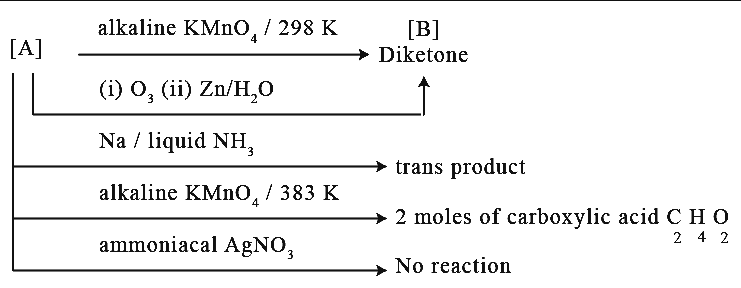 COMEDK 2025 Hard
 - \(f(x)=\left(\frac{5}{x}+7\right)\), where \(x \neq 0\) is decreasing forCOMEDK 2017 Easy
- Match the reactions in List I with the final products formed as given in List II.
List I List II W \(\text{C}_6\text{H}_5\text{CH}_3 \xrightarrow{\large{(i)\text{CrO}_3 + (\text{CH}_3\text{CO})_2\text{O};\ (ii)\text{H}_2\text{O} + heat}}\) P \(\text{R}_2\text{CO}\) X \(\text{RCOOC}_2\text{H}_5 \xrightarrow{\large{(i)\text{DIBAL-H};\ (ii)\text{H}_2\text{O}}}\) Q \(\text{C}_6\text{H}_5\text{COCH}_3\) Y \(\text{RCN} \xrightarrow{\large{(i)\text{R-Mg-X /dry ether};\ (ii)\text{H}_3\text{O}^+}}\) R \(\text{C}_6\text{H}_5\text{CHO}\) Z \(\text{C}_6\text{H}_5\text{COCl} + (\text{CH}_3)_2\text{Cd in dry ether} \rightarrow\) S \(\text{RCHO}\) COMEDK 2026 Medium - In which of the following case, does the reaction go farthest to completion ifCOMEDK 2014 Easy
- Which of the following gate give the similar output as the output of circuit diagram shown in the figure?
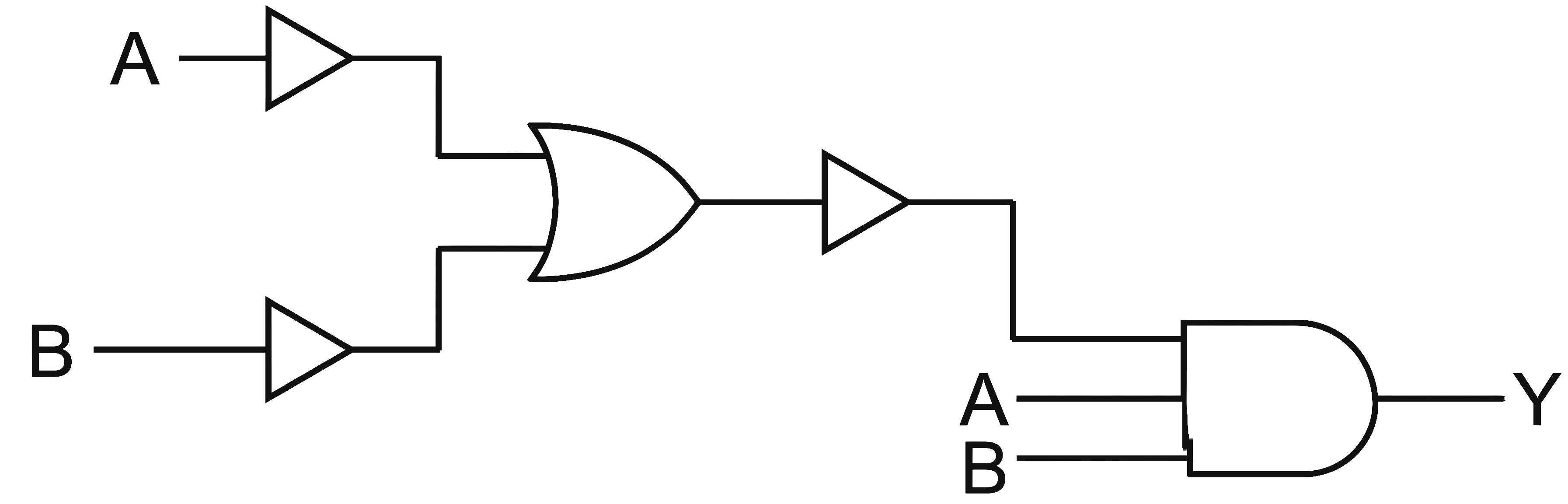 COMEDK 2022 Easy