


COMEDK · Maths · 33. Vector Algebra
\(\mathbf{a}=2 \hat{\mathbf{i}}+\hat{\mathbf{j}}-\hat{\mathbf{k}}, \mathbf{b}=\hat{\mathbf{i}}-\hat{\mathbf{j}}\) and \(\mathbf{c}=5 \hat{\mathbf{i}}-\hat{\mathbf{j}}+\hat{\mathbf{k}}\), then unit vector parallel to \(\mathbf{a}+\mathbf{b}-\mathbf{c}\) but in opposite direction is
- A \(\frac{1}{3}(2 \hat{\mathbf{i}}-\hat{\mathbf{j}}+2 \hat{\mathbf{k}})\)
- B \(\frac{1}{2}(2 \hat{\mathbf{i}}-\hat{\mathbf{j}}+2 \hat{\mathbf{k}})\)
- C \(\frac{1}{3}(2 \hat{\mathbf{i}}-\hat{\mathbf{j}}-2 \hat{\mathbf{k}})\)
- D None of these
Answer & Solution
Correct Answer
(A) \(\frac{1}{3}(2 \hat{\mathbf{i}}-\hat{\mathbf{j}}+2 \hat{\mathbf{k}})\)
Step-by-step Solution
Detailed explanation
Given, \(\mathbf{a}=2 \hat{\mathbf{i}}+\hat{\mathbf{j}}-\hat{\mathbf{k}}, \mathbf{b}=\hat{\mathbf{i}}-\hat{\mathbf{j}}\) and \(\mathbf{c}=5 \hat{\mathbf{i}}-\hat{\mathbf{j}}+\hat{\mathbf{k}}\)…
See the Complete Solution
Get step-by-step explanations for this and 2.5 Lakh+ more JEE, NEET & CET questions.
- Unlock all solutions
- Practice the full chapter
- Track accuracy across PYQs
4.8 rated on Google Play · 14,000+ reviews
More questions from Maths
- The general solution of \(\tan x-\sin x=1-\tan x \cdot \sin x\)COMEDK 2012 Medium
- If \(\tan (x+y)=33\) and \(x=\tan ^{-1} 3\), then \(y\) isCOMEDK 2015 Medium
- If the standard deviation of \(0,1,2,3 .......9\) is ' \(k\) ' then the standard deviation of \(10,11,12,13\),....... 19 will beCOMEDK 2025 Easy
- If \(Q_{1}\) is the set of all relations other than \(1\) with the binary operation * defined by \(a * b=a+b-a b\) for all \(a, b\) in \(Q_{1}\), then the identity in \(Q_{1}\) with respect to \(*\) isCOMEDK 2013 Easy
- An anti-aircraft gun can take a maximum of 4 shots at an enemy plane moving away from it. The probabilities of hitting the plane at the first, second, third and fourth shot are \(0.4,0.3,0.2\), \(0.1\) respectively. The probability that the gun hits the plane isCOMEDK 2017 Medium
- The domain of the function \(y=\sqrt{x-2}+\sqrt{1-x}\) isCOMEDK 2014 Easy
More PYQs from COMEDK
- If \(\cos \alpha=k \cos \beta\) then \(\cot \left(\dfrac{\alpha+\beta}{2}\right)\) is equal toCOMEDK 2023 Medium
- The complex number \(\frac{(-\sqrt{3}+3 i)(1-i)}{(3+\sqrt{3} i)(i)(\sqrt{3}+\sqrt{3} i)}\), when represented in the Argand diagram liesCOMEDK 2016 Medium
- An ideal gas goes from state \(A\) to state \(B\) via three different processes as indicated in the \(p-V\) diagram.
If \(Q_1, Q_2\) and \(Q_3\) indicate the heat absorbed by the three processes and \(\Delta U_1, \Delta U_2\) and \(\Delta U_3\) indicate the change in internal energy along the three processes respectively, then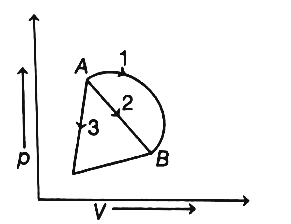 COMEDK 2023 Easy
 - When a body moves in a circular path, no work is done by the force sinceCOMEDK 2013 Easy
- Which of the following is an electromagnetic wave?
A. Sound waves
B. Alpha rays
C. Beta rays
D. Gamma raysCOMEDK 2025 Easy - \(\text { If } \alpha=\tan ^{-1}\left(\tan \dfrac{5 \pi}{4}\right) \text { and } \beta=\tan ^{-1}\left(-\tan \dfrac{2 \pi}{3}\right) \text { then }\)COMEDK 2024 Medium