


COMEDK · Chemistry · 14. Hydrocarbons
What can be \(A\) and \(B\) in the following reaction?
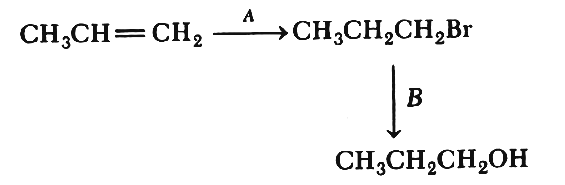
- A A. \(\mathrm{HBr}\) B. alc. \(\mathrm{KOH}\)
- B A. \(\mathrm{HBr}\), Peroxide B. alc. \(\mathrm{KOH}\)
- C A. \(\mathrm{HBr}\), Peroxide B. aq. \(\mathrm{KOH}, \Delta\)
- D A. \(\mathrm{HBr}\), B. \(a q . \mathrm{KOH}, \Delta\)
Answer & Solution
Correct Answer
(C) A. \(\mathrm{HBr}\), Peroxide B. aq. \(\mathrm{KOH}, \Delta\)
Step-by-step Solution
Detailed explanation
The conversion of propene (\(\text{CH}_{3}\text{CH}=\text{CH}_{2}\)) to 1-bromopropane (\(\text{CH}_{3}\text{CH}_{2}\text{CH}_{2}\text{Br}\)) is an anti-Markovnikov addition of HBr. This reaction occurs in the presence of organic peroxides (Kharasch effect or peroxide effect).…
See the Complete Solution
Get step-by-step explanations for this and 2.5 Lakh+ more JEE, NEET & CET questions.
- Unlock all solutions
- Practice the full chapter
- Track accuracy across PYQs
4.8 rated on Google Play · 14,000+ reviews
More questions from Chemistry
- Formation of coloured solution is possible, when metal ion in the compound containsCOMEDK 2020 Easy
- The rate constant for the reaction \(\mathrm{A} \rightarrow \mathrm{B}+\mathrm{C}\) at \(500 \mathrm{~K}\) is given as \(0.004 \mathrm{~s}^{-1}\). At what temperature will the rate constant become \(0.014 \mathrm{~s}^{-1}\) ? \(\mathrm{E}_{\mathrm{a}}\) for the reaction is \(18.231 \mathrm{~kJ}\).COMEDK 2024 Medium
- \(3.482 \times 10^{-1}\)g of Fe gets deposited when an aqueous solution of Ferric sulphate is electrolysed for 20 minutes using a current of "x" amperes. Find "x". (Atomic mass of Fe = 56amu).COMEDK 2026 Medium
- Highest osmotic pressure is shown by a solution ofCOMEDK 2019 Medium
- The solution which have lowest freezing point isCOMEDK 2022 Medium
- The electronic configuration of \(\mathrm{Cr}^{3+}\) isCOMEDK 2020 Easy
More PYQs from COMEDK
- Match the reactions given in Column I with the major product formed given in Column II.
S.No. Reactions S.No. Major Product formed A 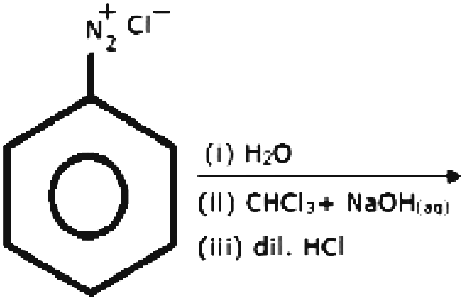
P 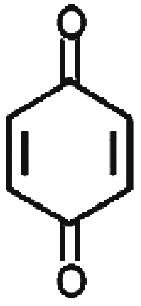
B 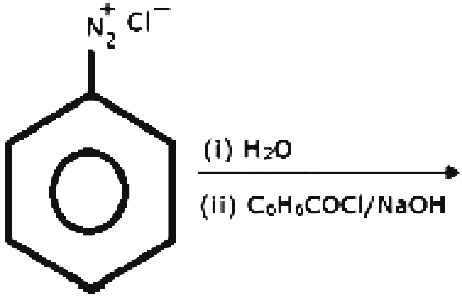
Q 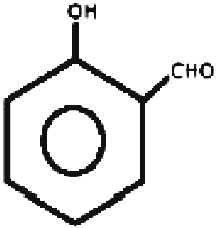
C 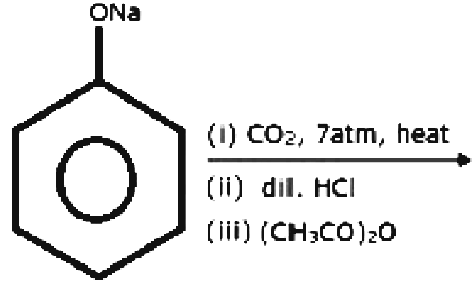
R 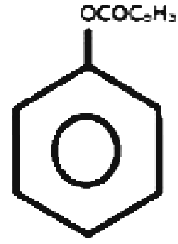
D 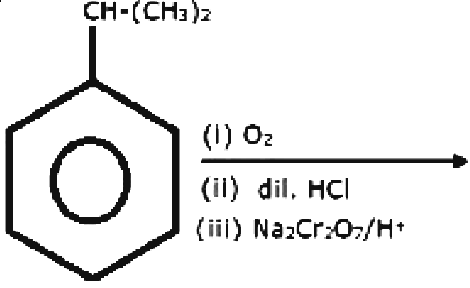
S 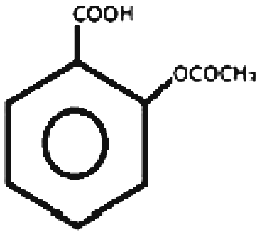 COMEDK 2025 Hard
 - The second derivative of \(\sin 3x \cos 5x\) is:COMEDK 2026 Medium
- In Young's double slit experiment, a third slit is made in between the double slits. Then,COMEDK 2018 Hard
- A drug that is antipyretic as well as analgesic isCOMEDK 2023 Easy
- \(\text { If } \sin y=x(\cos (a+y)) \text {, then find } \dfrac{d y}{d x} \text { when } x=0\)COMEDK 2024 Medium
- When unpolarised light beam is incident from air onto glass \((n=1.5)\) at the polarising angleCOMEDK 2017 Medium