


COMEDK · Chemistry · 23. d and f Block Elements
The statements given below contain an assertion and reason. Choose the correct option.
Assertion (A): Cr, Mo and W possess very high melting points in their respective series of elements.
Reason (R): Cr, Mo and W have a large number of unpaired electrons, resulting in strong metallic bonding.
- A Both A and R are true but R is not the correct explanation of A
- B Both A and R are true, R is the correct explanation of A
- C A is false but R is true
- D A is true but R is false
Answer & Solution
Correct Answer
(B) Both A and R are true, R is the correct explanation of A
Step-by-step Solution
Detailed explanation
The melting points of transition metals depend on the strength of their metallic bonds. The strength of metallic bonding is directly proportional to the number of unpaired electrons in the \((n-1)d\) and \(ns\) subshells that can participate in the bonding. Group 6 elements,…
See the Complete Solution
Get step-by-step explanations for this and 2.5 Lakh+ more JEE, NEET & CET questions.
- Unlock all solutions
- Practice the full chapter
- Track accuracy across PYQs
4.8 rated on Google Play · 14,000+ reviews
More questions from Chemistry
- Consider the following equilibrium,
\(\begin{aligned}
& 2 \mathrm{No}(g) \rightleftharpoons \mathrm{N}_2+\mathrm{O}_2 ; K_{\mathrm{G}_1}=2.4 \times 10^{20} \\
& \mathrm{No}(g)+\frac{1}{2} \mathrm{Br}_2(\mathrm{~g}) \rightleftharpoons \mathrm{NoBr}(g) ; K_{C_2}=1.4
\end{aligned}\)
Calculate \(K_C\) for the reaction,
\(\frac{1}{2} \mathrm{~N}_2(g)+\frac{1}{2} \mathrm{O}_2(g)+\frac{1}{2} \mathrm{Br}_2(g) \rightleftharpoons \mathrm{NOBr}(g)\)COMEDK 2023 Hard - In alkaline medium, \(I^{-}\)is oxidised to ' X ' by \(\mathrm{KMnO}_4\). The oxidation state of iodine in ' X ' is:COMEDK 2025 Medium
- Mohr's salt has the formulaCOMEDK 2023 Easy
- Catalytic dehydrogenation of a primary alcohol gives a/anCOMEDK 2017 Easy
- Select the reagents needed to convert Benzene to 4–Bromophenylpropene in the correct sequential order.
(A). \(\text{Cl}_2/\Delta\)
(B). \((\text{CH}_3)_2\)-CHCl /anhyd. \(\text{AlCl}_3\)
(C). Alc. KOH
(D). \(\text{Br}_2\) / FeCOMEDK 2026 Hard - The non-existence of \(\mathrm{PbI}_{4}\) and \(\mathrm{PbBr}_{4}\) is due toCOMEDK 2014 Medium
More PYQs from COMEDK
- A particle of mass 3 g and charge \(60 \mu \mathrm{C}\) is released from rest in a uniform electric field of intensity \(10^5 N C^{-1}\). If the value of kinetic energy attained by the particle after moving through a distance of 2 cm is \(m \times 10^{-2} \mathrm{~J}\), then the value of m is:COMEDK 2025 Medium
- In a pure inductive circuit, a sinusoidal voltage \(V(t)=200 \sin 250 t\) is applied to a pure inductance of \(\mathrm{L}=0.02 \mathrm{H}\). The current through the coil is:COMEDK 2025 Medium
- Rank the following compounds in order of increasing basicity.
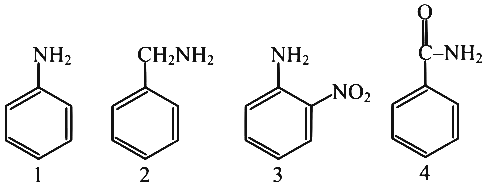 COMEDK 2023 Medium
 - When 2-bromopentane is heated with alcoholic solution of potassium hydroxide, the major product obtained isCOMEDK 2014 Easy
- Find the current through the 40 \(\Omega\) resistor in the given circuit having a diode, three resistors and two cells.
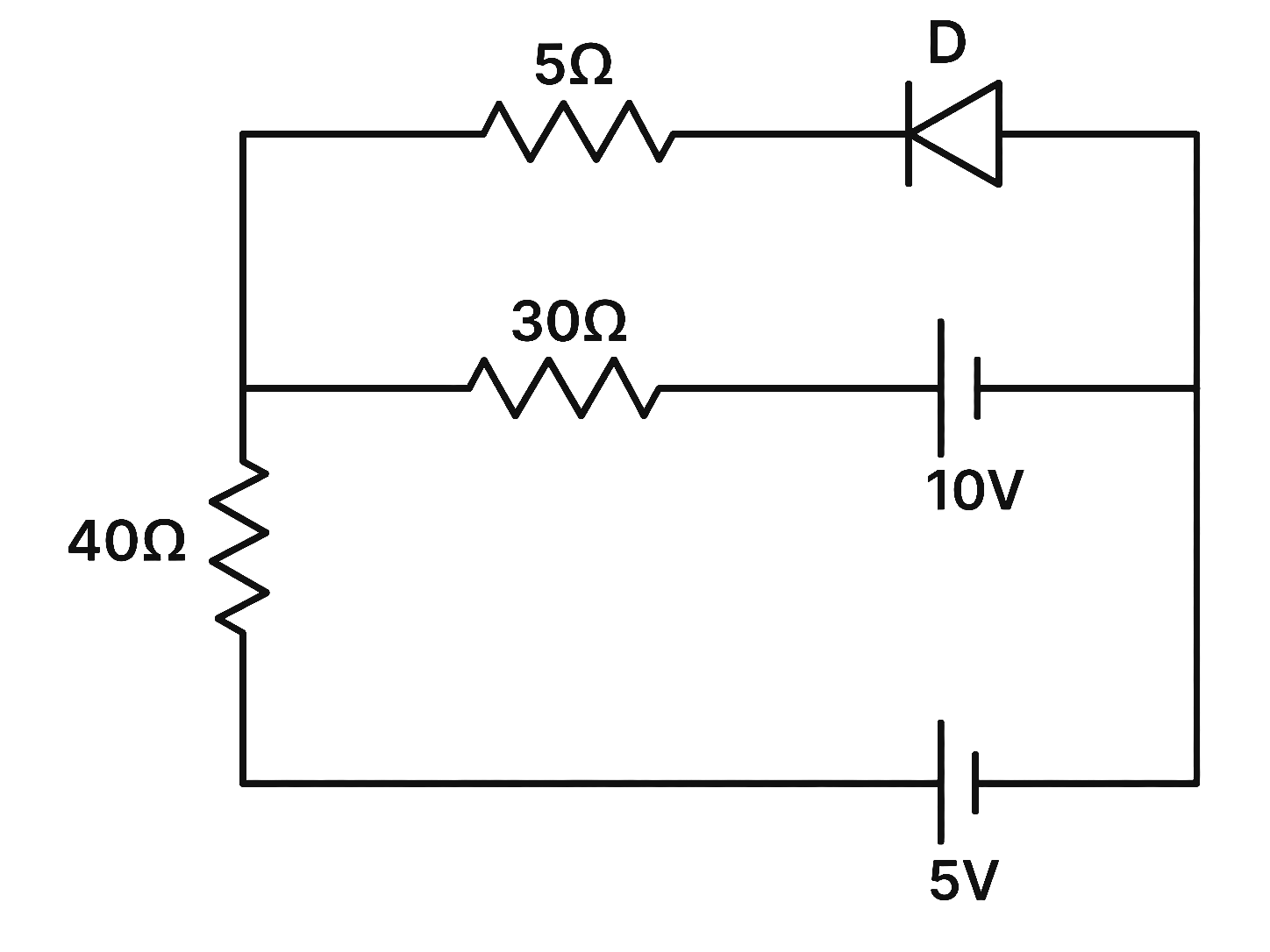 COMEDK 2026 Medium
 - Which among the following forms minimum boiling azeotropes?
(i) Heptane + Octane
(ii) Water + Nitric acid
(iii) Ethanol + Water
(iv) Acetone + Carbon disulfideCOMEDK 2022 Hard