


COMEDK · Chemistry · 18. Electrochemistry
The standard reduction potentials of \(\mathrm{Zn}\) and \(\mathrm{Ag}\) in water at \(298 \mathrm{~K}\) are,
\(\begin{aligned}
\mathrm{Zn}^{2+}+2 e^{-} \rightleftharpoons \mathrm{Zn}, & E^{\circ}=-0.76 \mathrm{~V} \\
\text { and } \quad \mathrm{Ag}^{+}+e^{-} \rightleftharpoons \mathrm{Ag} ; & E^{\circ}=+0.80 \mathrm{~V}.
\end{aligned}\)
Which of the following reactions take place?
- A \(\mathrm{Zn}^{2+}(a q)+2 \mathrm{Ag}(s) \longrightarrow 2 \mathrm{Ag}^{+}(a q)+\mathrm{Zn}(s)\)
- B \(\mathrm{Zn}(s)+2 \mathrm{Ag}^{+}(a q) \longrightarrow \mathrm{Zn}^{2+}(a q)+2 \mathrm{Ag}(s)\)
- C \(\mathrm{Zn}^{2+}(a q)+\mathrm{Ag}^{+}(a q) \longrightarrow \mathrm{Zn}(s)+\mathrm{Ag}(s)\)
- D \(\mathrm{Zn}(s)+\mathrm{Ag}(s) \longrightarrow \mathrm{Zn}^{2+}(a q)+\mathrm{Ag}^{+}(a q)\)
Answer & Solution
Correct Answer
(B) \(\mathrm{Zn}(s)+2 \mathrm{Ag}^{+}(a q) \longrightarrow \mathrm{Zn}^{2+}(a q)+2 \mathrm{Ag}(s)\)
Step-by-step Solution
Detailed explanation
For reaction to be spontaneous, \(E_{\text {cell }}^{\circ}>0\) For option (b), \[ \begin{aligned} E_{\text {cell }}^{o} &=\left(E_{\text {red }}^{0}\right)_{\text {Cathode }}-\left(E_{\text {red }}^{0}\right)_{\text {Anode }} \\ &=0.80-(-0.76)=156 \mathrm{~V} \end{aligned} \]…
See the Complete Solution
Get step-by-step explanations for this and 2.5 Lakh+ more JEE, NEET & CET questions.
- Unlock all solutions
- Practice the full chapter
- Track accuracy across PYQs
4.8 rated on Google Play · 14,000+ reviews
More questions from Chemistry
- What is the amount of ice that separates out on cooling a solution containing \(60 \mathrm{~g}\) of Ethylene glycol in \(250 \mathrm{~g}\) of water to \(-9.3^{\circ} \mathrm{C}\) ? \(\mathrm{K}_{\mathrm{f}}\) of \(\mathrm{H}_2 \mathrm{O}=1.86 \mathrm{~K} / \mathrm{m} ;\) MM of ethylene glycol= \(62 \mathrm{~amu}\)COMEDK 2024 Medium
- The \(\mathrm{P}-\mathrm{O}\) bond order in \(\mathrm{PO}_4^{3-}\) isCOMEDK 2022 Hard
- The standard emf of the cell \(\mathrm{Zn}\left|\mathrm{Zn}^{2+}\right|\left|\mathrm{Ag}^{+}\right| \mathrm{Ag}\) is \(1.56 \mathrm{~V}\). If the standard reduction potential of \(\mathrm{Ag}\) is \(0.8 \mathrm{~V}\), the standard oxidation potential of \(\mathrm{Zn}\) isCOMEDK 2014 Medium
- A process is taking place at constant temperature and pressure. Then,COMEDK 2016 Easy
- Given below are 2 statements: one Assertion and the other Reason. Which one of the following options is correct?
Assertion: Sulphur dioxide and Hydrogen peroxide can act as both oxidising and reducing agents but Nitric acid can act as only oxidising agent.
Reason: Sulphur and Oxygen can exhibit more than one stable oxidation states while Nitrogen does not.COMEDK 2025 Medium - Identify the correct IUPAC name of \([\mathrm{CoCl}_2(\mathrm{NO}_2)(\mathrm{NH}_3)_3]\)COMEDK 2023 Easy
More PYQs from COMEDK
- The group number of the element in the periodic table with the electronic configuration \((\mathrm{n}-1) \mathrm{d}^2 \mathrm{~ns}^2\).
For \(n=4\) is:COMEDK 2023 Easy - Ozone in stratosphere is depleted byCOMEDK 2023 Easy
- Which among the following compounds has the highest freezing point of its 1 molal aqueous solution?COMEDK 2024 Medium
- By using only two resistance coils-singly, in series, or in parallel-one should be able to obtain resistances of \(3,4,12\) and 16 ohms. The separate resistances of the coil areCOMEDK 2017 Hard
- Which of the following is the inverse of the proposition : "If a number is a prime, then it is odd"?COMEDK 2013 Easy
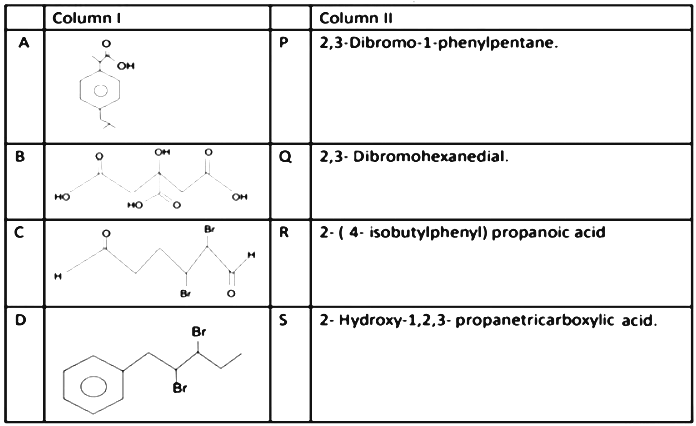
- Match the structures in Column I with their correct IUPAC names given in Column II.
 COMEDK 2025 Medium