


COMEDK · Chemistry · 19. Chemical Kinetics
The number of \(\alpha\) and \(\beta\)-particles emitted during the transformation of \({ }_{90} \mathrm{Th}^{232}\) to \({ }_{82} \mathrm{~Pb}^{208}\) are respectively
- A \(4,2\)
- B \(2,2\)
- C \(8,6\)
- D \(6,4\)
Answer & Solution
Correct Answer
(D) \(6,4\)
Step-by-step Solution
Detailed explanation
\({ }_{90}^{232} \mathrm{Th} \longrightarrow{ }_{82}^{208} \mathrm{~Pb}+n \alpha+m \beta\) Number of \(\alpha\)-particles, \(n=\frac{232-208}{4}=6\) Now, for charge balanced \[ \begin{aligned} 90 &=82+2 n-m \\ m &=4 \end{aligned} \] Number of \(\beta\)-particles, \(m=4\)
See the Complete Solution
Get step-by-step explanations for this and 2.5 Lakh+ more JEE, NEET & CET questions.
- Unlock all solutions
- Practice the full chapter
- Track accuracy across PYQs
4.8 rated on Google Play · 14,000+ reviews
More questions from Chemistry
- Arrange the following in the order of increasing reactivity towards \(\mathrm{SN}_{\mathrm{2}}\) reactions.
\(\begin{array}{ll}
\left(\mathrm{CH}_3\right)_3 \mathrm{CCH}_2 \mathrm{Br}(\mathrm{P}) ; & \\\mathrm{CH}_3\left(\mathrm{CH}_2\right)_3 \mathrm{Br}(\mathrm{Q}) ; &\\
\mathrm{CH}_3 \mathrm{CH}_2-\mathrm{CH}\left(\mathrm{CH}_3\right)-\mathrm{CH}_2 \mathrm{Br}(\mathrm{R}) ; & \\\left(\mathrm{CH}_3\right)_2 \mathrm{CHCH}_2 \mathrm{CH}_2 \mathrm{Br}(\mathrm{S})
\end{array}\)COMEDK 2024 Medium - The maximum number of electrons which can be held by subshell with azimuthal quantum number \(' l\) in an atom is given byCOMEDK 2024 Medium
- One mole of oxygen at \(273 \mathrm{~K}\) and one mole of sulphur dioxide at \(546 \mathrm{~K}\) are taken in two separate containers, thenCOMEDK 2020 Medium
- \(\text{K}_2\text{Cr}_2\text{O}_7\) on heating with aqueous NaOH gives -------------------------COMEDK 2026 Medium
- For a cell reaction, \(A(s)+B^{2+}(a q) \longrightarrow A^{2+}(a q)+B(s)\); the standard emf of the cell is \(0.295 \mathrm{~V}\) at \(25^{\circ} \mathrm{C}\). The equilibrium constant at \(25^{\circ} \mathrm{C}\) will beCOMEDK 2023 Medium
- What is the reduction potential of a half-cell consisting of a Pt electrode dipped in \(2.2 \mathrm{M} \mathrm{Fe}^{2+}\) and \(0.04 \mathrm{M} \mathrm{Fe}^{3+}\) solution where the reaction taking place is conversion of \(\mathrm{Fe}^{3+}\) ions to \(\mathrm{Fe}^{2+}\) ?
\(\mathrm{E}^0\left(\mathrm{Fe}^{3+} / \mathrm{Fe}^{2+}\right)=0.771 \mathrm{~V}\)COMEDK 2025 Medium
More PYQs from COMEDK
- At Constant volume, the heat required to raise the temperature of \(4.48 \mathrm{~L}\) of an ideal gas at STP by \(15^{\circ} \mathrm{C}\) is 12.0 calories.
The \(\mathrm{C_p}\) of the gas is _____________
\((\mathrm{R}=2 \mathrm{~Cal} \mathrm{~kg}^{-1} \mathrm{~mol}^{-1})\)COMEDK 2024 Medium - If the forward voltage in a diode is increased, then the width of the depletion regionCOMEDK 2017 Easy
- The angle between the lines \(\frac{x-2}{3}=\frac{y-1}{1}=\frac{z+3}{-1}\) and \(\frac{x+1}{2}=\frac{y-1}{-1}=\frac{z}{2}\) isCOMEDK 2024 Easy
- Hofmann's bromamide reaction is to convertCOMEDK 2020 Medium
- \(\int \frac{\sin x \cos x}{\sqrt{1-\sin ^{4} x}} d x=\)COMEDK 2019 Medium
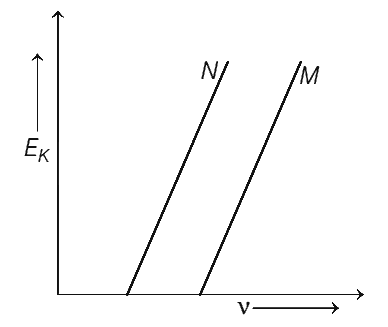
- The graph of kinetic energy of photoelectron versus frequency of incident radiation is shown for two metals \(M\) and \(N\). We may definitely conclude
 COMEDK 2012 Easy