


COMEDK · Chemistry · 6. Thermodynamics (C)
The melting of ice
- A is the phase transformation
- B takes place at constant pressure and temperature
- C takes place at \(373 \mathrm{~K}\)
- D Both (a) and (b)
Answer & Solution
Correct Answer
(D) Both (a) and (b)
Step-by-step Solution
Detailed explanation
Phase transformation involve the energy changes e.g., ice requires heat for melting. Normally this meltir: trkes place at constant pressure and during phase change, temperature remains constant (at \(273 \mathrm{~K}\) ).
See the Complete Solution
Get step-by-step explanations for this and 2.5 Lakh+ more JEE, NEET & CET questions.
- Unlock all solutions
- Practice the full chapter
- Track accuracy across PYQs
4.8 rated on Google Play · 14,000+ reviews
More questions from Chemistry
- The number of disulphide linkages present in insulin areCOMEDK 2017 Medium
- The bond dissociation enthalpy of the species in their correct order is:COMEDK 2024 Medium
- When common salt is added of a saturated solution of soap is precipitate(d)This is based on the principle ofCOMEDK 2019 Easy
- Formation of coloured solution is possible, when metal ion in the compound containsCOMEDK 2020 Easy
- Amines behave asCOMEDK 2017 Easy
- The essential amino acid are
(i) Leucine
(ii) Glutamic acid
(iii) Asparagine
(iv) Valine
correct option isCOMEDK 2022 Hard
More PYQs from COMEDK
- Two equal forces ( \(p\) each) act at a point inclined to each other at an angle of \(120^{\circ}\). The magnitude of their resultant isCOMEDK 2019 Easy
- The major product ' \(D\) ' of the following reaction is:
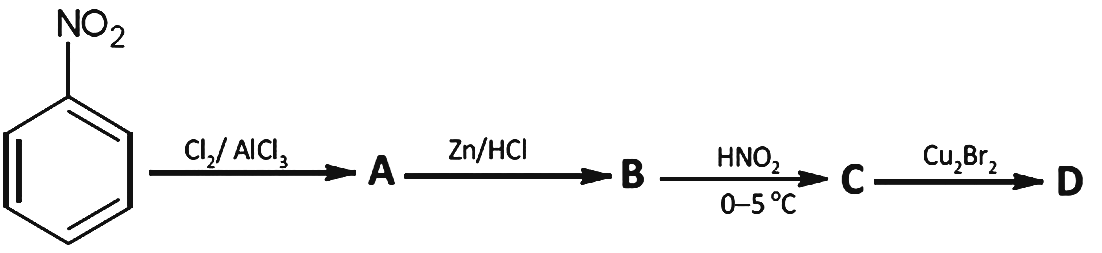 COMEDK 2025 Medium
 - The equation of a simple harmonic wave is given by \(y=6 \sin 2 \pi(2 t-0 . l x)\), where \(x\) and \(y\) are in \(\mathrm{mm}\) and \(t\) is in seconds. The phase difference between two particles \(2 \mathrm{~mm}\) apart at any instant isCOMEDK 2018 Hard
- One surface of a lens is convex and the other is concave. If the radii of curvatures are \(R\) and \(r\) respectively, the lens will be convex ifCOMEDK 2025 Medium
- Arrange the following compounds in the decreasing order of the molar conductivities of their aqueous solutions.
\(\begin{array}{cccc}\mathrm{A} & \quad \mathrm{B} & \quad \mathrm{C} & \quad \mathrm{D} \\ {\left[\mathrm{Co}\left(\mathrm{NH}_3\right)_5 \mathrm{Cl}] \mathrm{Cl}_2\right.} & \quad {\left[\mathrm{Co}\left(\mathrm{NH}_3\right)_3 \mathrm{Cl}_3\right]} & \quad {\left[\mathrm{Co}\left(\mathrm{NH}_3\right)_4 \mathrm{Cl}_2\right] \mathrm{Cl}} & \quad {\left[\mathrm{Co}\left(\mathrm{NH}_3\right)_6\right] \mathrm{Cl}_3}\end{array}\)COMEDK 2025 Medium - In a trial, the probability of success is twice the probability of failure. In six trials, the probability of at most two failure will beCOMEDK 2023 Medium