


COMEDK · Chemistry · 19. Chemical Kinetics
The following results were obtained during study of the reaction \(2 \mathrm{NO}(\mathrm{g})+\mathrm{Cl}_2(\mathrm{~g}) \rightarrow 2 \mathrm{NOCl}(\mathrm{g})\). Determine the value of \([\mathrm{X}]\) in \(\mathrm{mol} / \mathrm{L}\)
\(\begin{array}{|c|c|c|c|} \hline \text{Experiment} & \text{[NO] mol/L} & \left[\mathrm{Cl}_2\right] \text{ mol/L} & \text{Initial rate of formation. [NOCl] mol/L/min} \\ \hline \text{I} & 0.2 & 0.2 & 6.0 \times 10^{-3} \\ \hline \text{II} & 0.2 & 0.4 & 2.4 \times 10^{-2} \\ \hline \text{III} & 0.4 & 0.2 & 1.2 \times 10^{-2} \\ \hline \text{IV} & X & 0.6 & 1.35 \times 10^{-1} \\ \hline \end{array}\)
- A \([X]=0.4\)
- B \([\mathrm{X}]=0.8\)
- C \([\mathrm{X}]=0.3\)
- D \([\mathrm{X}]=0.5\)
Answer & Solution
Correct Answer
(D) \([\mathrm{X}]=0.5\)
Step-by-step Solution
Detailed explanation
The rate law for the reaction \(2 \mathrm{NO}(g) + \mathrm{Cl}_2(g) \rightarrow 2 \mathrm{NOCl}(g)\) is given by \(r = k[\mathrm{NO}]^a[\mathrm{Cl}_2]^b\). From experiment I and II, keeping \([\mathrm{NO}]\) constant at \(0.2 \text{ mol/L}\):…
See the Complete Solution
Get step-by-step explanations for this and 2.5 Lakh+ more JEE, NEET & CET questions.
- Unlock all solutions
- Practice the full chapter
- Track accuracy across PYQs
4.8 rated on Google Play · 14,000+ reviews
More questions from Chemistry
- Consider the cell
\(\mathrm{Pt}\left|\mathrm{H}_2(\mathrm{~g})(1 \mathrm{bar})\right| \mathrm{H}^{+}(\mathrm{aq}) \| \mathrm{Cu}^{2+}(\mathrm{aq}) \mid \mathrm{Cu}\)
At 298 K , the emf of the cell is 0.31 V . The pH of the acidic solution is 3 . The concentration of \(\mathrm{Cu}^{2+}\) is:COMEDK 2025 Medium - Pure water is neutral becauseCOMEDK 2019 Easy
- Bohr's radius of \(2 \mathrm{nd}\) orbit of \(\mathrm{Be}^{3+}\) is equal to that ofCOMEDK 2023 Easy
- In a mixture of acetic acid and sodium acetate the ratio of concentrations of the salt to the acid is increased ten times. Then the pH of the solutionCOMEDK 2016 Hard
- Arrange the following compounds in the decreasing order of reactivity towards \(\mathrm{S}_{\mathrm{N}} 1\) reaction.
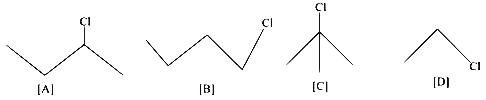 COMEDK 2024 Medium
 - If the equilibrium constant for \(\text{N}_{2(g)} + \text{O}_{2(g)} \rightleftharpoons 2\text{NO}_{(g)}\) is 49
The equilibrium constant for the reaction \(\text{NO}_{(g)} \rightleftharpoons \dfrac{1}{2}\text{N}_{2(g)} + \dfrac{1}{2}\text{O}_{2(g)}\) is __________COMEDK 2026 Easy
More PYQs from COMEDK
- Which of the following relations does not give the equation of an adiabatic process, where terms have their usual meaning?COMEDK 2013 Easy
- \(\text { If } P=\left[\begin{array}{lll}
1 & \alpha & 3 \\
1 & 3 & 3 \\
2 & 4 & 4
\end{array}\right] \text { is the adjoint of a } 3 \times 3 \text { matrix } A \text { and }|A|=4 \text { then } \alpha \text { is equal to }\)COMEDK 2024 Medium - In the Young's double slit experiment, when a monochromatic light is used, fringe width obtained is 1 mm . If the wave length is halved and the slit width is doubled, what will be the new fringe width?COMEDK 2025 Medium
- A concave mirror gives an image three times as large as its object placed at a distance of \(20 \mathrm{~cm}\) from it. For the image to be real, the focal length should beCOMEDK 2015 Medium
- 18 Points are indicated on the perimeter of a triangle \(\mathrm{ABC}\) as shown below. If three points are chosen then probability that it will from a triangle is
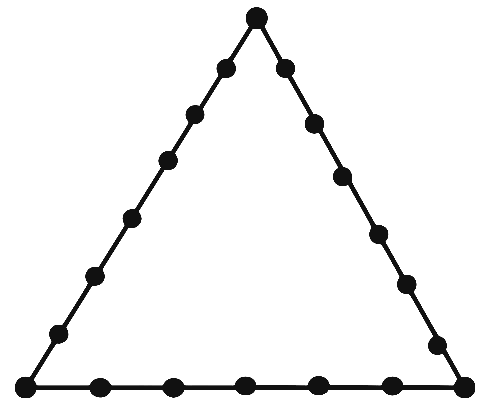 COMEDK 2023 Medium
 - If \(A=\left[\begin{array}{ll}1 & 2 \\ 0 & 1\end{array}\right]\), then \(A^{n}\) isCOMEDK 2018 Easy