


COMEDK · Chemistry · 14. Hydrocarbons
The conversion of Propyne to Benzene can be brought out in 4 steps.
Choose the reagents to be used, in the proper sequential order, to bring out the conversion.
Reagents provided: alc. \(\mathrm{KOH}, \mathrm{H}_2 / \mathrm{Pd}, \mathrm{Na} /\) dry ether, \(\mathrm{HBr}, \mathrm{HBr} /\left(\mathrm{C}_6 \mathrm{H}_5 \mathrm{CO}\right)_2 \mathrm{O}_2\),
Soda-lime, \(\mathrm{Cr}_2 \mathrm{O}_3\) (high T and P), Conc. \(\mathrm{H}_2 \mathrm{SO}_4\)
- A \(\mathrm{Cr}_2 \mathrm{O}_3\) (high \(\mathrm{T}\) and \(\mathrm{P}\)), \(\mathrm{Na} /\) dry ether, \(\mathrm{HBr}\), Conc. \(\mathrm{H}_2 \mathrm{SO}_4\)
- B \(\mathrm{H}_2 / \mathrm{Pd}, \mathrm{HBr} /\left(\mathrm{C}_6 \mathrm{H}_5 \mathrm{CO}\right)_2 \mathrm{O}_2, \mathrm{Na} /\) dry ether, \(\mathrm{Cr}_2 \mathrm{O}_3\) (high \(\mathrm{T}\) and \(\mathrm{P}\))
- C \(\mathrm{Na} /\) Ether, \(\mathrm{Cr}_2 \mathrm{O}_3\) (high \(\mathrm{T}\) and \(\mathrm{P}\)), \(\mathrm{HBr}, \mathrm{H}_2 / \mathrm{Pd}\)
- D \(\mathrm{HBr}\), alc. \(\mathrm{KOH}, \mathrm{HBr} /\left(\mathrm{C}_6 \mathrm{H}_5 \mathrm{CO}\right)_2 \mathrm{O}_2, \mathrm{Cr}_2 \mathrm{O}_3\) (high \(\mathrm{T}\) and \(\mathrm{P}\))
Answer & Solution
Correct Answer
(B) \(\mathrm{H}_2 / \mathrm{Pd}, \mathrm{HBr} /\left(\mathrm{C}_6 \mathrm{H}_5 \mathrm{CO}\right)_2 \mathrm{O}_2, \mathrm{Na} /\) dry ether, \(\mathrm{Cr}_2 \mathrm{O}_3\) (high \(\mathrm{T}\) and \(\mathrm{P}\))
Step-by-step Solution
Detailed explanation
The conversion of propyne (\(CH_3-C \equiv CH\)) to benzene (\(C_6H_6\)) involves the following steps: Step 1: Partial hydrogenation of propyne to propene using \(H_2 / Pd\) (Lindlar catalyst or poisoned Pd). \(CH_3-C \equiv CH + H_2 \xrightarrow{Pd} CH_3-CH=CH_2\) Step 2:…
See the Complete Solution
Get step-by-step explanations for this and 2.5 Lakh+ more JEE, NEET & CET questions.
- Unlock all solutions
- Practice the full chapter
- Track accuracy across PYQs
4.8 rated on Google Play · 14,000+ reviews
More questions from Chemistry
- In the following given reaction the molecule/compound ' S ' is
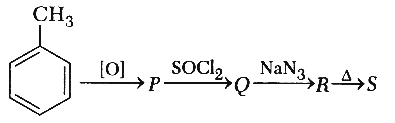 COMEDK 2024 Hard
 - The Enthalpy of combustion of 1.0 mole of a reactive metal X at \(27^{\circ} \mathrm{C}\) and 1.0 bar pressure to form a solid oxide (XO) is \(-601.83 \mathrm{~kJ} / \mathrm{mol}\). The Internal energy change for this reaction is ______ kJ .
\(\left(\mathrm{R}=8.314 \mathrm{j} \mathrm{~K}^{-1} \mathrm{~mol}^{-1}\right)\)COMEDK 2025 Medium - Which of the following is not true?COMEDK 2023 Easy
- Which of the following compounds undergo Aldol condensation followed by dehydration to give 3-phenylprop-2-en-1-al?COMEDK 2024 Medium
- Which one of the following compounds will give a yellow precipitate when reacted with \(\mathrm{I}_2 / \mathrm{NaOH}\) ?COMEDK 2025 Easy
- The molar conductivities of \(\mathrm{NaOH}, \mathrm{NaCl}\) and \(\mathrm{BaCl}_{2}\) at infinite dilution are
\(2.481 \times 10^{-2} \mathrm{~S} \mathrm{~m}^{2} \mathrm{~mol}^{-1}\)
\(1.265 \times 10^{-2} \mathrm{~S} \mathrm{~m}^{2} \mathrm{~mol}^{-1}\) and
\(2.800 \times 10^{-2} \mathrm{~S} \mathrm{~m}^{2} \mathrm{~mol}^{-1}\) respectively. The molar conductivity of \(\mathrm{Ba}(\mathrm{OH})_{2}\) at infinite dilution will beCOMEDK 2014 Hard
More PYQs from COMEDK
- The dissociation of lime stone in the slag zone of the blast furnace isCOMEDK 2012 Easy
- The differential equation of \(y=a e^{b x+c}\) isCOMEDK 2017 Easy
- Consider the following compounds
ethanamine (i); diethylamine (ii); aniline (iii) and \(N\) - methylbenzenamine (iv) The correct decreasing order of pKb values of the compounds is:COMEDK 2025 Medium - \(5.8 \mathrm{~g}\) of a gas maintained at \(95^{\circ} \mathrm{C}\) occupies the same volume as \(0.368 \mathrm{~g}\) of hydrogen gas maintained at a temperature of \(17^{\circ} \mathrm{C}\) and pressure being the same atmospheric pressure for both the gases. What is the molecular mass of the unknown gas?COMEDK 2023 Medium
- In a Fraunhofer diffraction experiment at a single slit using a light of wavelength \(400 \mathrm{~nm}\), the first minimum is formed at an angle of \(30^{\circ}\). The direction \(\theta\) of the first secondary maximum is given byCOMEDK 2018 Medium
- Identify the name of the reaction involved in conversion of A→B and name the compound B.
\(\mathrm{CH}_3 \mathrm{CN} \xrightarrow[\mathrm{H}_2 \mathrm{O}]{\mathrm{H}^{+}} \mathrm{A} \cdot \xrightarrow[\mathrm{H}^{+} / \mathrm{H}_2 \mathrm{O}]{\mathrm{Cl} 2 / \text { Red Phosphorous }} \mathrm{B}\)COMEDK 2026 Medium