


COMEDK · Chemistry · 20. Surface Chemistry
The basic principle of Cottnell's precipitator is
- A Le-Chatelier's principle
- B peptisation
- C neutralisation of charge on colloidal particles
- D scattering of light
Answer & Solution
Correct Answer
(C) neutralisation of charge on colloidal particles
Step-by-step Solution
Detailed explanation
The basic principle of Cottnell's precipitator is neutralisation of charge on colloidal particle by attracting them towards the wall of oppositively charged precipitator. Thus, lose their charge and coagulate colloidal particle.
See the Complete Solution
Get step-by-step explanations for this and 2.5 Lakh+ more JEE, NEET & CET questions.
- Unlock all solutions
- Practice the full chapter
- Track accuracy across PYQs
4.8 rated on Google Play · 14,000+ reviews
More questions from Chemistry
- Arrange stability of the given carbon cation in decreasing order
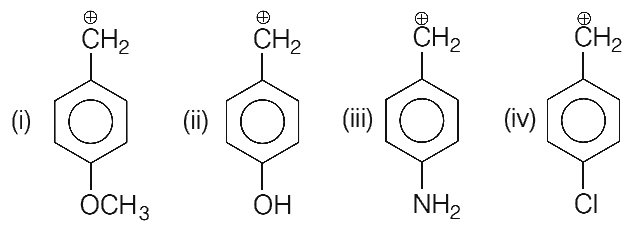 COMEDK 2021 Medium
 - For an adiabatic change in a system, the condition which is applicable isCOMEDK 2023 Easy
- A ligand can also be regarded asCOMEDK 2017 Easy
- On the basis of crystal field theory, electronic configuration of a low spin \(\mathrm{d}^4\) complex is:COMEDK 2024 Medium
- Mesomeric effect involves delocalisation ofCOMEDK 2017 Easy
- 800 mL of a \(0.5 \mathrm{M} \mathrm{HNO}_3\) at 300 K is heated to a temperature of 350 K , its volume is reduced to one half and 10.5 g of \(\mathrm{HNO}_3\) is evaporated. Assuming complete ionization, the osmotic pressure of the remaining solution is: [Given \(\mathrm{R}=0.082 \mathrm{~L} \mathrm{~atm} \mathrm{~K}^{-1} \mathrm{~mol}^{-1}\) ]COMEDK 2025 Medium
More PYQs from COMEDK
- Two subatomic particles 1 and 2, with the same kinetic energies have their de- Broglie wavelengths as \(\lambda_1 \& \lambda_2\) and masses as 3 m and 6 m respectively.
Determine the ratio \(\lambda_1: \lambda_2\).COMEDK 2025 Medium - The value of \(3^{\log _4 5}-5^{\log _4 3}\) isCOMEDK 2022 Easy
- Which one of the following is not true always?COMEDK 2016 Easy
- Among the complexes of Ni listed below, the following is the only correct statement about the given compounds.
I. \(\left[\mathrm{Ni}(\mathrm{CO})_{4}\right]\)
II. \(\left[\mathrm{Ni}(\mathrm{CN})_{4}\right]^{2-}\)
III. \(\left[\mathrm{NiCl}_{4}\right]^{2-}\)COMEDK 2015 Medium - The absolute maximum and minimum values of the function \(f(x) = \sin x + \sqrt{3}\cos x\) in \([0, \pi]\) areCOMEDK 2026 Medium
- Doping of silicon (Si) with indium (In) leads to the formation ofCOMEDK 2022 Easy