


COMEDK · Chemistry · 8. Ionic Equilibrium
On passing \(\mathrm{H}_{2} \mathrm{~S}\) into a solution containing both \(\mathrm{Zn}^{2+}\) and \(\mathrm{Cu}^{2+}\) in acidic medium, only CuS gets precipitate(d) This is because
- A \(K_{\mathrm{sp}}\) of \(\mathrm{CuS} < K_{\mathrm{sp}}\) of \(\mathrm{ZnS}\)
- B \(K_{\mathrm{sp}}\) of \(\mathrm{CuS}=K_{\mathrm{sp}}\) of \(\mathrm{ZnS}\)
- C \(K_{s p}\) of CuS \(>K_{\mathrm{sp}}\) of \(\mathrm{ZnS}\)
- D CuS is more stable than \(\mathrm{ZnS}\)
Answer & Solution
Correct Answer
(A) \(K_{\mathrm{sp}}\) of \(\mathrm{CuS} < K_{\mathrm{sp}}\) of \(\mathrm{ZnS}\)
Step-by-step Solution
Detailed explanation
On passing \(\mathrm{H}_{2} \mathrm{~S}\) into a solution containing \(\mathrm{Zn}^{2+}\) and \(\mathrm{Cu}^{2+}\) ions, \(\mathrm{ZnS}\) and \(\mathrm{CuS}\) are formed. The solubility product of CuS is less than that of \(\mathrm{ZnS}\). \(\therefore\) CuS get precipitated.
See the Complete Solution
Get step-by-step explanations for this and 2.5 Lakh+ more JEE, NEET & CET questions.
- Unlock all solutions
- Practice the full chapter
- Track accuracy across PYQs
4.8 rated on Google Play · 14,000+ reviews
More questions from Chemistry
- When the expansion of a gas occurs in vaccum and at constant volume, thenCOMEDK 2021 Medium
- In the redox reaction, taking place in acidic medium:
\(\text{X}\ \text{MnO}_4^-\ (aq) + \text{Y}\ \text{SO}_2(g) \rightarrow \text{Mn}^{+2}(aq) + \text{HSO}_4^-\ (aq)\),
the ratio of X:Y in a stoichiometrically balanced equation will beCOMEDK 2026 Medium - Which of the following factors is altered by the addition of a catalyst during a chemical reaction?COMEDK 2026 Easy
- An equilibrium mixture taken in 2litre vessel of the reaction: \(2\text{SO}_2(g) + \text{O}_2(g) \rightleftharpoons 2\text{SO}_3(g)\) has 4 moles of \(\text{SO}_2\), 3moles of \(\text{O}_2\) and 6moles of \(\text{SO}_3\) then the value of equilibrium constant \((K_c)\) will be:COMEDK 2026 Easy
- Phenols are highly acidic compared to alcohols due toCOMEDK 2014 Medium
- What is the final product \([Z]\) formed when the given reactions take place?
 COMEDK 2025 Medium
More PYQs from COMEDK
- If the curve \(y=2 x^{3}+a x^{2}+b x+c\) passes through the origin and the tangents drawn to it at \(x=-1\) and \(x=2\) are parallel to the \(X\)-axis, then the values of \(a, b\) and \(c\) are respectively,COMEDK 2016 Medium
- Identify the reagents, [A] and [B] used up when Salicylic acid undergoes the following reactions:
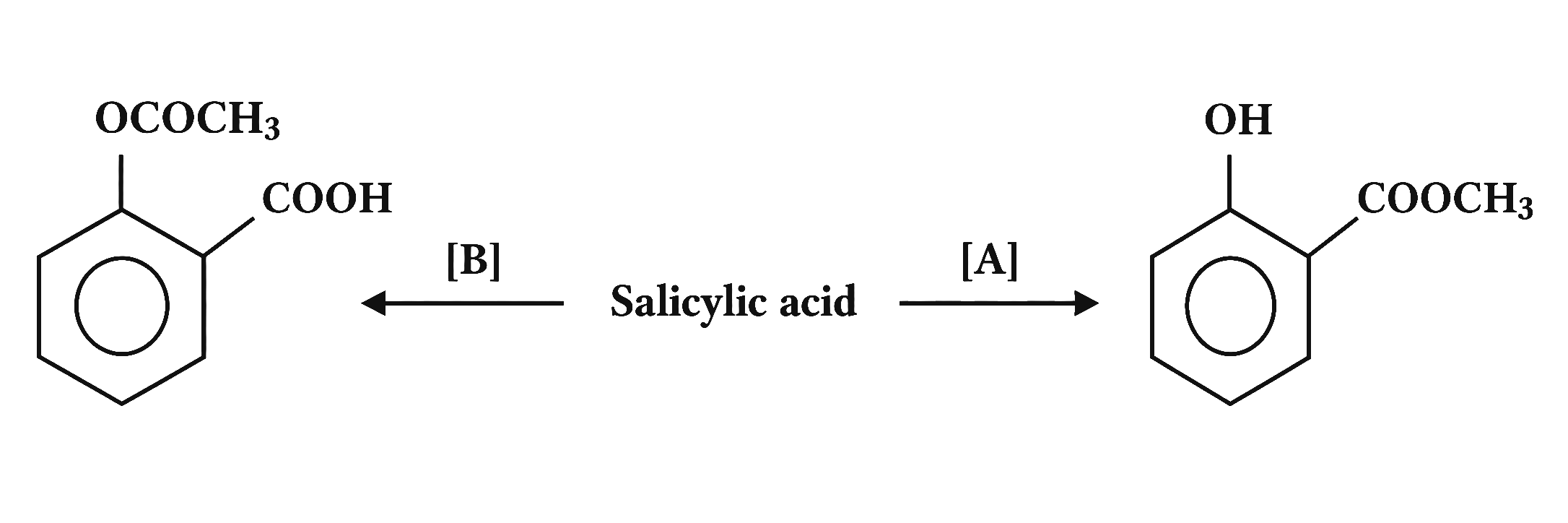 COMEDK 2026 Medium
 - The function \(y=\log \omega t\) can representCOMEDK 2021 Easy
- The maximum number of possible interference maxima when slit separation is equal to 4 times the wavelength of light used in a double slit experiment isCOMEDK 2018 Easy
- \(\int \sqrt{\operatorname{cosec} x-1} d x=\)COMEDK 2023 Medium
- The ion that is isoelectronic with \(\mathrm{CO}\) isCOMEDK 2023 Easy