


COMEDK · Chemistry · 24. Coordination Compounds
Observe the given below reaction.
Aqueous \(\mathrm{CuSO}_4 \xrightarrow{\text { Excess } a q \mathrm{KCN}} A \xrightarrow{\mathrm{H}_2 \mathrm{~S}} B\)
A, B respectively are
- A \(\mathrm{K}_3\left[\mathrm{Cu}(\mathrm{CN})_4\right]\), no precipitate
- B \(\mathrm{K}_2\left[\mathrm{Cu}(\mathrm{CN})_4\right]\), no precipitate
- C \(\mathrm{K}_4\left[\mathrm{Cu}(\mathrm{CN})_6\right]\), white ppt.
- D \(\mathrm{K}_2\left[\mathrm{Cu}(\mathrm{CN})_4\right]\), black precipitate
Answer & Solution
Correct Answer
(A) \(\mathrm{K}_3\left[\mathrm{Cu}(\mathrm{CN})_4\right]\), no precipitate
Step-by-step Solution
Detailed explanation
The complete reaction is as follow. As \(\mathrm{CN}^{-}\)is a strong ligand, the complex formed is highly stable and does not dissociate to give \(\mathrm{Cu}^{+}\)ions. However, no precipitate of CuS is formed when \(\mathrm{H}_2 \mathrm{~S}\) gas is passes through solution.
See the Complete Solution
Get step-by-step explanations for this and 2.5 Lakh+ more JEE, NEET & CET questions.
- Unlock all solutions
- Practice the full chapter
- Track accuracy across PYQs
4.8 rated on Google Play · 14,000+ reviews
More questions from Chemistry
- The basic character of transition metal monoxides follows the order:COMEDK 2026 Easy
- If the depression in freezing point of an aqueous solution containing a solute, which is neither dissociated nor associated, is \(\mathrm{a} \mathrm{K}\) with \(\mathrm{K}_{\mathrm{f}}=\mathrm{b ~ K ~ k g ~ m o l}{ }^{-1}\), what would be the elevation in boiling point \((\mathrm{X})\) for this solution if its \(\mathrm{K}_{\mathrm{b}}=\mathrm{\mathrm { ~K } \mathrm { ~K } \mathrm { ~kg } \mathrm { ~mol }}{ }^{-1}\) ?COMEDK 2023 Easy
- \(\mathrm{pH}\) of \(10^{-3} \mathrm{M}\) solution of \(\mathrm{KOH}\) is.COMEDK 2022 Easy
- Benzene can be obtained by heating either benzoic acid with \(X\) or phenol with \(Y . X\) and \(Y\) are respectivelyCOMEDK 2016 Easy
- A reaction is spontaneous at all temperature, whenCOMEDK 2019 Medium
- In the following reaction \(x A \rightarrow y B\),
\(\log _{10}\left[-\dfrac{d[A]}{d t}\right]=\log _{10}\left[\dfrac{d[B]}{d t}\right]+0.3010\)
The relation between x and y is: [Given: \(\log 2=0.3010, \log 4=0.6020\) ]COMEDK 2025 Medium
More PYQs from COMEDK
- Identify the product formed when the following reaction occurs.
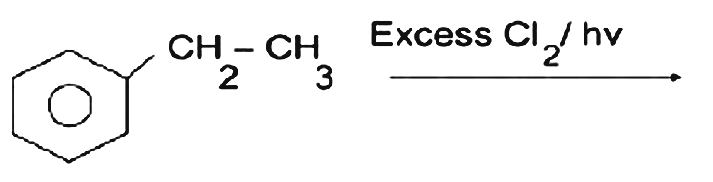
?COMEDK 2025 Medium - In Young's double slit interference experiment, using two coherent waves of different amplitudes, the intensities ratio between bright and dark fringes is 3 . Then, the value of the ratio of the amplitudes of the wave that arrive there isCOMEDK 2023 Medium
- The standard temperature used in thermo chemical calculations isCOMEDK 2019 Medium
- If a black body emits \(0.5 \mathrm{~J}\) of energy per second when it is at \(27^{\circ} \mathrm{C}\), then the amount of energy emitted by it when it is at \(627^{\circ} \mathrm{C}\) will beCOMEDK 2018 Medium
- A coin is placed on a disc rotating with an angular velocity \(\omega\). The co-efficient of friction between the disc and the coin is \(\mu\). The maximum distance of the coin from the centre of the disc up to which it will rotate with the disc isCOMEDK 2025 Medium
- In which of the processes, does the internal energy of the system remain constant?COMEDK 2018 Easy