


COMEDK · Chemistry · 26. Alcohols Phenols and Ethers
Match reactions in Column I with the corresponding products formed as given in Column II.
| Column I | Column II |
|---|---|
| A. \(\text{C}_6\text{H}_5\text{N}_2^+\ \text{Cl}^- + \dfrac{\text{H}_2\text{O}}{warm} \rightarrow\) | P. p–Bromophenol |
| B. \(\text{C}_6\text{H}_5\text{OH} + \dfrac{\text{Br}_2\ \text{in}\ \text{CS}_2}{273K} \rightarrow\) | Q. 2,4,6–Tribromophenol |
| C. \(\text{C}_6\text{H}_5\text{OH} + \dfrac{(i)\ \text{CHCl}_3 + \text{NaOH}(aq)}{(ii)\ \text{HCl}} \rightarrow\) | R. Phenol |
| D. \(\text{C}_6\text{H}_5\text{OH} + \text{Br}_2\ (aq) \rightarrow\) | S. 2–Hydroxybenzaldehyde |
- A A - S B - R C - Q D - P
- B A - R B - P C - S D - Q
- C A - Q B - R C - S D - P
- D A - Q B - P C - S D - R
Answer & Solution
Correct Answer
(B) A - R B - P C - S D - Q
Step-by-step Solution
Detailed explanation
Reaction A: Warming benzene diazonium chloride with water yields phenol. Thus, A matches with R. Reaction B: Bromination of phenol in a non-polar solvent like \(CS_2\) at low temperature (\(273\) K) yields monobromophenols, primarily p-bromophenol as the major product. Thus, B…
See the Complete Solution
Get step-by-step explanations for this and 2.5 Lakh+ more JEE, NEET & CET questions.
- Unlock all solutions
- Practice the full chapter
- Track accuracy across PYQs
4.8 rated on Google Play · 14,000+ reviews
More questions from Chemistry
- The species having tetrahedral shape isCOMEDK 2024 Easy
- \(\mathrm{Zn}(s)+\mathrm{Cl}_{2}(1 \mathrm{~atm}) \longrightarrow \mathrm{Zn}^{2+}+2 \mathrm{Cl}^{-} ; E^{\circ}=2.0 \mathrm{~V}\) To increase the emf of the above cellCOMEDK 2012 Easy
- An optically active compound \([\mathrm{X}]\) (Molecular formula \(\mathrm{C}_8 \mathrm{H}_{11} \mathrm{~N}\) ) reacts with \(\mathrm{CHCl}_3\) / Ethanolic KOH on heating to form an isocyanide. On reaction with \(\mathrm{NaNO}_2 / \mathrm{HCl}\), it yields an alcohol with liberation of \(\mathrm{N}_2\). Identify the compound \([\mathrm{X}]\).COMEDK 2025 Medium
- Which of the following complex show optical isomerism?
(i) \(c i s-\left[\mathrm{COCl}(\mathrm{en})_2\left(\mathrm{NH}_3\right)\right]^{2+}\)
(ii) \(cis-\left[\mathrm{CrCl}_2(\mathrm{ox})_2\right]^{3-}\)
(iii) \(cis-[ \left.\mathrm{CO}(\mathrm{en})_2 \mathrm{Cl}_2\right] \mathrm{Cl}\)
(iv) \(cis- \left[\mathrm{CO}\left(\mathrm{NH}_3\right)_4 \mathrm{Cl}_2\right]^{+}\)COMEDK 2023 Medium - \(10 \mathrm{~cm}^{3}\) of \(0.1 \mathrm{~N}\) monobasic acid requires \(15 \mathrm{~cm}^{3}\) of sodium hydroxide solution whose normality isCOMEDK 2017 Medium
- When a mixture of methane and oxygen is passed through heated molybdenum oxide, the main product formed isCOMEDK 2016 Medium
More PYQs from COMEDK
- The heat of combustion of carbon to \(\text{CO}_2\) is -393.5 kJ \(\text{mol}^{-1}\).
The heat released on the formation of 35.2 g of \(\text{CO}_2\) by combustion of C is:COMEDK 2026 Easy - An ideal gas is taken via path \(A B C A\) as shown in figure.
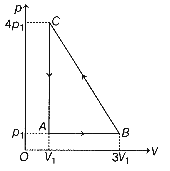
The network done in the whole cycle isCOMEDK 2018 Easy - Particles which are not composite and hence truly elementary areCOMEDK 2016 Medium
- A capacitor of \(2 \mu \mathrm{~F}\) is charged as shown in the figure. When the switch \(S\) is turned to position 2 , the percentage of its stored energy dissipated is
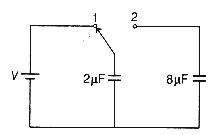 COMEDK 2024 Medium
 - If two waves of the same frequency and amplitude respectively on superposition produce a resultant disturbance of the same amplitude the waves differ in phase byCOMEDK 2019 Medium
- IR region lies betweenCOMEDK 2016 Easy