


COMEDK · Chemistry · 22. p Block Elements (Group 15, 16, 17 & 18)
In the chemical reaction, \(\mathrm{N}_{2}+3 \mathrm{H}_{2} \rightleftarrows 2 \mathrm{NH}_{3}\) at equilibrium point.
- A equal volumes of \(\mathrm{N}_{2}\) and \(\mathrm{H}_{2}\) are reacting.
- B equal manes of \(\mathrm{N}_{2}\) and \(\mathrm{H}_{2}\) are reacting.
- C the reaction has stopped.
- D the same amount of ammonia is formed, as it is decomposed into \(\mathrm{N}_{2}\) and \(\mathrm{H}_{2}\).
Answer & Solution
Correct Answer
(D) the same amount of ammonia is formed, as it is decomposed into \(\mathrm{N}_{2}\) and \(\mathrm{H}_{2}\).
Step-by-step Solution
Detailed explanation
The chemical reaction \(\mathrm{N}_{2} + 3\mathrm{H}_{2} \rightleftarrows 2\mathrm{NH}_{3}\) represents a reversible process at equilibrium. At equilibrium, the rate of the forward reaction (formation of \(\mathrm{NH}_{3}\)) is equal to the rate of the backward reaction…
See the Complete Solution
Get step-by-step explanations for this and 2.5 Lakh+ more JEE, NEET & CET questions.
- Unlock all solutions
- Practice the full chapter
- Track accuracy across PYQs
4.8 rated on Google Play · 14,000+ reviews
More questions from Chemistry
- The pH at which an acid indicator with \(K_\alpha=1 \times 10^{-5}\) changes colour when the indicator concentration is \(1 \times 10^{-3} \mathrm{M}\) isCOMEDK 2024 Easy
- When the combustion of one molecule of liquid heptane is carried out at a constant temperature ' \(T\) ', the difference between \(\Delta H^o\) and \(\Delta U^o\) is equal to:COMEDK 2025 Medium
- Pick out the complex compound in which the central metal atom obeys \(\mathrm{EAN}\) rule strictly.COMEDK 2013 Hard
- Molarity of a given orthophosphoric acid solution is \(3 \mathrm{M}\). It's normality isCOMEDK 2020 Easy
- Two statements, one Assertion (A) and the other Reason (R) are given. Choose the correct option.
Assertion: 2-aminoethanoic acid and p-aminobenzene sulphonic acid can exist as Zwitter ions while p-aminobenzoic acid cannot.
Reason: When the acid group is a relatively strong proton donor and the \(-\mathrm{NH}_2\) group is sufficiently basic it can accept a \(\mathrm{H}^{+}\)ion from the acid group to form the dipolar ion.COMEDK 2025 Medium - In a normal spinel type structure, the oxide ions are arranged in ccp, whereas \(1 / 8\) tetrahedral holes are occupied by \(\mathrm{Zn}^{2+}\) ions and \(50 \%\) of octahedral holes are occupied by \(\mathrm{Fe}^{3+}\) ions. The formula of compound isCOMEDK 2023 Medium
More PYQs from COMEDK
- Match the reaction in Column I with the major product formed given in Column II.
\(\begin{array}{|l|l|l|} \hline & \text { Column I- Reaction/conditions } & & \text { Column II- Product } \\ \hline A & \mathrm{C}_6 \mathrm{H}_6 \xrightarrow[\substack{\text{(ii) NaOH} \\ \text{(iii) H^+}}]{\text{(i) Oleum}} & P & \text { Pentan-2-ol. } \\ \hline B & \text{Butanal } \xrightarrow[\text{(ii) } \mathrm{H}^+]{\text{(i) } \text{MeMgBr/ dry ether}} & Q & \text { 2-Hydroxybenzoic acid. } \\ \hline C & \text {2-Methylpropene } \xrightarrow[\text { (ii) } \mathrm{H}_2 \mathrm{O}_2 / \mathrm{NaOH}]{\text { (i) } \mathrm{B}_2 \mathrm{H}_6} & R & \text { Phenol } \\ \hline D & \text{Phenol } \xrightarrow[\text { (ii) } \mathrm{CO}_2, 400 \mathrm{~K}, 7 \mathrm{~atm} .]{\text { (i) } \mathrm{NaOH}} & S & \text { 2-Methylpropan-1-0 I } \\ \hline \end{array}\)COMEDK 2025 Medium - When a mixture of calcium benzoate and calcium formate is dry distilled, we getCOMEDK 2019 Hard
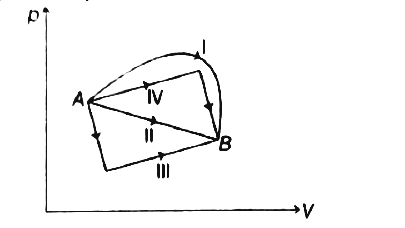
- From the following \(p\)-V diagram, an ideal gas undergoing a change of state from \(A\) to \(B\). Four different processes I, II, III and IV as shown in the figure may lead to same change of state.
 COMEDK 2022 Medium
 - Nuclear theory of the atom was put forward byCOMEDK 2016 Easy
- Let the HM and GM of two positive numbers \(a\) and \(b\) be in the ratio \(4: 5\), then \(a: b\) isCOMEDK 2017 Medium
- Which of the following laws of Physics is valid across all domains of nature?COMEDK 2020 Easy